

Buying a Home on the Sunshine Coast: How to Read the Roof Before You Offer
Scroll through Sunshine Coast listings and you will find a drone photograph on most of them. Almost none are of the roof. They are of the view — the water, the islands, the arbutus leaning out over the bank — shot from twelve metres up and angled carefully past the one component of the house that carries the largest single replacement cost.
Most buyers here come from off-Coast. You see the house twice, both times around a ferry schedule, and then you have a handful of days to remove subjects. In that window the roof is the part of the building you have the least information about, and the part where a wrong assumption costs five figures.
Pro Torch is a flat-roof specialist and we are new to the Sunshine Coast, so this is not a sales pitch dressed as advice. It is what we actually look at when somebody asks us to put eyes on a roof before they write an offer.
Key takeaways
- A general home inspection is not a roof inspection. Most reports describe what was visible from a ladder or from the ground, and say so in a limitations section people skip.
- There is no permit record of a Coast re-roof. Re-roofing is exempt in the Town of Gibsons and under SCRD Bylaw 779, so "new roof" in a listing needs an invoice behind it.
- Buying in summer means you never see the roof working. The wet season runs roughly 9 October to 23 April; July averages about 33 mm of rain.
- The flat sections cost the most per square foot and are the hardest to see. Two-ply membrane runs $10 to $20 per square foot against $5.50 to $9 for architectural shingles.
- Price the roof as remaining life, not as a replacement quote. Four years left on a 22-year roof is a cost that lands inside your first mortgage term.
What a home inspection actually tells you about the roof
Home inspectors do useful work and this is not a complaint about them. It is about scope.
An inspection is a visual examination of what is accessible on the day. A moss-furred 8:12 slope in November is not safely accessible, and on an older roof walking it can cause the damage the inspector is there to find. So a great many Coast roofs are inspected from a ladder at the eave, from the deck of the house next door, or from the ground with binoculars. That is a legitimate call. It is also a very partial view of a roof with four planes, two materials and a flat section behind the ridge.
Read the limitations section of the report first. The roof is usually in it. Then notice what the language is doing: appeared serviceable at the time of inspection is a statement about one morning, not a forecast.
Things a standard inspection does not include:
- Remaining service life. An inspector reports condition. Estimating how many winters are left is a roofer's call and it needs a close look at the details, not the field.
- Lifting anything. No pavers come up off a deck, no flashings come off a wall, no vent boots get pulled.
- Water testing. Nobody runs a hose on a suspect flashing for forty minutes to find out where it goes.
- A cost. Even a clear finding — "membrane at end of life" — arrives without a number, and the number is what you need for the offer.
If the house has flat areas or a deck over living space, the gap between what the inspection covers and what you are buying is at its widest exactly where the money is.
Reading a Coast roof from the driveway
You can learn a surprising amount in ten minutes without a ladder. Start by counting roofs, because a Coast house is rarely one roof. A 1970s Roberts Creek house might have four: the main shingle slopes, a nearly flat carport, a metal lean-to over the woodshed and a deck. Each has its own age, its own installer and its own failure mode. Note the material and the apparent condition of each, separately.
Then look for repair archaeology. Patches cluster where the problem is, and they are easier to read than the roof itself:
- Three colours of flashing on one roof means three visits across three decades.
- A cone of black sealant at a chimney, a vent or a skylight corner. Sealant is a temporary measure that has been there a while.
- A square of newer shingles mid-slope, or a strip of membrane lapped over the shingle course below it, which is the wrong direction and will leak by design.
- Fresh paint on the fascia at one eave only, often over soft wood.
- A downspout discharging onto a lower roof, concentrating the whole upper roof's water onto one spot of membrane or one shingle course.
Check the gutters and the splash blocks. Grit in the splash block is shingle granules, and granules in quantity mean the mat underneath is becoming exposed. A gutter packed with a felt of conifer needles tells you about the maintenance history and about the canopy at the same time.
Age clues are material by material:
- Architectural shingles (20 to 25 years on the Coast): colour gone flat and uneven, grit lost at the bottom of each slope, tabs curling or clawing upward, shiny black patches where the fibreglass mat is showing through, moss along the course edges on the shaded side. On most Coast houses the two slopes of one roof wear at different rates, which the Gibsons shingle post goes into.
- Two-ply SBS membrane (25 to 30 years): granules worn through to black bitumen along walking paths and under downspouts, surface crazed into a fine alligator pattern, blisters standing up off the field, the membrane pulling down and away at the upstands where it meets a wall, and drains ringed with debris. Field condition matters far less than the condition of the laps, upstands and flashings.
- Metal (40 to 50 years): chalky faded coating, red rust starting at cut edges and panel ends rather than in the middle, and on exposed-fastener panels the washers under the screw heads, which go long before the steel does. Look for snow guards above doors and walkways; their absence is a safety item, not a roofing fault.
- Cedar shakes: cupped and split, thinned at the butts, moss filling the keyways. On a shaded Coast lot shakes go quickly, and replacing them is not a like-for-like job — the deck underneath is usually spaced boards and has to be sheathed before anything modern goes on.
While you are in the driveway, notice the three things that will decide what a re-roof costs on this particular lot: where a disposal bin could physically sit, whether branches are touching the roof, and how far material would have to be carried.
Inside the house, and the question to ask the seller
At the viewing, go to the top floor and look at the ceiling under every valley, every skylight and every flat section, and at the junction where an addition meets the original house. That junction is where two roofs, two eras and two crews met, and it is the most common place to find a stain in a Coast house.
Stains tell you roughly when, not just whether. A ring with a defined darker edge, or several rings inside one another, means repeated wetting over time. A chalky, dry, uniform patch may be an old problem that was actually fixed. A single ceiling stain directly beneath a valley or skylight is one conversation. A stain at the top of a window on the southeast wall is often wind-driven rain getting in at a flashing or a window head, which is a different trade and a different number.
Fresh paint on one ceiling in an otherwise unpainted house is information. So is a patch of drywall tape with no feathering, under a flat roof.
If you get into the attic, the useful checks are in our storm season checklist and worth running at a viewing rather than after completion.
Then ask the seller the right question. "Does the roof leak" invites a one-word answer. "When was work last done on the roof, by whom, and do you have the invoice" produces a document or it produces a silence, and both are useful. The standard disclosure statement your agent provides asks about the roof as well; a "do not know" there is an answer with content in it, particularly on a house that has been a rental or a part-time property.
The flat sections, and the deck over living space
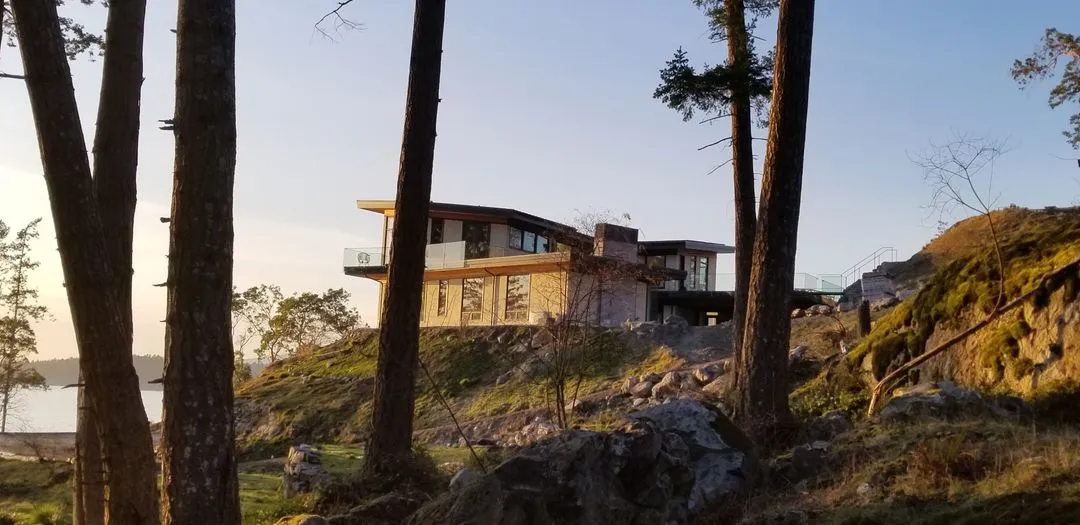
On West Coast contemporary houses — the Bluff and Upper Gibsons, the waterfront builds along Davis Bay and Selma Park, the newer places out toward Redrooffs — a large share of the roof area is low-slope, and a deck is often sitting on top of a heated room. This is the most expensive part of the building to get wrong and the least visible at a viewing.
A deck over living space is a flat roof with furniture standing on it. The waterproofing is underneath the pavers or the sleepers, so there is nothing to see at all unless somebody lifts them, which nobody does during a showing. What you can look at:
- The door threshold. If the deck surface is level with the threshold, or above it, there is no upstand to speak of and wind-driven rain has a direct path inside.
- Drainage. One drain and no overflow means one blockage away from a pond over your living room. Look for a second outlet or a scupper through the parapet.
- Railing posts. Posts bolted down through the deck surface are penetrations through the waterproofing in the most exposed position on the roof.
- The ceiling below. Staining near the edges of the room rather than the middle points at the perimeter details, which is where these assemblies fail.
Price these areas as membrane, not as shingles. At $10 to $20 per square foot installed, a modest deck and a flat garage roof can carry more replacement cost between them than the entire pitched roof above. Our waterproofing page covers the assembly; the point for a buyer is simply to find out what is up there before the subjects come off.
What to look at, by where the house is
The same roof wears differently in different parts of the lower Coast, and the thing worth checking changes with the address.
- Gibsons and Elphinstone. Shade sets the clock. Look at the north and east slopes and at the canopy overhead; the shaded slope will be the one that dates the whole roof.
- Sechelt, Davis Bay and Selma Park. Salt comes off Trail Bay and the Strait, and on a waterfront house it attacks the hardware before the roof surface: fasteners, cap flashings, drain assemblies, termination bars. Inspect the metal, not the field.
- Roberts Creek. The most heavily treed community on the lower Coast. Needle load, deep shade, north slopes that never dry, and long rural driveways that add real hours to any re-roof.
- Halfmoon Bay and the Redrooffs coves. Wind is the defining factor. Look at edges — rake, eave, ridge, corners — because that is where uplift starts, as our Halfmoon Bay post sets out in detail. A single lifted tab at a corner is worth more attention than a hundred sound ones in the middle.
- Pender Harbour and Madeira Park. Many houses here are recreational or part-time, which means nobody has looked at the roof between visits and small problems have had years to develop quietly. It is also roughly an hour beyond Langdale, so plan on one trip, not three.
- Langdale, Hopkins, Granthams and Williamsons Landing. Steep sites rising straight off the water, and cold outflow wind funnelling down Howe Sound in an arctic snap. Exposure here is about wind direction as much as elevation.
Why "new roof" in a Coast listing needs paperwork
Buyers coming from the city often assume they can verify a re-roof the way they would verify a renovation: look up the permit. On the Sunshine Coast that record generally does not exist.
The Town of Gibsons permit guide lists roof re-shingling among the work that does not need a building permit. Outside the Town, SCRD Building Bylaw No. 779 (2025), section 4.3(h), exempts replacement of roofing on a standard building unless the work follows building envelope failure. The District of Sechelt's materials do not address re-roofing at all, so the building department is the place to ask. Structural change — a dormer, altering the roof structure, turning a flat section into a pitched one — needs a permit everywhere.
So a roof that was replaced five years ago leaves no municipal trace. What it does leave, if the work was done properly, is a paper trail worth asking for:
- The contractor's invoice, with the scope on it. "Re-roof" on a one-line invoice tells you nothing about whether the deck was replaced or the flat section was done.
- The manufacturer's system warranty, if one was registered. Ask specifically whether it transfers to you and on what terms, rather than assuming either way.
- The workmanship warranty. These are generally between the contractor and the original owner. Ask whether it carries over, and get the answer in writing rather than from a listing.
- Photographs with dates. Any decent roofer takes them. They are the only evidence of what the deck looked like before it was covered up.
If the house is a strata — and much of the townhome stock in Upper Gibsons and Sechelt is — the documents are better and you should read them. Find the roof line in the depreciation report and the date it was written, check the contingency reserve fund balance against that number, and search two years of council minutes for "roof" and "levy". A depreciation report describes a roof's expected life, which is not the same as its current condition. Our strata and commercial page covers how condition surveys work.
A drone survey before you remove subjects
This is the part of the process we do, so take the recommendation with that in mind. It is still the cheapest useful thing available to a Coast buyer.
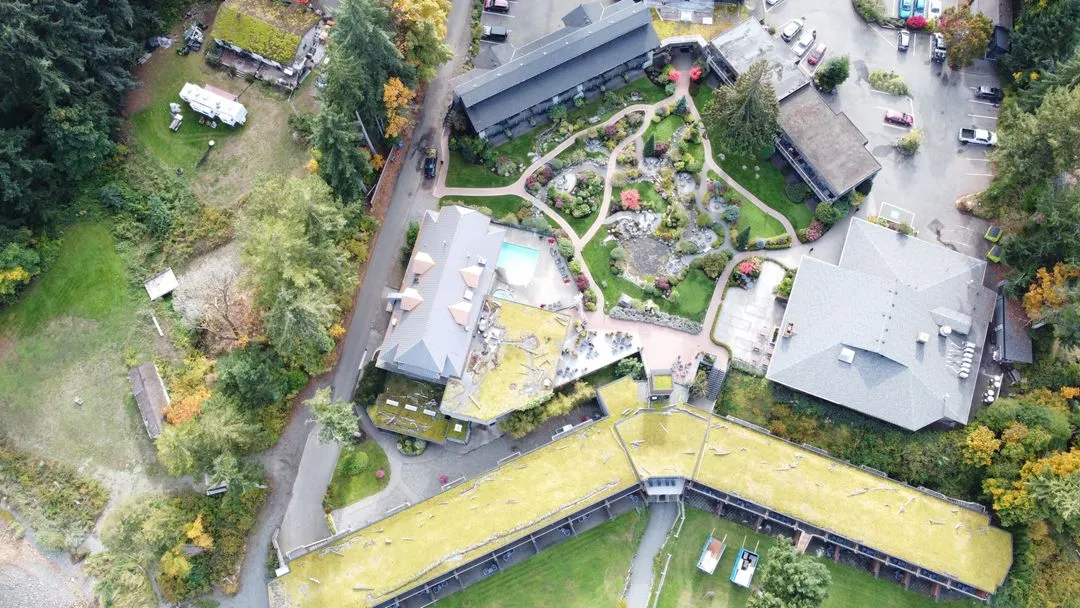
A certified pilot can photograph every plane, every flashing, every drain and every penetration on a house in about twenty minutes, from directly above, without anybody setting foot on a roof the seller has not agreed to have walked. On a steep treed Roberts Creek lot, a cliffside house at Halfmoon Bay, or anything with a flat section hidden behind a ridge, it is the only way to see the whole roof at all. Our pilot is Transport Canada Advanced RPAS certified, assessments are free where the site allows a flight, and the photographs are yours to keep.
Two things make the photo set worth more than the flight itself. It is dated, so you know the condition of the roof on the day you agreed to buy the house — which matters if something changes between inspection and completion. And it is specific enough to price from, which turns a vague worry into a number you can act on.
Be clear about the limits. A drone sees surfaces. It does not see under pavers, inside a deck assembly, or what the deck boards are doing under a membrane. What a good survey does is tell you which two or three spots need a hands-on look before you commit, instead of treating the whole roof as an unknown.
Book it inside the subject period. Coast work is scheduled in blocks, so the sooner you ask the more likely a crew is already crossing that week. Details are on our drone roof inspections page.
Turning roof condition into an offer
A replacement quote waved across the table is a blunt instrument, and sellers discount it accordingly. Remaining life is the honest frame, and it is harder to argue with.
Take a typical Coast house with both materials: 1,600 square feet of architectural shingle and a 400 square foot flat section over a garage or an addition. At $5.50 to $9 per square foot the shingle area is roughly $8,800 to $14,400. At $10 to $20 per square foot the membrane area is $4,000 to $8,000. Call the whole roof $12,800 to $22,400 before GST, in that order of magnitude, before anything site-specific.
Now apply the life you have left. A shingle roof with four years left out of twenty-two is not a maintenance item, it is a cost arriving inside your first mortgage term, and the flat section — older, and double the rate per square foot — may be arriving sooner. Three outcomes are reasonable from there:
- The roof has real life left. Put the survey in a folder, note the date, and carry on. You now know what you own.
- The roof is at the end. Price it into the offer rather than asking for it to be replaced before completion. If it is done before completion, you inherit a roof chosen on price by somebody who is leaving — so insist on the invoice, the system warranty and dated photographs, and have a say in the scope.
- Something cannot be determined. A deck over living space with no history is the usual case. Keep a subject, hold money back, or get the assembly opened up at one corner with the seller's permission.
Get the number before subject removal, not after. The full breakdown of what drives roofing costs on the Coast, and the checklist for reading a quote, are in our Sunshine Coast roof cost guide.
Pro Torch Roofing has 25 years and more than 850 roofs behind it, 4.8 stars from 84 verified reviews, IKO and Soprema systems, an in-house sheet metal shop, and $5M liability insurance including hot work. We are a flat-roof specialist taking on Sunshine Coast work in scheduled blocks with no ferry premium, and we are new to the Coast, so the completed roofs we can point you at are on the other side of the water. If you have a Coast house under contract and want the roof looked at properly before your subjects come off, our Sunshine Coast page has the coverage area and the number is (778) 316-1247.
