

Asphalt Shingle Roofing in Gibsons: What Shade and Slope Do to a Roof
Drive around Gibsons and look up. On plenty of houses the two slopes of the same roof do not match. The side open to the south has gone a lighter grey and has been dropping its grit into the gutters for years. The side under the firs is dark, soft-looking and furred along the course edges. Same roof, same crew, same week sometime in the early 2000s, and two very different amounts of life left.
That is the Gibsons shingle story in one picture. The town sits under heavy tree cover, from the Landing up through the Bluff and out along Elphinstone, and shade is the single biggest influence on how long a shingle roof lasts here. Further up the coast the conversation is about salt and open-water wind. In Gibsons it is about water that never gets a chance to leave.
Pro Torch installs asphalt shingles without pretending they are the specialty. Two-ply membrane is. On a great many Gibsons houses both materials end up on the same building, so where one stops and the other starts is a question we take seriously. This is what the canopy and the slope actually do to shingles here, and what to specify when you replace them.
Key takeaways
- Shade sets the clock, not salt. On most Gibsons roofs the shaded slope is finished years before the sunny one, and both get replaced together.
- Under conifers an open metal valley earns its extra cost. A closed-cut valley packs with needles and holds water at the trim line.
- Below 2:12, asphalt shingles are not a roofing system — and Landing garages, covered entries and shed additions are full of slopes like that.
- Between 2:12 and 4:12 shingles need a doubled underlayment. Plenty of low-slope sections around town were shingled as though they were steep.
- Re-shingling needs no building permit in the Town of Gibsons, and under SCRD Bylaw 779 it is exempt in Elphinstone and West Howe Sound unless it follows building envelope failure.
Two Gibsons, two different roof problems
For roofing purposes this is two towns.
Down in Gibsons Landing and around the harbour, the housing stock is older and has been added to in stages. A 1940s or 1960s house gets a back addition, then a carport, then a covered entry, and each piece was built at whatever slope suited the headroom at the time. The result is a roof that is part pitched shingle and part something much flatter, with a junction wherever two decades met. Lots are small, lanes are narrow, and mature trees stand close enough to the building that branches touch the roof.
Up on the Bluff and through Upper Gibsons, the stock is newer and the geometry is different: larger footprints, architectural houses with long low-slope runs between pitched elements, parapets, and decks built over living space. Get above the tree line and exposure to the southeast changes too. On these houses the shingles themselves are usually the least interesting part of the roof. The junctions and the flat areas decide the job.
There is a third category worth naming because it has its own timeline: the townhome stratas in Upper Gibsons, many of them shingled, a good number now reaching the end of their first roof.
What a conifer canopy does to shingles
A shingle roof works in two stages. It sheds water, then it dries. Under a closed canopy the second stage does not happen for half the year. The Gibsons wet season runs roughly 9 October to 23 April, and July, at about 33 mm of rain, is the only stretch you can count on for drying. A shaded north slope in Gibsons spends the winter damp and the summer in shade.
Conifer debris makes it worse in ways broadleaf debris does not:
- Needles do not blow off. They are fine enough to lodge under the leading edge of each course, and they mat together into a felt that holds water directly against the granules.
- They are mildly acidic and they decompose on the roof, which leaves a thin layer of organic material for moss to root into.
- Cones and small branches arrive with every southeast blow and collect in the same places: valleys, behind chimneys, at the back of dormers.
- Gutters fill twice a year, not once. Needle drop in late autumn is the big one, but there is a second flush in spring, and a gutter that overflows under a canopy sends water down the back of the fascia rather than off the roof.
Then come the organisms. Moss lifts the edge of a shingle and wicks water underneath it, which is a structural problem rather than a cosmetic one. Lichen is worse in one specific way: it roots into the asphalt itself, so pulling it off takes granules with it. Our post on moss on Sunshine Coast roofs covers safe removal, the treatments that work and why nobody should put a pressure washer on shingles — it applies to this town more than any other on the lower Coast.
The honest maintenance answer for a treed Gibsons lot is unglamorous. Clear the roof surface and the gutters twice a year, keep the valleys and the back of the chimney clear, and get the canopy trimmed back far enough that light and air reach the roof. A roof that dries lasts years longer than the identical roof that does not.
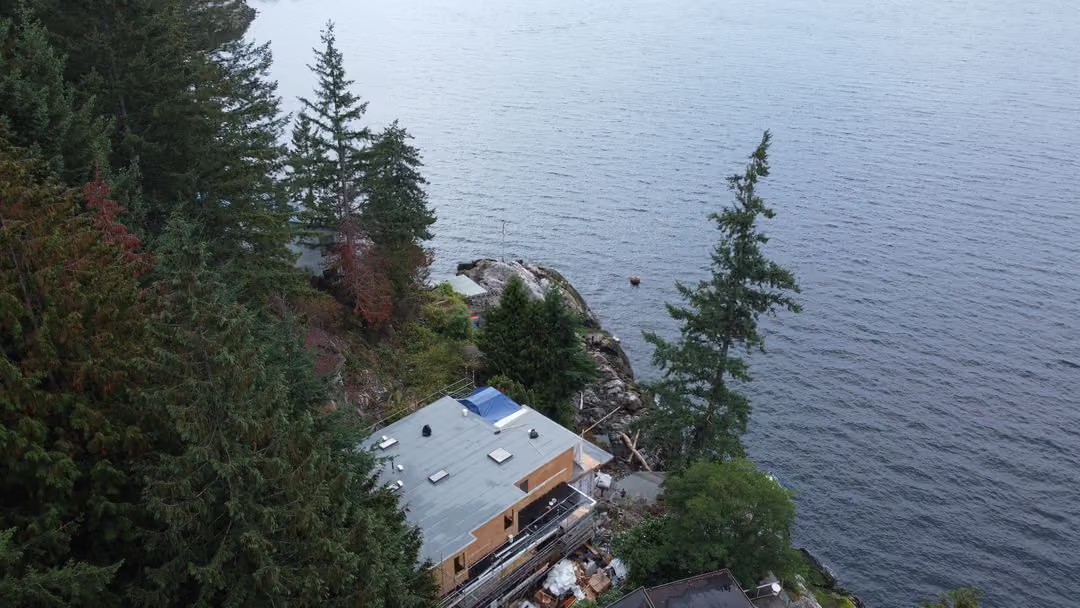
Valleys are the detail that decides a Gibsons re-roof
A valley carries the water off two planes of roof at once, so it handles several times the volume of the open field. Under trees it also collects everything the trees drop. That combination is why valleys are the first place we look on a shaded roof.
There are two ways to build one in shingles.
A closed-cut valley carries the shingles from one plane through the valley and trims the shingles from the other plane in a line along it. It is quicker, it uses no extra metal, and it looks tidy on a sunny suburban roof. Under a conifer canopy it is the wrong detail. Needles collect along the trim line because there is nothing for them to slide off, they build into a dam, and water backs up across a cut shingle edge that was never meant to sit in standing water.
An open metal valley stops the shingles back on both sides and runs a formed metal channel — usually a W-profile with a centre rib — down the middle. Debris either flushes through or can be brushed out in two minutes. The cut edges sit above the water line instead of in it. On a treed Gibsons lot it is worth the extra cost every time, and it is worth specifying the metal and the finish rather than leaving it to whatever is on the truck. We bend valley metal and flashings in our own shop, which means the profile suits the roof rather than the roof accommodating a stock piece.
One more valley-adjacent detail, because it causes expensive interior damage and is routinely left out: a kick-out flashing where a roof edge or valley runs into a wall. Without it, the water concentrated by the valley is delivered straight into the wall assembly instead of into the gutter. If you have a stain inside below a roof-to-wall junction, that is the first thing to check.
Slope decides whether shingles belong there at all
This is the part that matters most on older Landing houses, and it has nothing to do with the quality of the shingle.
- 4:12 and steeper. Normal shingle application. Water leaves quickly and the courses work as intended.
- 2:12 up to 4:12. Permitted, but only as a low-slope application: a doubled underlayment, either two plies lapped so that there is full coverage everywhere or a self-adhered membrane across the whole area. Water moves slowly on these slopes and wind-driven rain gets up under the courses, so the underlayment is the actual waterproofing and the shingles are a wearing surface over it.
- Below 2:12. No asphalt shingle is a roofing system at this slope. It does not matter what the warranty on the bundle says.
Now picture the Landing: garage and carport roofs built nearly flat, porch roofs tucked under a window, additions deliberately built flatter than the house to keep them below a sightline. Those are exactly the areas that get shingled anyway, usually with a single layer of felt beneath them, because shingles were what the rest of the roof needed and the crew carried on.
When that happens, water sits at every course edge, the underlayment is doing a job it was not specified for, and the leak shows up inside the addition. The repair is not more sealant. It is to strip the low-slope section back to the deck and put a proper two-ply membrane on it, tied in under the shingle courses above so the laps run the right way — membrane first, shingles lapping over it, never a strip of membrane lapped over the bottom course of shingles. Our torch-on roofing page covers the assembly, and the earlier post in this series on torch-on in Gibsons goes through the four places flat roofs actually fail.
What is under the shingles on an older Gibsons house
On a house that has been re-roofed twice since it was built, the tear-off is where the surprises live.
The common one in this town is spaced sheathing. Houses originally roofed in cedar shakes were built on 1x4 boards with gaps between them, because shakes need air underneath. When those roofs were converted to shingles in the 1970s or 1980s, the cheap route was to nail the shingles to the spaced boards or over the shakes themselves. Asphalt shingles need continuous support; on gapped boards they telegraph every joint and the nails never get consistent holding. Putting a proper roof on a house like that means sheathing the whole area in plywood or OSB first. That is a real line item, and it should be identified and priced before the job starts rather than negotiated while your roof is open.
The other common find is rot at the eave. Years of gutters overflowing under a canopy soak the first few hundred millimetres of sheathing and the fascia behind it. Expect the eave edge to need work on an older treed lot, and expect new drip edge with it.
Both of these are why a quote should carry an agreed per-sheet price for deck replacement, settled in writing before anything is opened up. The full quote checklist is in our Sunshine Coast roof cost guide.
Flat sections and decks on the Bluff
The newer contemporary houses above the harbour have a different list. Large low-slope areas, interior drains or scuppers rather than gutters, parapets, and decks built over heated rooms.
A deck over living space is a flat roof with furniture standing on it. The waterproofing lives under the pavers or the sleepers, it needs fall to a drain, and it fails at the edges — at the door threshold where the upstand is too short, where railing posts pass through the membrane, and at the junction with the wall. None of that is shingle work, and a crew that is set up for shingles should say so.
If your Gibsons house has both, treat it as one roof with two systems and hire accordingly. The expensive failures happen at the seam between trades, not in the middle of either one.

What a shingle roof costs in Gibsons
Architectural shingles run roughly $5.50 to $9 per square foot installed, before GST. A 1,400 square foot roof area therefore lands somewhere around $7,700 to $12,600. Expect 20 to 25 years on the Coast, and less than that from the shaded slope.
What moves the number in this town specifically:
- Access. Narrow Landing lanes with nowhere to put a truck and a disposal bin close to the house, or a steep Bluff driveway. Both add hours.
- Trees over the roof. Branches that have to be worked around mean more hand-carrying and more protection below, and trimming is sometimes cheaper than working around them.
- Layers and deck. One old layer or two, shakes underneath, spaced boards, eave rot.
- The low-slope areas. Priced as membrane, because that is what should go on them. Quoting them as shingles is how a cheap bid gets cheap.
Gibsons is quoted at our Lower Mainland rates with no ferry premium. It is about fifteen minutes from Langdale, which makes it the first stop on any Coast block we schedule: crew, materials and equipment cross together and stay until each roof is watertight.
Which authority your address actually falls under
A Gibsons mailing address does not tell you who regulates your roof, and the answer differs on either side of the town boundary.
- Inside the Town of Gibsons, the Town's permit guide lists roof re-shingling among the work that does not require a building permit.
- Outside it — Elphinstone, West Howe Sound and the rest of the electoral areas — SCRD Building Bylaw No. 779 (2025), section 4.3(h), exempts replacement of roofing on a standard building, unless the work results from building envelope failure. That exception matters: if the reason you are re-roofing is that the envelope failed, you are back in permit territory and you should talk to the SCRD before work starts.
- Structural change needs a permit everywhere. Altering the roof structure, adding a dormer, or changing a flat section to a pitched roof is not a re-roof.
Check with the building department for your address rather than relying on what a neighbour did. A contractor working across the Coast should know which of the three authorities applies to your house before you ask.
Pro Torch Roofing has 25 years and more than 850 roofs behind it, 4.8 stars from 84 verified reviews, IKO and Soprema systems, an in-house sheet metal shop for valley metal and flashings, and $5M liability insurance including hot work. We are a flat-roof specialist taking on Coast work in blocks, and we are new to the Sunshine Coast, so the roofs we can point you at are on the other side of the water. Assessments are free and flown by drone where the site allows, and you keep the photographs. Coverage and services for the town are on our Gibsons roofing page, and the number is (778) 316-1247.
