

Sunshine Coast Storm Season: What to Check on Your Roof Before October
On the Sunshine Coast the weather turns inside a fairly predictable window. The wet season starts around the second week of October and runs to late April. November is the wettest month of the year, averaging roughly 250 millimetres of rain in Gibsons — close to eight times what falls in July.
The wind comes with it. Pacific fronts push southeast gales up the Strait of Georgia, and during cold snaps outflow winds funnel down Howe Sound onto Langdale, Hopkins Landing and Gibsons. In November 2024 one of those storms closed Highway 101 at Redrooffs and Lower Road in Roberts Creek, dropped trees onto at least two houses in Sechelt, and had the regional district open its Emergency Operations Centre. The December 2018 windstorm, the most damaging in BC Hydro's history, left more than 750,000 customers across the South Coast without power.
Very little of what fails in a storm like that fails without warning. In September it was a loose edge, a blocked gutter or a limb over the roof. This is what to look at while it is still dry, and what to do after the first big blow.
Key takeaways
- The Coast's wet season runs from about mid-October to late April. The dry window for roof work closes quickly once it starts.
- A lot of winter roof damage begins as something visible in September: a lifted edge, loose flashing, a packed gutter, or a limb over the roof.
- On treed lots, trees are the storm risk you can actually reduce. Have an arborist look at anything that overhangs the house.
- After a storm, inspect from the ground. A wet roof in wind is the most dangerous place on the property.
- Photograph your roof now. Dated photos of its condition make any insurance conversation far simpler.
Why October matters on the Coast
Roofing materials have weather limits, and on the Coast those limits start to bite in October.
Torch-on membrane needs a dry substrate, so flat sections can only be worked between rain events. Asphalt shingles have a strip of sealant on the underside that bonds each course to the one below, but it needs warmth and sun to activate. Shingles laid in cold, grey weather can sit unsealed until spring, and an unsealed shingle is exactly what a southeast gale lifts first. Metal is the least fussy of the three, but its trim and flashings still need a dry day to be sealed properly.
So if something needs fixing, September and early October are when it can be fixed properly. By mid-November every repair is a race between showers.
Start with the trees
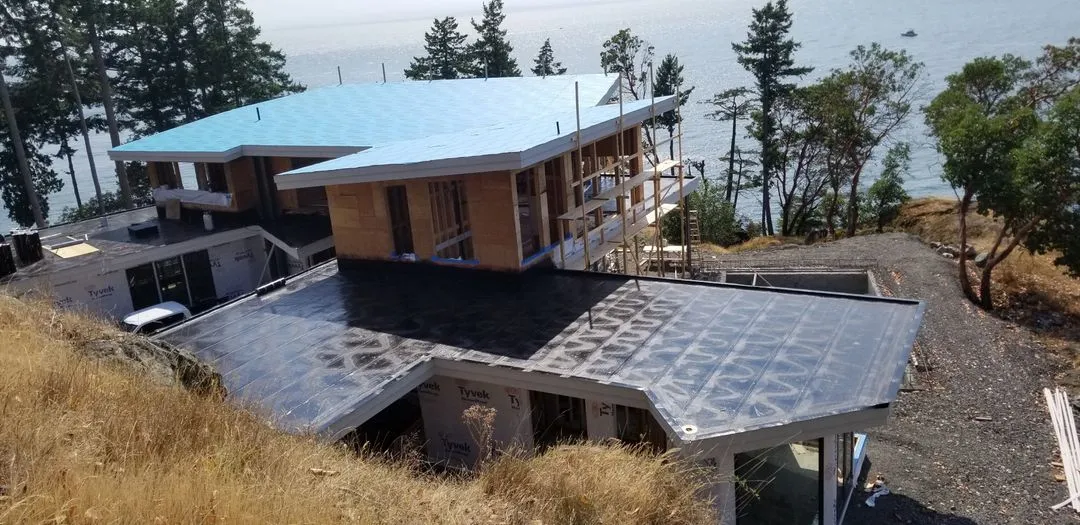
Most properties on the lower Coast have big conifers close to the house — Douglas fir, western redcedar and hemlock, with alder and maple in the wetter hollows. They are a large part of why people live here, and in a big storm they are behind much of the serious roof damage.
Two things matter. First, limbs that overhang or touch the roof. In wind they act as levers and scrubbing brushes, stripping granules from shingles and gouging membrane, and they drop a steady load of needles into gutters and valleys. Second, whole-tree failure. Trees come down far more easily once weeks of rain have saturated the soil, which is why storms in late November and December tend to topple more trees than the first blows of October.
What to do about it:
- Look up from every side of the house. Note any limb over the roof, any tree leaning toward the house, any dead top, and any tree with cracks, cavities or fungus near the base.
- Get a certified arborist to assess anything large. Pruning or felling a big tree near a house is not a homeowner job, and it is not a roofer's job either.
- Aim for a few metres of clearance between branches and the roof surface. It cuts debris and abrasion as well as impact risk.
Gutters, valleys and downspouts
Conifer needles are harder on a drainage system than broad leaves. They are small, they arrive all year rather than in one autumn drop, and they pack into a dense wet mat that holds water. A gutter can look clear from the ground and still be sitting full behind a thin crust of needles.
Valleys are the less obvious problem. Where two roof slopes meet, debris collects into a dam, and water that should run down the valley is pushed sideways under the edges of the shingles. Downspouts block at the bottom as often as at the top, and once they do, the gutter overflows onto the fascia and down the wall.
Clean everything in early October, and look again after the first big November storm, which is usually the one that brings the most debris down. Mesh gutter guards help with leaves, but fine needles sit on top of them or slip through, so guards reduce the cleaning rather than end it.
The wind-exposed edges
Wind does not damage a roof evenly. It gets a grip at the eaves, the rakes, the corners and the ridge, and once it is under an edge it peels backward across the roof.
On shingles, look for tabs that are lifted or curled, exposed nail heads, and cracked or missing ridge caps. On metal, look for loose trim and, on exposed-fastener panels, screws that have backed out or washers that have perished. On flat sections, check the perimeter metal and the membrane edge beneath it. None of this is expensive to fix in September. Left alone, the same edge can let go in a December gale and take a strip of roof with it.
Exposure varies a lot along the Coast. The headlands around Halfmoon Bay and Redrooffs, the Davis Bay and Selma Park waterfront, and the Howe Sound side above Langdale all take far more wind than a sheltered lot in Upper Gibsons or among the trees in Roberts Creek. If your house faces open water, its edges deserve a closer look.
Flashings and sideways rain
In a Coast gale, rain does not simply fall. It is driven horizontally, and even upward, into joints that stay dry the rest of the year. That is why so many winter leaks appear around chimneys, skylights, vents and anywhere a roof meets a wall.
From a ladder at the eave, or with a phone on full zoom, look for sealant that has cracked or pulled away, metal that has lifted or rusted, and any detail that relies on a bead of caulk alone. Indoors, look for stains on ceilings near chimneys and skylights. A brown ring that was not there in spring is worth tracing now, while it is still small.
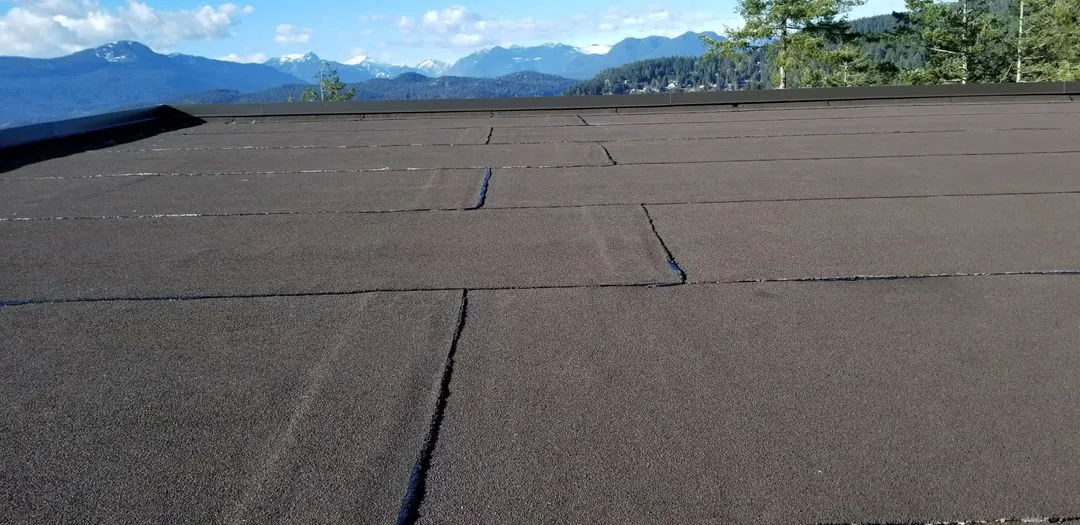
If part of your roof is flat — over a garage, a carport, an entry or a deck — give it its own inspection. Look for water still standing two days after rain, blisters, and open laps. Our post on torch-on roofing in Gibsons explains where flat sections fail and why.
Check the attic after the first heavy rain
The attic tells you things the outside of the roof cannot. After the first real rain of the season, go up with a flashlight and look at the underside of the roof deck.
- Dark stains or damp patches on the sheathing point to a leak above, and they are usually near a penetration, a valley or a wall.
- Drips from nail tips during a cold snap are often condensation rather than a leak: warm, moist household air freezing on the cold nails and thawing when the weather turns.
- A musty smell, frost or wet insulation points to a ventilation problem. The two most common causes are insulation packed over the soffit vents, and bathroom or kitchen fans that vent into the attic instead of outside.
Moisture from inside the house rots a roof deck as surely as rain does, and Coast winters give it months to work.
After a storm: what to do, and what not to
- Stay off the roof. Inspect from the ground with binoculars or a phone zoom. Wet shingles, moss and wind make a roof the most dangerous place on the property.
- Keep well away from downed lines and report them to BC Hydro at 1-800-BCHYDRO, or *49376 from a mobile.
- If a tree is on the house, get everyone out of that part of the house, then call your insurer and a tree service. A roofer cannot start until the tree is off.
- Photograph everything before any cleanup, and keep receipts for emergency work such as tarping.
- Get missing shingles or an open edge sealed within days. On the Coast the next front is often right behind the first.
A badly anchored tarp becomes a sail that does more damage than the original hole. If you put one on yourself, batten it down along every edge.
Getting it done before the window closes
Fall is the busiest season for roof work on the South Coast, and on the Coast every job also has to line up with a ferry and a forecast.
We book Sunshine Coast work in scheduled blocks: the crew, materials and equipment come over together and stay until the job is watertight, and the earlier slots get the better weather. If you are not sure whether your roof needs anything, a free drone assessment answers the question — and its photographs double as a dated record of your roof going into winter.
Pro Torch Roofing repairs and replaces roofs across the Sunshine Coast, from Langdale to Pender Harbour. See our Sunshine Coast roofing page, read about our drone roof inspections and roof repairs, or book an assessment on (778) 316-1247.
