

What a New Roof Costs on the Sunshine Coast in 2026: Shingles, Metal and Torch-On
Roofing prices are rarely written down, which makes it hard to know whether a quote in front of you is fair. You can compare two numbers, but not what sits behind them.
These are the installed ranges we quote on the Sunshine Coast for 2026, for the three systems that cover almost every roof here. They are the same rates we charge in Vancouver and Burnaby; there is no ferry premium. Below them: how to work out how big your roof really is, what moves a job within the range, and what a Coast quote should include.
All figures are installed prices, including materials, labour and disposal, before 5% GST.
Key takeaways
- Architectural asphalt shingles: roughly $5.50 to $9 per square foot installed, lasting 20 to 25 years on the Coast.
- Standing seam metal: roughly $12 to $20 per square foot installed, lasting 40 to 50 years.
- Two-ply SBS torch-on for flat and low-slope sections: $10 to $20 per square foot installed, lasting 25 to 30 years.
- Spread over its service life, metal costs about the same per year as shingles. The difference is how much you pay up front.
- Your roof is bigger than your floor plan. Pitch alone adds 5 to 40 percent, before the overhangs.
The 2026 numbers
Take a typical Coast house with 1,800 square feet of roof, a mid pitch and a straightforward layout. Here is where each system lands:
- Asphalt shingles: about $9,900 to $16,200.
- Standing seam metal: about $21,600 to $36,000.
- A 400 square foot flat section in torch-on, over a garage or an addition: about $4,000 to $8,000.
For what shortens a shingle roof near salt water, and what to specify on one, see our post on asphalt shingles in Sechelt.
Small flat sections usually land toward the top of their range. Setting up a torch-on job, protecting the walls and rebuilding the details takes about the same effort whether the membrane in the middle covers 400 square feet or 1,400.
How big is your roof, really
Roofs are priced on roof area, not floor area, and the two are rarely the same.
Start with the footprint of the house, including the overhangs past the walls. Then multiply by a factor for the pitch, because a sloped surface is longer than the flat distance it covers:
- 4/12 pitch (low, walkable): multiply by 1.05
- 6/12 pitch (common on Coast homes): multiply by 1.12
- 8/12 pitch: multiply by 1.20
- 12/12 pitch (steep, 45 degrees): multiply by 1.41
A house with a 1,600 square foot footprint and a 6/12 roof therefore has close to 1,800 square feet of roof. Roofers usually talk in squares, where one square is 100 square feet, so that roof is 18 squares.
Complexity matters as much as size. Every valley, dormer, skylight, chimney and wall junction means cutting, flashing and waste. A simple two-sided gable roof and a cut-up roof with the same area can be priced thousands of dollars apart, and they should be.
What it costs per year of roof
The price on the quote tells you what you pay. Dividing it by the years of service tells you what you get.
On the same 1,800 square foot roof, shingles work out at roughly $400 to $800 per year of service. Standing seam metal comes to roughly $430 to $900. Over their lifetimes the two cost about the same per year. Metal simply asks for all of it up front, and then does not need replacing a second time.
That arithmetic leaves out repairs, and it assumes each roof reaches its expected life, which depends heavily on installation. But it is a more useful way to compare the two than the headline price alone. If you plan to stay in the house for decades, metal usually comes out ahead. If you expect to sell in a few years, shingles usually make more sense.
What moves a Coast quote up or down
Within those ranges, a handful of things decide where a particular roof lands. On the Coast, several of them are about the site as much as the roof.
- Getting materials to the roof. A long gravel driveway, a steep lot, or a house with no room for a disposal bin all add labour. Around Pender Harbour some properties are reached by boat or by a narrow track, and that changes the plan entirely.
- Trees. Branches over the roof have to be cut back before work starts, and heavy canopy means more time spent protecting the roof and clearing debris.
- Exposure. Waterfront and headland sites need a marine-grade specification: better fasteners, better metal, and wind-rated installation. On a sheltered lot the same upgrades would be optional.
- Height and pitch. Steep and tall roofs need more safety equipment and move more slowly.
- The season. Shingles, torch-on and metal trim all need dry days. A job booked for October has fewer of them than one booked for July, and the schedule has to allow for that. Our storm season checklist covers what that means for repairs.
Torch-on and the flat sections
Most Coast homes are pitched, but plenty also have a flat or near-flat part — a carport roof, an entry canopy, an addition, a deck over living space. Those areas need a membrane rather than shingles, and a proper quote prices them separately.
The expensive part of a flat section is rarely the flat part. It is the edges: where the membrane turns up a wall, where it meets the pitched roof, and where water leaves through a drain or scupper. How those roofs are built, and exactly where they fail, is in our guide to torch-on roofing in Gibsons.
Why there is no ferry premium
When an off-Coast contractor adds a travel charge, it pays for real costs: a truck and trailer on the ferry both ways, the crew's time in the lineup, and days when half a crew is waiting for a sailing or a missing part. Charge those to one small job and the surcharge gets large quickly.
We avoid most of those costs through scheduling rather than by quietly absorbing them. Coast work is booked in blocks: one crossing carries the crew, the equipment and everything needed to finish, and nobody leaves until each roof is watertight. Blocks let several jobs share a sailing, so the logistics are spread thin enough that they do not need a line on your quote.
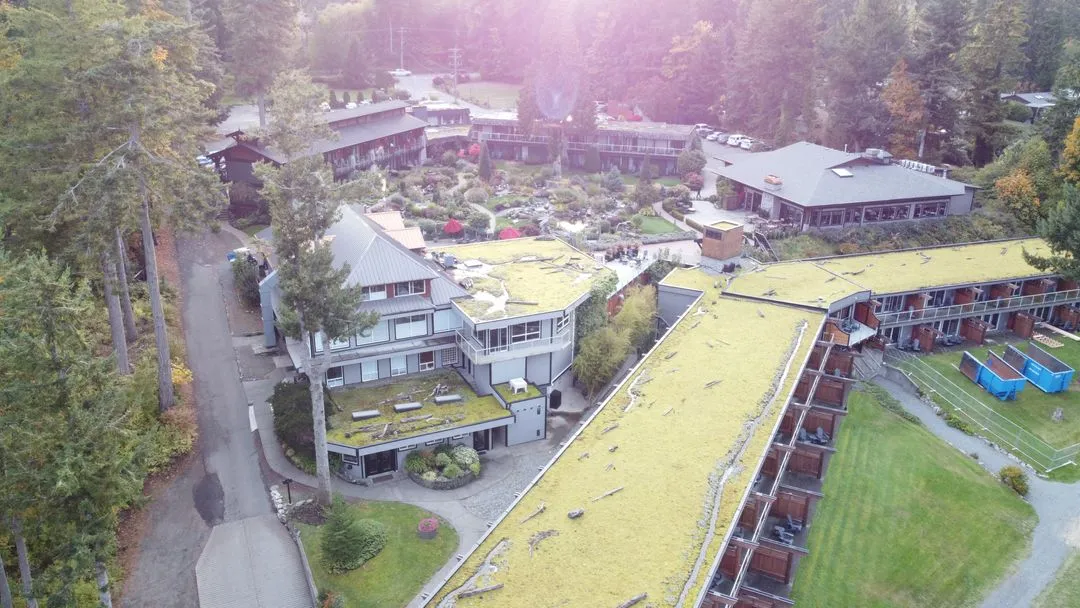
It is not a new arrangement for us. We have roofed on Bowen Island, and at the Kingfisher Oceanside Resort near Courtenay on Vancouver Island.
Do you need a permit?
Usually not for a straight replacement, but it depends on where the house is.
- Rural areas under the Sunshine Coast Regional District — Roberts Creek, Halfmoon Bay, Pender Harbour, Elphinstone and the Howe Sound side. Building Bylaw No. 779 exempts the replacement of roofing on a standard building, provided the replacement is not the result of a building envelope failure.
- Town of Gibsons. The town's permit guide lists roof re-shingling as exempt. Membrane replacement and anything structural are worth confirming with the building department.
- District of Sechelt. The district's website does not address re-roofing directly, so ask the building department before you start.
Anything structural — new framing, a changed roof shape, or a roof deck added where there was none — needs a permit everywhere.
How to read a Coast roofing quote
Two quotes can differ by thousands of dollars and both be honest, if they describe different roofs. Make sure each one answers the same questions:
- Tear-off and disposal: included, and how many layers are assumed?
- Deck repair: is there a per-sheet price for replacing rotten sheathing? Nobody knows how much there is until the old roof is off, but the price per sheet should be agreed before it is.
- Underlayment and edges: what goes under the roofing, and is there self-adhered membrane at the eaves and in the valleys?
- Metal: new flashings throughout, or old ones reused? Reusing tired flashings is one of the most common ways a quote is made cheaper.
- Ventilation: is it being assessed and corrected, or left as it is?
- Paperwork: a written workmanship warranty, proof of liability insurance, and a WorkSafeBC clearance letter. We carry $5 million in liability insurance, including hot work.
- GST shown separately, so you are comparing like with like.
Pro Torch Roofing quotes shingle, metal and torch-on work anywhere on the lower Sunshine Coast. Every quote starts with a free assessment, by drone where the site allows, and you keep the photographs either way. Our Sunshine Coast roofing page has services and coverage, or call (778) 316-1247 to book.
