

Metal vs Asphalt Shingles on the Sunshine Coast: Choosing by Site
The question arrives in a particular shape. Two quotes on the kitchen table for the same pitched roof, one of them about twice the other, and nothing in either document that explains why you would pay the difference. The cheaper quote is architectural asphalt shingles. The expensive one is standing seam metal.
Neither quote is wrong. On most Coast houses both are legitimate answers, and the real difference between them is not a difference between products. It is a difference between sites, between roofs, and between how long you intend to be the person who owns that roof. Metal on a simple, sheltered roof in Upper Gibsons is a straightforwardly good decision. The same choice on a complicated 1980s house under a second-growth canopy in Roberts Creek is much closer, and on an exposed headland at Redrooffs it turns on specification details that neither quote probably mentions.
What follows is the decision rather than the case for either material. We install both. We are a flat-roof shop first, which means we have no stake in what goes on your pitched slopes, and it also means we are usually the ones looking at the place where the pitched roof runs into the flat section. On a Coast house, that junction is often what actually decides the job.
Key takeaways
- Count the planes before you compare the prices. Metal charges for complexity; shingles absorb it. The premium is not a flat multiplier.
- Near salt water, metal's advantage is the specification, not the metal. A poorly specified metal roof on the waterfront is worse value than a well-flashed shingle roof.
- Under a canopy neither material is maintenance-free, and they fail differently when neglected: shingles lose their surface, metal corrodes quietly where you cannot see it.
- How long you will own the house is the most decisive number in the comparison, and it is the one no quote asks about.
- Shingle sealant strips bond with warmth, so a late-autumn shingle roof on an exposed site may not be fully sealed until spring. That is an argument about scheduling, not about materials.
Start with the roof you have
Before the site and before the budget, two things about the roof itself narrow the field.
Pitch sets the hard limits. Asphalt shingles stop being a system below 2:12, and standing seam metal is the wrong answer below about 3:12. Most Coast houses have at least one section in that territory — a carport, a porch roof, a shed dormer flattened out over a stair. Those sections are membrane work whatever you put on the slopes above them, and pretending otherwise is how a roof gets a leak written into it on day one.
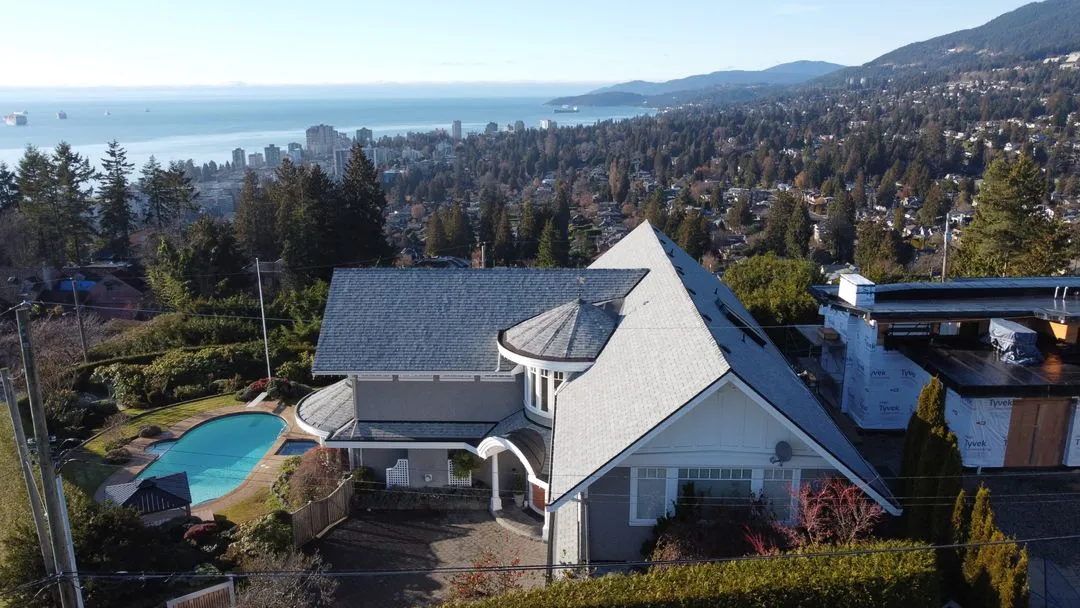
Then count the planes. Stand at the corner of the house and count every separate roof surface, every valley, every hip, every dormer cheek, every chimney and skylight. This number matters more to the metal quote than to the shingle quote, and that surprises people. Shingles absorb complexity cheaply: a valley is two courses cut to a line, a dormer is labour and another bundle. On a metal roof every one of those features is fabricated flashing, cut and hemmed panels, and slow hand work by someone who makes a living bending metal. A plain gable in Upper Gibsons might come in at the bottom of the metal range. A stepped 1980s West Coast house with four roof planes a side, two valleys, a chimney and three skylights will sit near the top of it, while the shingle number on the same house barely moves.
So the honest version of the comparison is this: on a simple roof the gap between the two materials is narrower than the per-square-foot numbers suggest, and on a complicated roof it is wider. Get both quotes on your own roof before you reason from averages.
The deck can change the answer too. Older Coast houses that still have their original cedar shakes are usually on spaced sheathing — boards with gaps between them — and converting to shingles means a full plywood deck goes on first. That is real money that appears in only one of the two quotes. Cedar conversion deserves its own post and will get one.
What the site decides
Four Coast conditions push the decision, and they do not all push the same way.
Exposed waterfront: wind first, salt second. On a pitched roof the uplift question is the perimeter and the fixings. Metal answers it with concealed clips and a mechanical lock. Shingles answer it with nailing pattern, starter courses and the factory sealant strip along each shingle — and that strip is worth understanding, because it bonds with warmth and sun rather than on contact. A shingle roof finished on a Halfmoon Bay headland in late October may not be fully sealed until the following spring, which means one winter of gales on a roof that is relying on nails alone. That is a reason to book the work for a warm block, not a reason to buy a different material.
Salt cuts the other way. Metal's durability on the water is entirely a function of what was specified — substrate, coating system, fastener metallurgy, what is upslope of what — which we went through in detail in our post on metal roofing in Pender Harbour. A metal roof bought on gauge and colour alone, 200 metres from tidewater, can look tired in fifteen years. A correctly specified one will outlast two shingle roofs. Both of those statements are true, which is why "metal is better near the ocean" is not usable advice on its own.
Deep canopy: pick the maintenance you will actually do. Under second growth in Roberts Creek, Elphinstone or West Sechelt, debris is the constant and shade is the multiplier. Metal hosts no growth, which is the usual reason people choose it there, but it still has to be cleared, because a damp acidic mat of needles sitting in a valley is the corrosion mechanism — the full version of that argument is in our post on metal roofing in Roberts Creek. Shingles under the same canopy grow moss, and moss on asphalt is a mechanical problem rather than a cosmetic one, as we set out in the post on moss.
The useful question on a treed lot is not which material resists the trees. It is which neglect you can live with. A shingle roof that nobody maintains tells you loudly: the moss is visible from the driveway, the granules show up in the splash block, and the failure is at the course edges where you can see it coming. A metal roof that nobody maintains keeps shedding water impeccably for years while the coating gives up under the debris in the valleys and behind the chimney. One of those gives you warnings. The other gives you a surprise.
Wildfire interface. Steel does not burn and class-rated asphalt shingles are tested for fire exposure, but on a rural Coast lot the roof covering is rarely what lets embers in. Gutters and valleys full of dry needles, unscreened soffit and gable vents, and debris piled against a wall are, and that is a property-wide job rather than a material choice. It is coming up as its own post.
Elevation and snow. Snow slides off metal, which is an advantage over a walkway and a liability over a door, and it is why snow guards are decided at installation. Load is a separate subject that belongs to flat roofs and old carports more than to either of these materials, and we will take it properly later this season.
How long you plan to own the house
This is the variable that decides most of these conversations, and no quote asks about it.
On the Coast we quote architectural shingles at 20 to 25 years of service and standing seam metal at 40 to 50. Set the per-year arithmetic aside — we worked that through in the Coast roof cost guide, and the short version is that the two land closer together than the sticker prices suggest. What the per-year number hides is who is standing there when the roof comes due.
If you expect to sell inside about seven years, the metal premium is difficult to justify. A re-roof is not an improvement a buyer pays a premium for; it is a problem they are relieved not to have. A new shingle roof with the invoice, the manufacturer system warranty and dated photographs clears that concern completely at the inspection stage, and it does it for roughly half the money. Nobody has ever paid more for a house because the roof had another thirty-five years in it rather than another twenty.
If this is the house you intend to grow old in, or a family property that will pass to someone, the calculation inverts. A shingle roof means you will do this again, probably in your seventies, probably at whatever labour costs then. Metal, specified properly for your site, means the next conversation about the roof is a conversation about flashings and fasteners, not about replacement. Clients who choose metal and are happy about it years later are almost always in this group.
Between those two cases, the tiebreaker is usually the roof's complexity from the section above, and whether the house is on a site that punishes the cheaper material.
One practical footnote for anyone planning to be there a long time: you can walk a shingle roof in dry weather with reasonable care, and a metal roof you walk in the right place, in the right footwear, where a dent in a panel is permanent and visible. If you clean your own gutters, have a chimney swept or put lights up in December, that is a genuine change in how you live with the roof. Neither material is maintenance-free, whatever you are told. Both want their valleys and gutters cleared twice a year.

Where either one meets a flat section
Most Coast houses are not a single-material decision at all. They are a pitched covering plus one or more low-slope sections, and the junction between them is where we are called most often. With shingles, the membrane has to run up under the shingle courses in the correct direction with enough lap; done the other way round the roof leaks every time it rains hard, and it is a surprisingly common mistake. With metal, the membrane runs up under the panel with an upstand and the panel laps over it, and the problem is ownership rather than technique: the 300 millimetres where the two systems meet sits between two trades and neither one costs it.
When you are comparing quotes, read what each one says about that junction. Silence there is the most expensive kind of silence in roofing.
The numbers, and how to compare two quotes
Our installed prices, before 5% GST, quoted the same way every time:
- Architectural asphalt shingles: $5.50 to $9 per square foot, 20 to 25 years on the Coast.
- Standing seam metal: $12 to $20 per square foot, 40 to 50 years.
On a 2,200 square foot roof area that is roughly $12,100 to $19,800 in shingles against $26,400 to $44,000 in metal. The gap of $14,000 to $24,000 on that house is the actual decision, and it is why the ownership horizon above matters more than any brochure.
Comparing two quotes for different materials is harder than comparing two quotes for the same one, so look for the line items that differ between them rather than only at the totals:
- Deck allowance. Both should state a price per sheet of plywood for what the tear-off reveals. A quote with no number there has not priced the risk, it has moved it.
- Underlay. What product, how many layers, and on a metal roof whether it is a high-temperature membrane. Metal gets hot and ordinary underlay is not rated for it.
- Valleys and flashings. Open metal W-valley or closed-cut on the shingle quote; who fabricates the flashings on the metal quote and from what material.
- Fixings. Nailing pattern and starter course detail on shingles. Clip type, panel gauge, substrate, coating system and fastener metallurgy on metal — "26 gauge, charcoal" is not a specification.
- Ventilation. What intake and exhaust the roof will have when the work is done, in both cases.
- The low-slope sections. Named, with a system, not folded into a square-foot rate.
There is no ferry premium on our pricing. Coast work is booked in blocks: crew, materials and equipment cross together and stay until each roof is watertight.
Pro Torch Roofing has 25 years and 850-plus roofs behind it, IKO and Soprema systems, in-house sheet metal fabrication and $5 million liability insurance including hot work. We install standing seam metal and asphalt shingles, and flat roofs are the specialty, so if your house has both we are quoting the whole thing rather than the easy part. See the Sunshine Coast page for what we do here. Assessments are free, by drone where the site allows, and the photographs are yours to keep. Call (778) 316-1247.
