

Metal Roofing in Roberts Creek: Shade, Debris and Fire on a Treed Lot
Drive Lower Road, or any of the lanes running up off Flume Road, and you will pass roofs you cannot actually see. Second-growth fir and cedar close over the lot, and the roof underneath sits in shade from October through April.
That changes which roofing problems matter. On the Sechelt waterfront a roof is judged by what the wind and the salt do to it. In Roberts Creek it is judged by what lands on it, and how long that stays wet.
Metal is often the right answer here — but not for the reasons it gets sold on the waterfront, and the specification that matters is different too.
Key takeaways
- In Roberts Creek, metal earns its place through debris shedding, fire resistance and a 40 to 50 year life — not salt resistance.
- The panels shed. Valleys and transitions do not. Needle dams, rather than rain, are what shorten a metal roof under canopy.
- A non-combustible roof covering counts on a wildfire-interface lot, but embers get in at the vents, gutters and eave closures, never through the panel.
- Exposed-fastener panels fail at the gaskets. Under heavy tree cover, concealed-fastener standing seam is the one worth buying.
- Standing seam runs roughly $12 to $20 per square foot installed. On Creek lots the driveway and the canopy affect the schedule more than the price.
What permanent shade does to a roof
Roberts Creek is the most heavily treed community on the lower Coast, and the canopy is the biggest single factor in how long a roof lasts here. A north-facing slope under second-growth fir may not see direct sun between the equinoxes. With November averaging around 250 mm of rain, surfaces that never dry out are the normal condition.
On an asphalt roof that shows up as organic growth and lifted shingle edges. Metal does not host growth the same way, which is most of why people on treed lots start asking about it. A coated steel panel sheds fast, gives moss almost nothing to root into, and does not soften when it stays damp for six months.
What shade does to metal is slower. A panel that stays wet relies entirely on its coating to protect the steel underneath, which is why the coating system and the edge treatment matter far more here than the gauge.
Debris is the real test, not rain
Conifers drop constantly. Needles, cones, bark and small branches land year-round and far outweigh anything the weather does on a sheltered lot. On a pitched metal roof most of that slides off. The trouble is everywhere it cannot:
- Valleys. Where two slopes meet, debris builds a dam. Water then backs up and travels sideways under the panel edges instead of down the valley.
- Behind chimneys and dormers. Anything interrupting the slope collects a wedge of needles on its uphill side, which stays wet permanently.
- Low-slope sections. A carport or addition at 2/12 has no energy to move debris, so it sits.
- Gutters. Full gutters hold standing water against the drip edge and fascia metal.
The damage is not dramatic. It is a damp organic mat sitting against a coating for years, holding acidic litter in permanent contact with a cut edge or a fastener. That is how a roof rated for fifty years becomes a thirty-year roof.
So the maintenance item on a Creek metal roof is not the roof. It is the valleys and gutters, cleared twice a year: once after the autumn needle drop, once in spring.
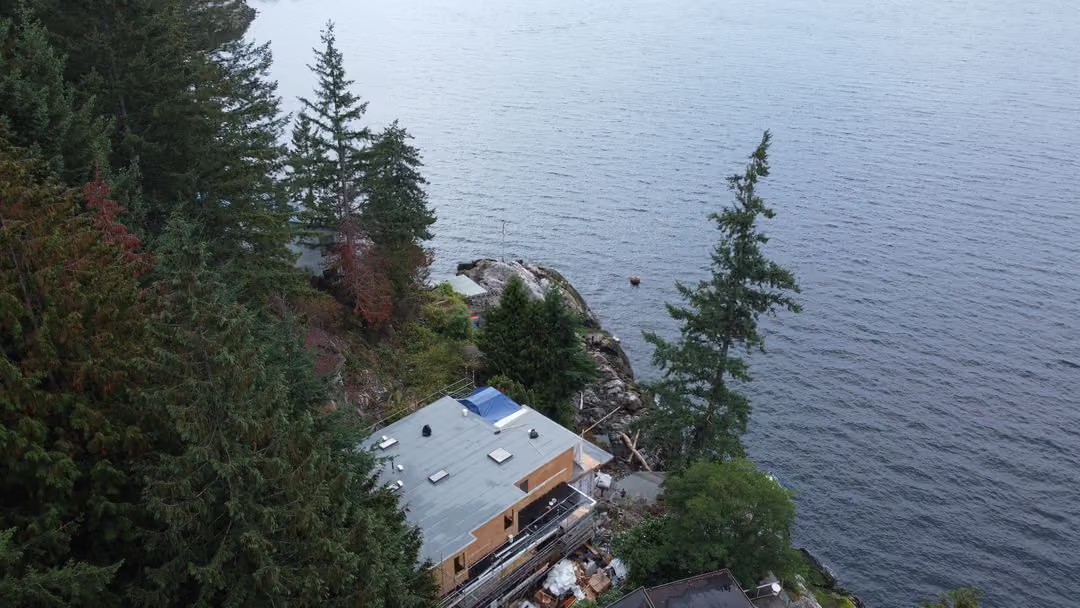
Non-combustible, on a lot where that matters
Roberts Creek sits in the wildfire interface. Homes stand among standing timber on rural lots, often well back from the road, and that is a genuine consideration rather than a sales line.
Steel does not burn. A metal roof takes the roof covering off the list of things an ember can ignite — a real advantage over wood, a measurable one over asphalt. It does not make the house fire-resistant, though. Embers rarely ignite a roof by landing in the middle of it; they get into the assembly at the openings:
- Gutters and valleys full of dry needles in August.
- Ridge and eave closures, where a profiled metal roof leaves gaps that need foam or metal closures fitted properly.
- Soffit and gable vents without fine mesh.
- Debris sitting on a low-slope section against a wall.
On a Creek lot, specify the closures and screens properly and keep the gutters clear through the dry months. FireSmart BC publishes the home assessment guidance worth reading alongside that.
Standing seam versus exposed-fastener panels
This decision changes the outcome most, and it is usually presented as a price difference.
Exposed-fastener panels — ribbed sheets screwed straight through the face — are cheaper and quicker to install. Every screw carries a rubber washer, and there are hundreds of them. Those washers compress, harden under UV, and the panel moves against them with every temperature swing. Eventually each one is a hole with a tired gasket in it.
Standing seam hides its fasteners. Panels clip to the deck and lock to each other at a raised seam, so there is no penetration in the water plane and the panel can expand and contract against its clips.
On an open, sunny lot the exposed-fastener roof is a defensible economy. Under a Roberts Creek canopy it is the wrong one: every one of those gasketed penetrations spends the winter under a wet mat of needles.
The same logic applies to the metal you cannot see. Flashings, valley metal and drip edge should be the same family of metal as the panel, or isolated from it; mixing metals at a wet junction sets up galvanic corrosion that eats the less noble metal from the joint outward. We fabricate ours in our own sheet metal shop, so the metal at every junction is specified rather than whatever the supplier had.
Snow guards are the other thing decided at installation and awkward to retrofit. Roberts Creek runs from the shoreline up toward Mount Elphinstone, and snow gets heavier with elevation. Metal sheds it, which is usually good and occasionally dangerous — a full slope of wet coastal snow releasing onto a doorway or a heat pump. Work out what sits under the eaves before the roof goes on.
The noise question, answered for a treed lot
Everyone asks about rain on a metal roof. Rain is not the issue. Over a solid plywood deck with underlay and an insulated attic beneath, standing seam is not meaningfully louder than shingles; the barn-roof sound people remember comes from panels over open purlins with nothing underneath.
On a Creek lot the real sound is different, and nobody mentions it: fir cones. A cone dropping twenty metres onto a metal panel makes a noise you will hear. So do branches in a southeast gale.
That is not a reason to avoid metal, only to be honest about the assembly. Metal over a vaulted ceiling with a thin assembly and no attic above you will transmit more, and that is worth knowing before the quote is signed.
Getting panels down a Creek driveway
Standing seam panels are made in single lengths running the full slope, which is their great advantage — no horizontal joins for water to find. It is also a logistics problem on rural lots. Many Roberts Creek properties sit at the end of a long gravel driveway with canopy closing over it and no turning room at the house; some cannot take a flat-deck truck at all.
There are two ways around it, and a quote should say which applies: panels cut shorter with a deliberate detail where they join, or roll-forming on site so panels are made to length in the driveway. Both are normal. What is not normal is finding out on the first morning.
It is also why we book Coast work in blocks — crew, equipment and materials cross together and stay until each roof is watertight. There is no ferry premium in our pricing.

Where the metal meets the flat part
Plenty of Creek houses are not simple gables. Owner-built homes gained additions; newer rural builds have a flat entry canopy, a carport, or a section of low-slope roof tucked behind the main pitch. Metal does not work below about a 3/12 slope, so those sections need a membrane — and a junction where the panel ends and the membrane begins, usually right where debris has already collected.
It is the detail we see fail most, for a predictable reason: it sits between two trades. The metal company terminates its panel, the roofer starts the membrane, and nobody owns the 300 mm in between. Done properly, the membrane runs up under the metal with a proper upstand and the panel laps over it, built as one assembly instead of two.
We are a flat-roof shop first, so this is the part of a metal job we care most about. How those membrane sections are built, and the four places they leak, is in our post on torch-on roofing in Gibsons.
What it costs, and whether you need a permit
Standing seam runs roughly $12 to $20 per square foot installed on the Coast, with a 40 to 50 year service life. On an 1,800 square foot roof that is about $21,600 to $36,000 before GST. The full breakdown, including how to measure your own roof, is in our Sunshine Coast roof cost guide.
Two things move a Creek job within that range: access, as above, and tree work. Branches over the roof have to come back before panels go on, and on a heavily canopied lot that is a real line item rather than an afterthought.
On permits, Roberts Creek falls under the Sunshine Coast Regional District. Building Bylaw No. 779 exempts the replacement of roofing on a standard building unless it results from a building envelope failure, so a straight shingle-to-metal re-roof normally needs no permit. Anything structural does.
Pro Torch Roofing installs standing seam and profiled metal roofing throughout Roberts Creek and the lower Sunshine Coast, and fabricates the flashings itself. Every quote starts with a free assessment, by drone where the canopy and the site allow, and you keep the photographs either way. Our Sunshine Coast roofing page covers services and coverage, or call (778) 316-1247.
