

Strata Roofing Proposal Requirements in Vancouver: A Board Checklist
The lowest roofing bid may be the hardest one for a Vancouver strata council to approve. If contractors price different materials, repairs, exclusions, or site conditions, the totals alone won’t show which proposal offers the clearest plan or leaves the fewest questions.
For a fair comparison, give every contractor the same project information and ask for a clear, building-specific scope. That’s the foundation of sound strata roofing proposal requirements in Vancouver, whether the building needs a flat-roof membrane, flashing work, or another roofing system.
This checklist covers what to include in a request, how to compare technical details and contractor documentation, and what to clarify about exclusions, contingencies, disruption, scheduling, and hot-work planning. It also explains how to document a recommendation so council and owners can understand what’s proposed, what could change, and why the preferred option fits the building.
Key Takeaways
• Give every bidder the same roof details, known concerns, and access information so proposals start from a consistent scope.
• Ask contractors to explain the roofing system, materials, preparation, and installation sequence, including SBS membrane layers where applicable.
• Use the strata roofing proposal requirements Vancouver checklist to compare assumptions, exclusions, schedules, and documentation, not just the total.
• Check approval, spending, and notice requirements against current legislation and your strata documents before setting project checkpoints.
• Gather roof records, photos, leak history, and access limits. Request a site review if those details don’t clearly define the work.
What Vancouver Strata Roofing Proposals Should Cover Before Bids Are Requested
A useful roofing proposal starts with a well-defined request. Identify the strata property, roof type, areas under consideration, and reason for seeking bids, such as recurring leaks, visible deterioration, or planned replacement. Because a strata building includes individual lots and shared property, its strata title ownership structure makes it important to specify which roof areas and related components are included.
Give every bidder the same starting information. Note roof access routes, occupied-building constraints, and any limits on staging or resident access. Share available drawings, inspection records, leak history, and details of previous repairs. Label each condition as confirmed or suspected so contractors can distinguish documented issues from items requiring on-site assessment. These details make the strata roofing proposal requirements Vancouver councils set more useful and comparable.
For a visual look at a strata roof inspection, watch this video:
Create a clear Vancouver strata roofing project brief
Define the work areas and the outcome you’re seeking, but avoid prescribing a repair method unless the strata has a professional assessment to support it. For example, identify a recurring leak location and any related interior impacts, then ask the contractor to assess the likely roof-level cause. On a flat roof, the assessment may need to clarify membrane condition, perimeter flashing, and other details before the scope can be finalized.
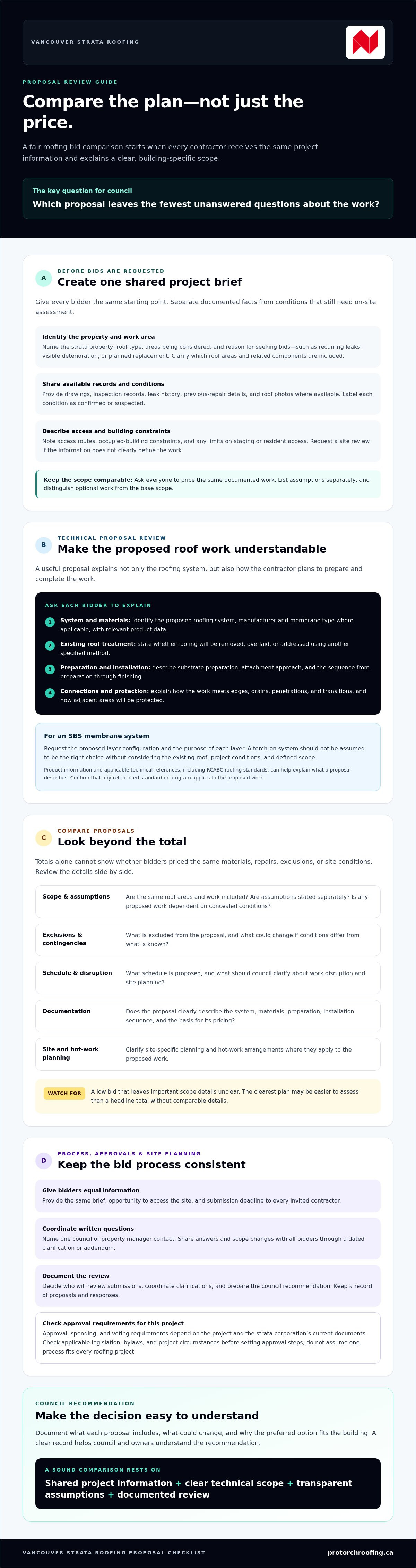
Ask bidders to price the same documented scope and list assumptions separately. Clearly distinguish optional work from the base scope, and identify any proposed work that depends on concealed conditions. This lets council compare equivalent proposals rather than relying on headline totals.
Set a fair, comparable bid process
Give every invited contractor the same brief, opportunity to access the site, and submission deadline. Name one council or property manager contact to receive written questions. Share answers and scope changes with all bidders through a dated clarification or addendum so each proposal reflects the same information.
Before issuing the request, decide who will review submissions, coordinate clarifications, and prepare the council recommendation. Keep a record of proposals and responses. Approval, spending, and voting requirements depend on the project and the strata corporation’s current documents. Check the applicable legislation, bylaws, and project circumstances before setting approval steps. Don’t assume the same process applies to every roofing project.
Technical Details a Vancouver Strata Roofing Proposal Must Explain
A proposal should explain not only which roofing system is proposed, but also how the contractor plans to prepare and complete the work. Ask bidders to identify each roof area in scope, describe the proposed materials and installation sequence, and explain how the work connects at edges, drains, penetrations, and transitions. These details are especially important when comparing different approaches to a flat roof.
For an SBS membrane system, request the proposed layer configuration and the purpose of each layer. A torch-on system may suit some buildings, but it shouldn’t be assumed to be the right choice without considering the existing roof, project conditions, and defined scope. Product information and applicable technical references, including RCABC roofing standards, can help council understand what a proposal describes. Confirm that any referenced standard or program applies to the proposed project and work.
Specify the roof system and installation scope
Ask each contractor to name the manufacturer and membrane type where applicable, describe the layer arrangement, and provide relevant product data. The proposal should state whether existing roofing will be removed, overlaid, or addressed using another specified method. It should also explain substrate preparation, the attachment approach, and how adjacent areas will be protected during the work.
Request a clear sequence from preparation through installation and finishing. This helps council assess whether the proposed work addresses the full roof area and understand how it will be carried out, rather than having to infer key methods.
Make water management and finishing details visible
Drainage and transitions need specific attention. Ask bidders to identify the drains, scuppers, penetrations, perimeter flashing, and tie-ins included in the scope. The proposal should explain how water flow will be managed and how exposed areas will be protected if wet weather interrupts work. Don’t assume these items are included just because the bid describes a roof replacement.
Have contractors separate included work from exclusions, allowances, and assumptions about concealed conditions. If inspection or testing is needed before a detail can be priced, require the bidder to identify the location, explain what remains uncertain, and describe how approval of additional work would be handled. This makes possible scope changes visible before council compares totals.
Clear descriptions of membrane, flashing, and work sequence make technical differences easier to discuss. For project-specific context on roofing and waterproofing services, strata representatives can review the work categories offered by Pro Torch Roofing, a Burnaby contractor serving Vancouver and the Lower Mainland.
How to Compare Strata Roofing Proposals Beyond the Total
A lower total doesn’t necessarily mean a better-value proposal. One bid may include flashing, cleanup, and protection during wet-weather delays, while another may leave those items unclear or outside the price. To apply the strata roofing proposal requirements Vancouver councils need, compare scope and risk alongside cost, then resolve differences before recommending a contractor.
Build a side-by-side comparison using the same criteria for every submission:
Scope and materials
Roof areas, proposed system, preparation, membrane or other materials, flashing, and tie-ins.
Site work
Water protection, access needs, safety planning, cleanup, and expected resident disruption.
Timing
Schedule, working-hour assumptions, sequencing, and approach to weather delays.
Commercial details
Inclusions, exclusions, allowances, contingencies, and assumptions about concealed conditions.
Documentation
Supporting product information, applicable insurance and WorkSafeBC documents, and written warranty terms.
Mark each item as included, excluded, unclear, or not applicable. Ask contractors to clarify omissions and differing assumptions in writing, then update the comparison. An allowance or contingency isn’t automatically a saving. Find out what it covers, what could trigger extra work, and how a change would be approved. Keep the base proposal distinct from optional work so council can compare equivalent scopes.
Use consistent criteria for every bid
Review each proposal line by line for work areas, preparation, perimeter flashing, drainage details, and cleanup. Record schedule and access assumptions, including how the plan accounts for weather and occupied areas. Assess completeness and clarity separately from the quoted total. A clearly stated limitation can be evaluated. A vague description needs follow-up before it can support a sound recommendation.
Also consider how contractors describe site safety, water protection during the work, and communication about disruption. Ask who will supervise the work and how residents or building representatives will be informed about access needs and schedule changes.
Check contractor and project documentation
Request current insurance and WorkSafeBC documentation appropriate to the project, and verify what applies before approval. Ask for relevant project examples or references and the name of the proposed site supervisor. Don’t treat a general statement about coverage or experience as a substitute for documents council can review.
Review the warranty wording directly. Confirm in writing who issues it, its duration, what it covers, and any exclusions. Record unanswered questions and the contractor’s responses so the council recommendation explains both the comparison and any remaining uncertainty.
Vancouver Strata Approvals, Schedule, and Site Planning Checklist
A roofing proposal can be technically sound and still stall if the strata hasn’t mapped out the decision process or considered how work will affect residents. Plan a sequence from proposal review through contractor clarification, council recommendation, owner communication, and the required approval. The strata roofing proposal requirements Vancouver councils follow should reflect the specific project and the corporation’s governing documents, not assumptions about a standard voting or notice process.
Confirm the strata corporation's decision pathway
Review the bylaws, budget, and relevant meeting records before deciding how the work will be approved and funded. If it’s unclear whether the proposed work is maintenance, repair, or a significant change, get appropriate advice and verify how that classification affects the decision pathway. Check applicable voting, spending, and notice requirements against current legislation and the strata’s documents. Don’t rely on a general rule of thumb.
Once the pathway is confirmed, document the selected scope, reasons for the recommendation, decision, and funding process in the appropriate meeting records. A clear record helps owners understand what council considered and what was approved.
Coordinate work around residents and Vancouver weather
Ask the contractor for a work sequence covering mobilization, roof access, protection of shared areas, daily site protection, debris control, cleanup, and completion checks. Clarify expected parking or access restrictions, noise, and how residents will be kept informed. Agree on who will communicate schedule changes and how residents will be notified if temporary restrictions shift.
Vancouver’s wet weather makes protection planning especially relevant. Ask how exposed roof areas and materials will be secured if rain interrupts work, and how water protection will be managed between work stages. The proposal should explain the approach rather than leave council to infer it from a general schedule.
If the proposed system involves torch-on roofing, request project-specific hot-work controls and fire-safety planning. Confirm which documents and procedures apply to the selected contractor and site before work is approved. Also verify with the appropriate authority whether permits or other requirements apply to the specific scope and property.
Before approval
Confirm decision, spending, and notice steps against current strata documents and applicable requirements.
Before work begins
Confirm access arrangements, resident communication, weather protection, and project-specific safety planning.
For the record
Keep the recommendation, clarifications, approval, and selected scope together in the strata’s project documentation.
A project-specific roofing assessment can help clarify scope and sequencing. Information about requesting a roofing quote from Pro Torch Roofing is available online. Pro Torch Roofing is based in Burnaby and serves Vancouver and the Lower Mainland.
Get a Project-Specific Strata Roofing Proposal in Vancouver
A useful proposal depends on clear, building-specific information. Before contacting contractors, gather what the strata already knows about the roof and identify what still needs professional assessment. This helps define the work more accurately and gives council a stronger basis for comparing proposals. Preparing these strata roofing proposal requirements Vancouver boards can use also helps prevent a visible symptom from being treated as a confirmed diagnosis.
What to provide when requesting a proposal
Collect available records and practical details in one package. Include roof plans or previous inspection reports if the strata has them, along with photos, known leak locations, and a brief repair history. Note which roof areas are involved and distinguish observed conditions from suspected causes. For example, report where water has appeared inside without assuming the precise point of entry on the roof.
• Roof area details and available drawings or inspection records
• Photos, leak history, and known repairs, labelled by location where possible
• Building occupancy, roof access arrangements, and any work-hour or access limits
• The strata or property-management contact who can coordinate questions and site access
If records and visible conditions don’t define the full scope, ask the contractor to review the roof on site. Request written clarification of uncertainties, exclusions, proposed sequencing, and recommended next steps. If further inspection is needed to confirm concealed conditions, have the proposal explain what remains unknown and how that could affect the work.
When a torch-on roofing assessment may fit
For a flat roof, ask whether the existing assembly and building conditions are suitable for a torch-on system rather than treating it as the default. The contractor should explain the proposed membrane details, preparation, flashing, and project sequence in terms council can evaluate. Pro Torch Roofing offers torch-on roofing, repairs, maintenance, waterproofing, and custom sheet metal work. Its roofing services page outlines these work categories.
For broader context on commercial flat-roof systems, consult a roofing professional and ask how any suggested approach relates to the specific building. A project-specific review matters: a sound proposal connects the roof’s known condition to a defined scope, identifies remaining uncertainties, and gives the strata a clear next step.
Pro Torch Roofing is a family-owned Burnaby contractor serving Vancouver and the Lower Mainland, with more than 25 years of roofing experience. Strata representatives can share available roof records, photos, known leaks, and access details when requesting a project-specific roofing proposal.
Make Your Next Roofing Decision with Confidence
A defensible strata roofing decision starts with a shared scope, not the lowest bid. Give contractors the same building information, ask them to explain materials, preparation, exclusions, and schedule, then compare proposals against consistent criteria. Before approval, clarify remaining uncertainties and verify the required decision steps against current legislation and strata documents.
These strata roofing proposal requirements Vancouver councils use can help turn a complex project into a recommendation owners can understand. Clear documentation also helps with planning site access, resident communication, and protection of the building during the work.
For project-specific context, Pro Torch Roofing is a family-owned Burnaby contractor serving Vancouver, West Vancouver, North Vancouver, and the Lower Mainland. Its services include torch-on roofing and waterproofing, which may be relevant when council is defining a flat-roof project scope.
Request a project-specific strata roofing quote and share the roof records, photos, known leaks, and access details available to your strata.
Frequently Asked Questions
What should a strata roofing proposal include?
A strata roofing proposal should clearly define the work, materials, schedule, exclusions, and assumptions. It should identify the roof areas, proposed system, preparation and installation sequence, flashing and drainage details, site access needs, and cleanup. Ask for allowances and concealed-condition risks to be listed separately, along with relevant product information and written warranty terms. These strata roofing proposal requirements Vancouver councils can use make it easier to understand the work and compare bids consistently.
How many roofing proposals should a Vancouver strata obtain?
There isn’t one number that fits every strata roofing project. Check the strata’s procurement policies, bylaws, budget, and project circumstances, then seek a practical number of comparable proposals. The goal is to evaluate suitable contractors against the same documented scope, not to collect bids based on different assumptions. If only a limited number of contractors can provide proposals, record the reason and explain how council assessed the submissions received.
Can a strata council approve a roof replacement without an owner vote?
It depends on the project, the strata corporation’s documents, and applicable legislation. Don’t assume a roof replacement can always be approved by council alone or that an owner vote is always required. Check the bylaws, spending authority, meeting records, and current requirements for the specific work. If the approval pathway or classification of the work is unclear, seek appropriate legal or strata-management advice before committing funds or authorizing the project.
How can strata councils compare roofing bids fairly?
Compare proposals against the same scope, then ask contractors to clarify differences before ranking them. Review roof areas, materials, preparation, flashing, drainage, schedule, access, cleanup, exclusions, allowances, and documentation. Mark items as included, excluded, unclear, or not applicable. Assess completeness and clarity separately from the total. A lower bid may omit work or rely on assumptions, so resolve scope differences before council prepares its recommendation.
What insurance and safety documents should a roofing contractor provide?
Ask for current insurance and WorkSafeBC documentation relevant to the contractor and project, then verify which documents and requirements apply. Request project-specific safety information, including fall-protection planning where applicable. If the proposed work involves torch-on roofing, ask what hot-work controls and fire-safety planning will be used. Confirm the proposed site supervisor and how safety measures will be coordinated at the property. Review applicable written documentation rather than relying on general assurances.
What should a strata proposal say about torch-on roofing?
A torch-on roofing proposal should explain why the system is being considered for the building and describe its materials, membrane layers, preparation, installation sequence, flashing, and tie-ins. It should also identify relevant safety planning and assumptions about the existing roof assembly. Torch-on roofing isn’t automatically suitable for every flat roof. Ask the contractor to assess the building’s conditions, state uncertainties in writing, and explain any exclusions or further investigation needed.
How long does a strata roofing project take in Vancouver?
There’s no reliable single duration for every strata roofing project. Timing depends on the roof areas and system, preparation, access, sequencing, building occupancy, and weather conditions. Ask each bidder for a schedule identifying mobilization, work stages, expected access restrictions, cleanup, and completion checks. The proposal should also explain how exposed roof areas will be protected if wet weather interrupts work and how residents will be informed about schedule changes.
