

Roof Insulation in Vancouver & Burnaby: The 2026 Homeowner’s Reference Guide
Did you know that a poorly sealed attic can leak up to 40% of your home's heat directly through the shingles during a typical Burnaby winter? Most Lower Mainland homeowners expect their monthly BC Hydro and FortisBC bills to climb every year, yet few realize their roof insulation is the primary culprit behind those rising costs. You likely already feel the chill of coastal moisture or worry about the damp spots that signal potential mold growth in your attic space. It's a common frustration to see C$300 utility bills while still dealing with cold drafts and the threat of ice damming during our increasingly unpredictable snowfalls.
At ProTorch Roofing, we believe your home should be a fortress of structural integrity and comfort. This guide provides the technical roadmap you need to secure your property against the elements while ensuring full compliance with the updated 2026 BC Building Code requirements. We will break down the specific R-values required for our humid climate, compare SBS membrane integration with modern insulating materials, and show you how to eliminate condensation for a healthier, drier living environment.
Key Takeaways
• Learn why Vancouver’s unique coastal climate requires specialized thermal barriers to protect your home’s structural integrity from persistent moisture.
• Compare the most effective materials for 2026, including how blown-in cellulose and fiberglass batts perform in traditional Burnaby residential attics.
• Discover how specialized roof insulation like rigid polyiso boards integrates with torch-on membranes to provide a durable, energy-efficient seal for flat roofs.
• Identify how to qualify for the 2026 CleanBC Better Homes rebate program to offset your upgrade costs and lower your monthly FortisBC or BC Hydro bills.
• Understand the critical role of professional air sealing and ventilation in preventing the trapped moisture and mold growth often caused by DIY installation errors.
Understanding Roof Insulation in Vancouver’s Coastal Climate
Roof insulation functions as the primary thermal and moisture barrier for your home. In our specific "Wet Coast" climate, this system does more than just trap heat; it manages the delicate balance between interior comfort and exterior environmental pressure. Unlike the dry interior regions of British Columbia, Vancouver and Burnaby homeowners deal with persistent humidity that can compromise building materials if not properly managed. A high-performance barrier is essential because moisture laden air in the Pacific Northwest behaves differently than in arid climates.
Effective roof insulation is a central pillar of your roof maintenance strategy. It prevents the extreme temperature fluctuations that cause roofing membranes to expand and contract prematurely. More importantly, it stops the attic from becoming a breeding ground for mold. When heat leaks into a cold attic space, it creates a dew point. This moisture leads to wood rot and structural degradation that can cost thousands in avoidable repairs. At ProTorch Roofing, we view insulation as a protective layer that ensures the longevity of your entire roofing system.
The Role of R-Value in British Columbia
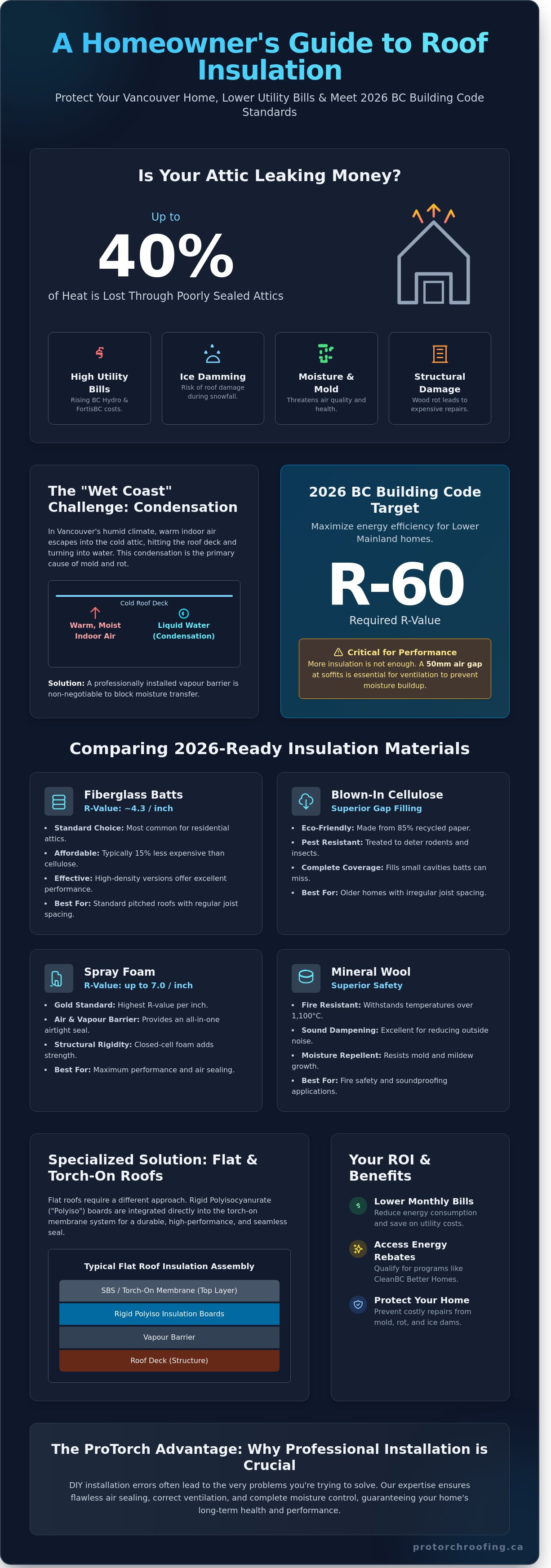
R-Value measures the capacity of a material to resist heat flow. Understanding basic building insulation principles helps you see why the 2026 BC Building Code now emphasizes higher performance standards for the Lower Mainland. For most residential projects in 2026, we aim for targets around R-60 to maximize energy efficiency. However, adding more material isn't always the solution. Without maintaining a 50 millimeter gap for airflow at the soffits, thick insulation can block ventilation. This mistake causes the very moisture problems it's meant to prevent.
Combating Condensation and Humidity
Vancouver nights are often damp and chilly, while our interiors stay warm. When that warm, moist air escapes into the attic, it hits the cold underside of the roof deck and turns into liquid water. This is why vapour barriers are non-negotiable in high-humidity zones. They act as a shield, preventing indoor humidity from reaching the cold structural components of your roof.
Homes in North Vancouver face even steeper challenges due to their specific geography. Increased elevation often results in 15% more annual precipitation and more frequent "freeze-thaw" cycles compared to sea-level properties. These conditions demand a robust roof insulation setup that keeps the roof deck cold. This prevents ice dams from forming and protects the structural integrity of your SBS membranes or torch-on systems. We focus on these technical details to provide the peace of mind that your property is secure against the elements.
Comparing Popular Insulation Materials for 2026
Selecting the right roof insulation involves balancing thermal performance with the specific structural needs of your property. In the Greater Vancouver area, the damp coastal climate and evolving 2026 building codes require materials that do more than just trap heat; they must also manage moisture and prevent air leakage. Our team at ProTorch Roofing focuses on solutions that protect your structural integrity for decades, not just a few seasons. Every home requires a tailored approach based on its age and roof pitch.
Fiberglass Batts
This remains the standard for most Burnaby residential attics. It's affordable and effective when installed without gaps. High-density versions now offer R-values of approximately R-4.3 per inch.
Blown-In Cellulose
Comprising 85% recycled paper, this is a top choice for older Vancouver homes with irregular joist spacing. It fills small cavities that batts might miss.
Spray Foam Insulation
Often considered the gold standard, it provides both a thermal barrier and an airtight seal. Closed-cell options offer R-values as high as R-7 per inch.
Mineral Wool
This material is prized for its fire resistance, withstanding temperatures over 1,100°C. It's also an excellent sound dampener for homes near busy transit corridors.
Fiberglass vs. Cellulose: A Homeowner’s Choice
Budget often drives the choice between these two materials. Fiberglass is typically 15% less expensive to install in standard pitched roofs. However, cellulose provides better resistance to pests like silverfish and rodents because it's treated with boric acid. While fiberglass doesn't settle, cellulose can lose 20% of its depth over time. We often over-blow the initial layer to maintain the target R-value. For homeowners prioritizing a smaller carbon footprint, cellulose is the clear winner due to its high recycled content.
High-Performance Spray Foam
Coastal homes benefit greatly from closed-cell spray foam because it acts as a secondary vapor barrier. This is vital for preventing rot in our humid environment. When dealing with complex architecture, BC Housing's guide to high-performance roofs highlights how specialized applications are necessary for vaulted or flat roof assemblies. Spray foam is the ideal remedy for cramped attics and cathedral ceilings where space for traditional venting is limited. While the initial cost is higher, the ROI is evident in energy bill reductions of up to 20%. If you're unsure which material fits your budget, you can request a professional assessment to see a detailed breakdown of your options.
Flat Roof Insulation: Special Considerations for Torch-On Systems
Flat roofs in Burnaby and Vancouver face unique environmental pressures that sloped roofs simply don't encounter. Because water doesn't naturally shed off a flat surface, the integration of roof insulation is a critical factor in the structural integrity of the building. Most modern installations in British Columbia utilize a "Warm Roof" design. This approach places the insulation layer above the structural deck but below the waterproof membrane. It's the most effective way to prevent condensation from forming inside the roof assembly during our damp, 5-degree Celsius winter nights.
By keeping the entire roof structure at a consistent indoor temperature, we eliminate the risk of internal rot and mold. This setup is essential for high-performance torch on roofing systems. It ensures the SBS membrane remains stable and protected from the thermal shock caused by rapid temperature swings common in the Pacific Northwest.
Polyisocyanurate (Polyiso) and Tapered Systems
Polyisocyanurate, commonly known as Polyiso, is the gold standard for commercial roofing in Vancouver. It provides the highest R-value per inch of any rigid foam board, typically ranging from R-5.6 to R-6.0. This efficiency allows us to meet 2026 BC Energy Step Code requirements without creating an excessively thick roof profile. For properties in West Vancouver where heavy rainfall is a constant, we utilize tapered Polyiso systems. These boards are custom-cut at an angle to create a mandatory 2% slope toward internal drains or scuppers.
Tapered systems are the best defense against ponding water, which is the primary cause of premature flat roof failure. To maximize energy efficiency, we install these boards in multiple staggered layers. This technique eliminates thermal bridging, a common flaw where heat escapes through the gaps between insulation boards or through metal fasteners. By offsetting the joints, we've seen property owners reduce their annual heating costs by as much as 18% compared to single-layer installations.
Insulation and SBS Membrane Synergy
The bond between the roof insulation and the SBS membrane determines how long your roof will actually last. We don't apply the torch-on membrane directly to the Polyiso. Instead, we install a high-density cover board, such as Securock or a specialized asphaltic board, over the rigid insulation. This creates a fire-safe, durable substrate that can withstand the high temperatures of the propane torch during the fusion process. It acts as a protective shield for the insulation while providing a smooth surface for the base sheet to adhere to.
Fire safety is our absolute priority during this phase. Our crews use specialized "low-flame" techniques and monitor the roof with thermal imaging cameras for at least one hour after the torching is complete. The thickness of the insulation also plays a vital role in membrane health. Thicker insulation provides a more stable thermal mass, which slows down the expansion and contraction of the roof throughout the day. This stability prevents the "alligatoring" or cracking of the membrane, often extending the functional lifespan of a 2-ply SBS system by 10 years or more.
Maximizing ROI: BC Energy Rebates and Savings
Investing in high-quality roof insulation is a strategic financial decision that protects your property while reducing overhead costs. For 2026, the CleanBC Better Homes rebate program continues to offer substantial financial incentives for homeowners in Vancouver and Burnaby. These provincial grants can provide up to C$1,200 for attic insulation upgrades, significantly lowering the net cost of your project. When combined with federal incentives like the Canada Greener Homes Loan, which offers interest-free financing up to C$40,000, the barrier to entry for energy-efficient upgrades is lower than ever before.
Calculating your monthly savings involves looking at your current BC Hydro or FortisBC consumption. On average, a detached home in the Lower Mainland saves between 15% and 20% on annual heating and cooling costs after a professional insulation retrofit. For a standard 2,200-square-foot home, this equates to roughly C$380 to C$520 in yearly utility savings. Professional roofing contractors are essential partners in this process. We provide the precise technical documentation, including photos of the thermal barrier and detailed invoices specifying R-values, that provincial auditors require for rebate approval. This administrative support ensures you don't leave money on the table due to filing errors.
Navigating Local Rebate Requirements
To qualify for BC grants in 2026, your home must meet specific thermal performance benchmarks. The current requirement usually involves increasing your attic or roof cavity insulation to a minimum of R-40 or R-60, depending on the existing structure. You must schedule a pre-installation EnerGuide evaluation through a licensed energy advisor before any work begins. This baseline assessment is a mandatory step for both provincial and federal programs. Once we complete the installation, a post-work assessment confirms the roof insulation meets the target R-value. Homeowners in Burnaby and Vancouver must submit all receipts and assessment reports within six months of the final invoice to secure their funds.
Long-Term Energy Cost Forecasting
Energy prices in British Columbia are projected to increase by approximately 2.8% to 3.4% annually through 2030. By upgrading your thermal envelope now, you effectively lock in lower operating costs and create a hedge against inflation. Most high-quality insulation projects in the Vancouver area reach a full return on investment through energy savings alone within 5 to 7 years. Beyond utility bills, a "Green" certified roof adds tangible value to your property. Real estate data from 2025 suggests that homes with documented energy-efficiency upgrades sell for 4% to 6% more than comparable uninsulated properties. This investment secures your home's structural integrity while boosting its future market position.
Professional Installation: The Pro Torch Advantage
While many homeowners focus solely on the thickness of their roof insulation, the real secret to a high-performance attic is air sealing. Without a tight seal, warm air from your living space escapes into the attic, carrying moisture that leads to mold and structural decay. We prioritize blocking these thermal bypasses before adding a single inch of material. This methodical approach ensures your home remains protected for 25 years or more. During our professional assessment, we evaluate your current R-value and use thermal imaging to find hidden leaks around chimneys and plumbing stacks. We've found that proper sealing can improve thermal efficiency by up to 20% compared to insulation alone.
Professional installation eliminates the guesswork that often leads to costly repairs. Our team looks for signs of compromised structural integrity, such as wood rot or rusted fasteners, that a DIYer might overlook. We don't just blow in material; we build a system. This includes ensuring your attic hatch is weather-stripped and insulated to the same standard as the rest of the floor. By focusing on these small details, we provide a level of security that protects both your comfort and your property value.
The Critical Need for Proper Ventilation
Proper airflow is the backbone of a healthy roof. One of the most common DIY mistakes is covering the soffit vents with insulation, which effectively chokes the system. We install high-durability baffles to maintain a clear channel for roof ventilation from the eaves to the ridge. If you notice ice dams or a damp smell in your attic, your current insulation likely blocks this airflow. Our team balances high R-value targets with a breathable design that meets the 2024 BC Building Code requirements, ensuring your roof doesn't trap heat in the summer or moisture in the winter.
Safety and Craftsmanship Standards
Working in tight attic spaces involves handling materials like fiberglass or mineral wool that require specific safety protocols. Our team manages hazardous material removal and maintains 75mm fire-safe clearances around recessed lighting and heat sources. Our local expertise in Burnaby means we understand how coastal humidity impacts roof insulation performance. Every project concludes with a 12 point final inspection to ensure a gap-free thermal envelope. This rigorous standard prevents the 15% energy loss typically seen in poorly installed systems. We provide a detailed report upon completion, giving you peace of mind that your investment is secure and your home is protected against the elements.
Protect Your Property with Optimized Roof Insulation
Upgrading your roof insulation is a vital step toward long-term structural health and energy efficiency in our unique coastal climate. By choosing 2026-ready materials and utilizing CleanBC rebates, you can significantly reduce monthly utility costs while enhancing your home's protection. For those with flat roof structures, specialized torch-on expertise is essential to ensure moisture-proof performance that lasts for decades. Our team at ProTorch Roofing brings over 25 years of local BC experience to your doorstep. We're a family-owned and operated company that believes in transparent pricing and clear communication. We specialize in torch-on systems and flat roof solutions, ensuring your investment is backed by a quarter-century of technical skill. It's time to stop worrying about heat loss and start enjoying a more comfortable, secure living space. Our experts are standing by to provide the clarity and quality you deserve.
Get a Professional Roof Insulation Assessment in Burnaby & Vancouver Today
We look forward to helping you build a safer and more efficient home for years to come.
Frequently Asked Questions
What is the recommended R-value for roofs in Vancouver?
For most residential properties in Vancouver and Burnaby, the BC Building Code and CleanBC guidelines recommend a minimum R-value of R-60 for attic spaces. This level of roof insulation helps maintain a stable indoor climate despite our damp coastal winters. If you're retrofitting a flat roof with a torch-on system, we typically aim for a minimum of R-30 using high-quality rigid foam boards to ensure long-term thermal efficiency.
Can I add new insulation on top of my old attic insulation?
You can add new insulation over existing material as long as the old layer is dry and free of mold or pests. It's a practical way to boost your home's thermal performance without the cost of a full removal. However, if your current material is compressed or shows signs of moisture from a previous leak, we'll recommend a complete extraction to protect your home's structural integrity and air quality.
How do I know if my Burnaby home needs more roof insulation?
Watch for energy bills that have increased by 15% or more over the last two winters without a change in your heating habits. If your upper floors feel 3 to 5 degrees warmer than the main level during the summer, your thermal barrier is likely insufficient. We also suggest checking for "hot spots" on your roof where snow melts significantly faster than on neighboring Burnaby properties, indicating heat loss.
Does roof insulation help keep my house cool in the summer?
Proper roof insulation acts as a critical barrier that slows heat transfer into your living space during hot July and August afternoons. By reducing the heat gain through your attic or flat roof deck, your air conditioning system doesn't have to cycle as frequently. This can lower your summer cooling costs by approximately 20% while providing a more consistent and comfortable environment for your family.
What is the difference between attic insulation and roof insulation?
Attic insulation sits on the floor of your attic to protect the ceiling below, while roof insulation is installed directly between rafters or on top of the roof deck. For many Burnaby homes with flat roofs, we install rigid polyisocyanurate boards directly under the SBS membrane. This method ensures the entire building envelope remains secure and energy efficient, whereas attic batts only protect the rooms directly beneath the crawlspace.
Are there specific rebates for insulating a flat roof in BC?
Through the CleanBC Better Homes program, eligible homeowners can access rebates up to C$1,200 for attic or flat roof insulation upgrades. To qualify for these 2026 incentives, you must use a licensed contractor and meet specific R-value targets. Our team provides the necessary technical documentation and invoices to ensure your project complies with these provincial energy efficiency standards, making the professional upgrade more affordable.
How long does a typical roof insulation installation take?
A typical installation for a standard 1,500 square foot home usually takes between 1 and 2 business days. If we're performing a full replacement on a flat roof involving new SBS membranes, the process might extend to 3 days to ensure the perimeter flashing is perfectly sealed. Our crew maintains a disciplined schedule and a clean workspace to minimize any disruption to your daily routine or your neighbors.
Will new insulation stop ice dams from forming on my roof?
New insulation prevents ice dams by stopping warm air from escaping your living space and melting the snow on your roof deck. When combined with proper ventilation, it keeps the roof surface at a consistent outdoor temperature. This prevents the melt and freeze cycle that leads to C$5,000 in average repair costs for water-damaged drywall and structural rot caused by water backing up under your shingles.
