

How to Check a Roofer’s WorkSafeBC Status in Vancouver: A 2026 Homeowner’s Guide
What if a routine roof repair on your Vancouver home turned into a legal nightmare because your contractor failed to pay their insurance premiums? It's a valid fear for many property owners who worry that a workplace injury could lead to personal liability. While the construction injury rate has decreased by 25 percent over the past decade, the responsibility to verify coverage still rests with you. Learning how to check a roofer's WorkSafeBC status in Vancouver is the only way to ensure you aren't held responsible for unpaid premiums or accidents on your property.
We'll show you exactly how to secure a verified clearance letter to protect your financial interests and your home's structural integrity. This guide covers the 2026 regulatory landscape, including the average base premium rate of C$1.55 and recent OHS amendments that affect site safety. As a local British Columbia business, we want you to have a clear path to verifying a contractor's standing so you can hire with confidence. By following these steps, you can focus on the quality of your new torch-on system or asphalt shingles while enjoying the peace of mind that comes from a fully compliant project.
Key Takeaways
• Understand how the Occupiers Liability Act can hold you responsible for workplace injuries and why verifying coverage is your best defense.
• Follow our clear walkthrough on how to check a roofer's WorkSafeBC status in Vancouver using the official employer search tool.
• Distinguish between simple registration and being "in good standing" to ensure your contractor is actually paying their insurance premiums.
• Recognize common red flags like "exempt" status claims and learn the protocol for handling contractors who fail a compliance check.
• Gain peace of mind by learning why specialized safety protocols for torch-on roofing are essential for long-term property protection.
Why WorkSafeBC Status is Non-Negotiable for Vancouver Roofing
WorkSafeBC is the provincial body that provides no-fault insurance for workplace injuries across British Columbia. It's designed to protect both the person doing the work and the person paying for it. In our industry, roofing is strictly classified as "high-risk" work. Whether a crew is installing SBS membranes or performing detailed roof repairs, the heights and equipment involved require rigorous safety standards. WorkSafeBC's mandate ensures that if a worker is injured on the job, they receive medical care and wage loss benefits without the need for litigation. However, if your contractor isn't in good standing, that protective shield disappears, leaving the homeowner vulnerable to the fallout.
Many Vancouver property owners unknowingly fall into the "Prime Contractor" trap. Under provincial law, every construction site must have a designated prime contractor who is responsible for overall safety. If you hire a roofing company that lacks proper registration, or if you manage multiple trades yourself without a written agreement, the legal responsibility for site safety may default to you. This means you could be held liable for any safety violations or accidents that occur during the project. Learning how to check a roofer's WorkSafeBC status in Vancouver is a vital step to ensure you're hiring a professional firm that assumes these legal responsibilities on your behalf.
The Financial Risks of Uninsured Roofing
The financial consequences of hiring an uninsured roofer can be devastating. Million-dollar lawsuits are a real possibility if a worker suffers a life-altering injury on your property. You might assume your standard home insurance policy covers these incidents, but most policies in BC specifically exclude professional construction accidents. Without WorkSafeBC coverage, an injured worker has the right to sue the property owner under the Occupiers Liability Act, which requires you to ensure your premises are reasonably safe for anyone you invite onto the site.
BC Workers Compensation Act: What Property Owners Must Know
The BC Workers Compensation Act creates a clear legal framework for hiring contractors in the Lower Mainland. It's important to understand the difference between "independent operators" and "employers" under the Act. Some small outfits may claim they don't need coverage, but this creates a massive legal grey area for you. In 2026, a contractor's verbal promise of being "fully insured" carries no legal weight. You must verify their status through official channels because:
• Homeowners can be held liable for a contractor's unpaid WorkSafeBC premiums.
• Verbal confirmations don't protect you in a court of law.
• Active coverage is the only way to prevent personal injury lawsuits from workers.
Checking a roofer's status isn't just a formality; it's a legal necessity that safeguards your home and your savings. By taking a few minutes to verify a clearance letter, you ensure the project remains professional, legal, and stress-free.
Step-by-Step: How to Check a Roofer’s WorkSafeBC Status
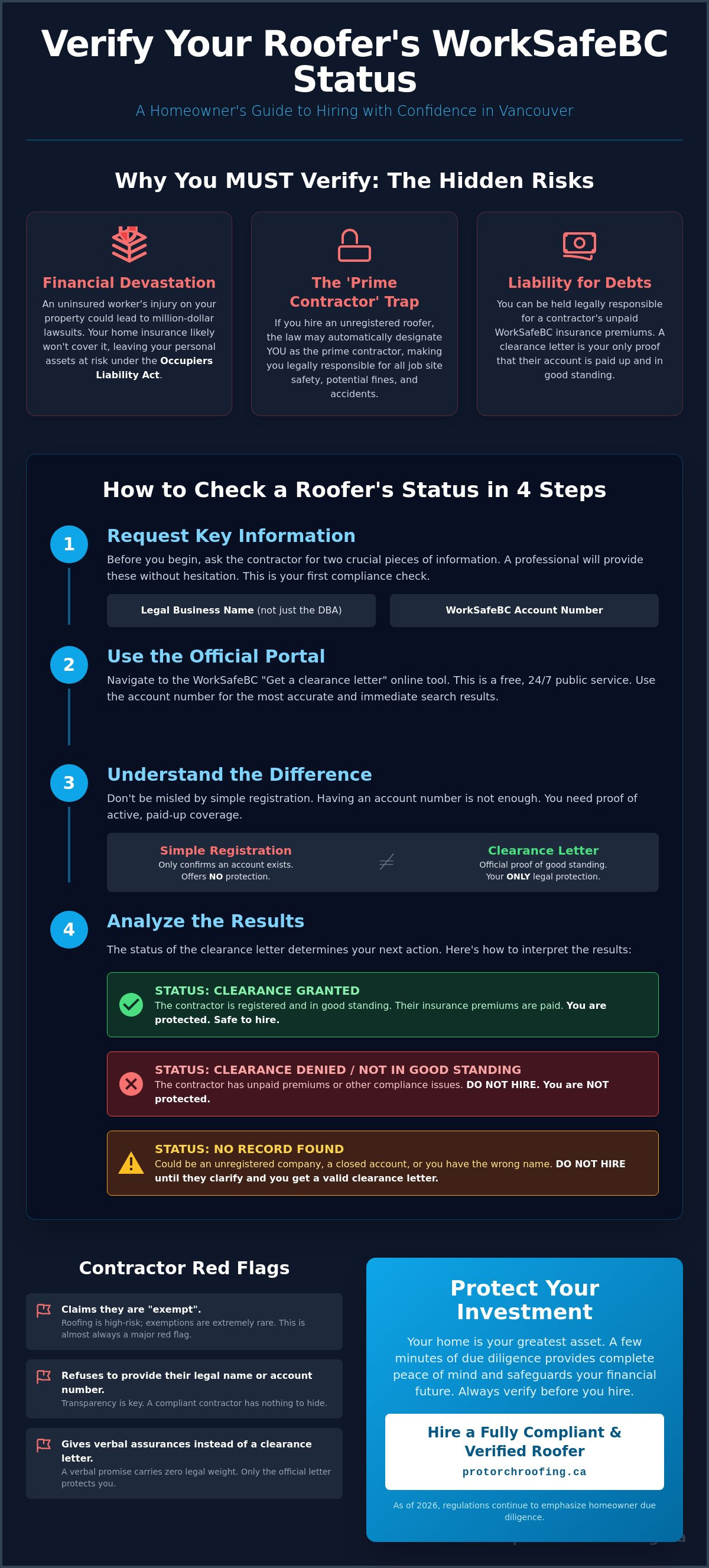
Securing your home starts with accurate information. Before you can verify a contractor, you need their legal business name. Many companies in the Lower Mainland operate under a "Doing Business As" (DBA) name, which might differ from the entity registered with the province. If you only search for a catchy trade name, you might get a false negative result. Always ask the contractor for their legal name and their WorkSafeBC account number to ensure your search is precise. This transparency is a hallmark of a disciplined, local expert.
A search result that shows "No results found" is an immediate red flag that requires your attention. It could mean the company isn't registered, their account has been closed, or they're operating under a different name entirely. Don't take a verbal excuse for this. If they aren't in the system, they aren't covered, and you're at risk. When you request a professional assessment for your roof maintenance or repair, a reputable contractor will provide these details without hesitation.
Using the WorkSafeBC Employer Search Tool
The first step is to navigate to the official WorkSafeBC "Clearance Letter" portal. This tool is available 24/7 and is free for public use. You can search by the legal name or the account number. Using the account number is the most reliable method. Once you find the business, look at the account status. An "Active" status is a good start, but an "Inactive" status means the coverage has lapsed, likely due to non-payment or business closure. This is why understanding your clearance letter is crucial for your protection.
Generating and Reading a Clearance Letter
A simple search result isn't enough; you need a clearance letter. This document is the final proof that a contractor is in good standing. To generate one, follow the prompts in the portal to create a letter for the specific contractor. Once you have the PDF, check two critical areas:
The Effective Date
Coverage must span the entire duration of your project. If the letter expires mid-way through your torch-on roofing installation, you'll need a new one to remain protected.
Industry Classification
Ensure the firm is classified under "Roofing." A company registered only for "Janitorial Services" or "Landscaping" isn't properly insured for high-risk roofing work like installing SBS membranes or custom sheet metal.
Always request this letter directly from the contractor or generate it yourself before any work begins. This small step confirms that the business is meeting its legal obligations and that your property is shielded from liability for unpaid premiums. Knowing how to check a roofer's WorkSafeBC status in Vancouver gives you the confidence to proceed with your project safely, ensuring the long-term health of your home.
Understanding Clearance Letters vs. Simple Registration
A common misconception among property owners is that a WorkSafeBC account number is enough to prove a contractor is safe to hire. In reality, registration is only the first step. A company can be registered in the system but still lack active coverage. This happens when a business fails to report payroll or falls behind on premium payments. If you don't look closer, you might hire a firm that is technically "in the system" but legally "out of compliance." Understanding how to check a roofer's WorkSafeBC status in Vancouver requires looking past the registration number and focusing on the actual standing of the account.
When you verify a contractor, you are looking for the phrase "In Good Standing." This is the only status that provides you with legal indemnity. If a roofer has unpaid premiums, WorkSafeBC has the authority to collect that debt from you, the homeowner, as the person who benefited from the work. This financial burden can be significant, especially on large-scale projects involving torch-on roofing or complex custom sheet metal installations. By ensuring the clearance letter confirms a status of good standing, you effectively transfer the risk of workplace injuries and premium liabilities away from your personal finances and back to the contractor's insurance pool.
Registered vs. In Good Standing: The Key Difference
Registration simply means the business has opened an account at some point in its history. "Good Standing" means their bills are paid, their paperwork is current, and their insurance is active right now. You should never allow a roofer on your property if their status appears as "Pending," "Inactive," or "Delinquent." "Good Standing" is the only status that provides homeowner indemnity and ensures the provincial no-fault insurance system is actually protecting you. If a contractor cannot provide a letter showing this status, it's a clear sign that their business management doesn't match the quality of their craftsmanship.
What is a COR Certified Roofer?
For those seeking the highest level of security, look for a contractor with a Certificate of Recognition (COR). This is a voluntary program that rewards employers who go beyond the legal requirements of the Workers Compensation Act. COR certification indicates that a roofing company has implemented a comprehensive safety management system and passed a rigorous external audit. In the Vancouver construction industry, a COR-certified firm represents a lower risk of accidents and a higher level of professional discipline. You can verify this status by looking for the COR logo on their clearance letter or by checking the BC Construction Safety Alliance registry. When a firm maintains both good standing and COR certification, it demonstrates a deep commitment to the safety of their crew and the protection of your home's structural integrity.
What to Do if a Contractor Fails the WorkSafeBC Check
Discovering that a contractor lacks active coverage after you have already initiated a project is a stressful scenario. However, the steps you take in that moment define your level of protection. If the search tool shows an "Inactive" or "Delinquent" status, you must stop the work immediately. While it might feel awkward to delay a project once the crew is on-site, the alternative is a lifetime of financial regret. Knowing how to check a roofer's WorkSafeBC status in Vancouver is only the first half of the equation; the second half is having the discipline to enforce compliance before any shingles are removed.
You should also ensure your written contract includes a clause mandating continuous WorkSafeBC compliance. This language should state that "the contractor must remain in good standing for the duration of the project, and final payment is contingent upon a clear final clearance letter." This protects you from being held liable for any unpaid premiums the contractor might accrue while working on your home. If you are ever unsure about a contractor's safety record, it's best to seek a professional roofing assessment from a firm that prioritizes transparent documentation.
Common Excuses for Lack of Coverage
Contractors who lack proper standing often rely on a few common myths to bypass your concerns. One frequent claim is the "Independent Operator" excuse. While some sole proprietors can opt out of personal coverage, this rarely applies to a roofing crew. If there is more than one person on your roof, they are an employer and must have an active account. Another dangerous myth is the "private liability insurance" claim. Private insurance is excellent for property damage, but it does not replace the statutory no-fault system provided by WorkSafeBC. In the eyes of the law, private insurance won't stop an injured worker from suing you if the contractor isn't in good standing.
Protecting Your Project Mid-Construction
Compliance isn't a one-time check. For larger projects like a full torch-on installation or complex cedar shake replacement, coverage could lapse mid-way through. The WorkSafeBC portal allows you to "follow" an employer, which sends you an automated alert if their status changes. You should also make it a habit to check the status one last time before you release the final payment. This ensures that the contractor has paid all premiums related to your specific job. For ongoing peace of mind, we recommend scheduling regular roof maintenance only with verified professionals who maintain a perfect standing. This methodical approach ensures your home remains a safe haven, protected by both quality craftsmanship and legal compliance.
Safety First: Why Pro Torch Roofing Leads in BC Compliance
Pro Torch Roofing doesn't just meet provincial standards; we set the benchmark for professional accountability. We understand that property owners researching how to check a roofer's WorkSafeBC status in Vancouver are looking for more than just a checkbox. They want proof of a long-term commitment to workplace safety and financial security. With a 25-year history of perfect standing with WorkSafeBC, we provide that certainty. We include a current clearance letter with every single quote, so you never have to guess about our status or your potential liability.
Our safety culture extends through every facet of our work, from custom sheet metal fabrication to the installation of asphalt shingles and cedar shakes. Each team member undergoes continuous training to handle specialized industry equipment and maintain structural integrity on every site. This methodical approach ensures that every perimeter flashing is secure and every SBS membrane is perfectly sealed without compromising safety. By staying ahead of the 2026 OHS Regulation amendments, we guarantee that our site protocols are always current and compliant, protecting your property and our crew simultaneously.
Our Approach to Torch-On Safety in Vancouver
Torch-on roofing involves open flames and high heat, making it a high-risk activity that requires specialized fire safety and fall protection measures. We take this responsibility seriously, employing strict protocols to protect your home from fire hazards during the application process. Our status as a local British Columbia business means we are deeply invested in our community's safety. For more information on how we apply these rigorous standards to larger properties, see our commercial roofing Vancouver guide. Our family-owned values mean we treat your job site with the same level of protection we would want for our own families.
Request Your Quote and Clearance Package Today
We believe transparency should be the industry standard. When you request a quote for roof repairs or waterproofing, our compliance documents and verified clearance letters are included in your initial package. Hiring a roofing contractor in Burnaby with local roots ensures better accountability and specialized regional knowledge of the Lower Mainland's unique climate. While you now know exactly how to check a roofer's WorkSafeBC status in Vancouver, we make that process effortless by providing the verified documentation you need before you even ask. Contact us today for a professional, fully insured roof assessment and experience the security that comes with true local expertise.
Secure Your Home with Verified Professionalism
Your roof is your property's first line of defense, and its installation should never come with hidden legal or financial risks. We have explored why active coverage is non-negotiable and how the "Prime Contractor" trap can catch even the most cautious homeowners. By now, you understand that a clearance letter is your only true shield against liability for unpaid premiums or workplace accidents. Knowing how to check a roofer's WorkSafeBC status in Vancouver is the final piece of the puzzle for a successful, stress-free project.
At Pro Torch Roofing, we take this responsibility off your shoulders by maintaining an A+ WorkSafeBC standing and over 25 years of local experience. As specialized torch-on experts, we prioritize disciplined safety protocols that ensure the longevity of your home and the health of our crew. Don't leave your property's security to chance or verbal promises. Get a Quote from a Fully Insured Vancouver Roofing Expert today. We look forward to providing the craftsmanship and transparent communication your home deserves.
Frequently Asked Questions
Is every roofing company in Vancouver required to have WorkSafeBC?
Most roofing companies in Vancouver are legally required to register with WorkSafeBC if they hire workers or operate as a corporation. Even independent operators often maintain personal optional protection to secure contracts with reputable firms. Because roofing is classified as a high-risk industry, any crew on your roof must be covered to prevent you from unknowingly assuming the role of the employer and the associated legal liabilities.
What happens if a roofer gets injured and doesn’t have WorkSafeBC coverage?
If an uninsured worker is injured on your property, you could be held personally liable for their medical costs and lost wages under the Occupiers Liability Act. Without the no-fault protection of WorkSafeBC, the injured party has the right to sue you directly. This can result in devastating financial claims that standard home insurance policies typically exclude for professional construction activities.
Can I check a roofer’s WorkSafeBC status for free?
Yes, you can verify a contractor's standing at no cost through the official WorkSafeBC website. The Employer Search tool is available 24/7 and allows you to generate a clearance letter instantly. Learning how to check a roofer's WorkSafeBC status in Vancouver using this tool is the most efficient way to confirm that a company's premiums are paid and their account is active before any work begins.
How often should I request a new clearance letter during a long project?
You should request a clearance letter at the start of the project and again before issuing the final payment. For extensive projects, such as a full torch-on system installation, it is wise to check the status monthly. This ensures the contractor has remained in good standing throughout the duration of the work, protecting you from liability for any premiums that may have gone unpaid during the construction period.
Does private liability insurance cover worker injuries on my roof?
No, private liability insurance typically covers property damage or third-party injuries, not workplace injuries for the contractor's crew. In British Columbia, WorkSafeBC is the exclusive provider of workers' compensation insurance. Private policies don't prevent an injured worker from suing you if the contractor lacks WorkSafeBC coverage. You need both types of insurance to ensure full protection for your home and finances.
What should I do if a contractor’s WorkSafeBC status is "under review"?
If a status is "under review," you should treat it as a lack of active coverage and postpone the start of your project. This status often indicates an administrative issue or an ongoing investigation regarding the contractor's account. Wait until the contractor provides a clear letter stating they are in good standing before allowing any crew to begin roof repairs or maintenance on your property.
Are out-of-province roofing companies covered by WorkSafeBC in Vancouver?
Out-of-province companies must register with WorkSafeBC if they are performing work within British Columbia. Even if they have insurance in Alberta or Ontario, it doesn't automatically cover them here. You must still use the BC search tool to confirm they have a local account in good standing. Hiring a local expert who understands how to check a roofer's WorkSafeBC status in Vancouver ensures all regional regulations are met.
What is the difference between a WorkSafeBC account and a business license?
A business license is a permit from the City of Vancouver allowing a company to operate within city limits, while a WorkSafeBC account is specifically for workplace disability insurance. One does not guarantee the other. A contractor might have a valid license but a delinquent WorkSafeBC account. You must verify both to ensure the roofing project is legal and that you are protected from injury-related lawsuits.
