

Get Strata Approval for a New Roof in West Vancouver
What if the strongest case for a new roof isn’t a dramatic leak, but clear evidence that repeated repairs are no longer enough? If you’re researching how to convince strata council on new roof West Vancouver, you may already be weighing that question alongside owners’ concerns about cost, noise, and disruption.
A persuasive proposal gives council more than a contractor’s recommendation. It documents the roof’s condition, explains why repair or replacement is being considered, and compares practical options using the same criteria. Clear records and a realistic plan also help owners understand the work and why it’s being proposed.
This guide explains how to build an evidence-led case, present inspection findings in plain language, and compare roofing proposals without getting lost in technical details. You’ll also learn how phased scheduling and written project documentation can support planning and communication. Pro Torch Roofing serves strata clients in West Vancouver, Vancouver, Burnaby, and North Vancouver with roofing services, free itemised written estimates, and documentation for council approvals.
Key Takeaways
• To learn how to convince strata council on new roof West Vancouver, build the case around documented roof condition, practical options, and clear resident impacts.
• Organize inspection findings, maintenance records, and proposal details into a concise brief that explains technical issues in plain language.
• Compare repair and replacement using the same criteria, including scope, evidence, disruption, and future review needs.
• Address concerns about postponement, repair-first approaches, disruption, and funding with specific information rather than pressure.
• Record the council’s decision and use written documentation and phased scheduling to support practical project planning.
How to Make the Case for a New Strata Roof in West Vancouver
A roof proposal asks council to balance building protection with owners’ questions about cost, disruption, and timing. Start with evidence, not a predetermined answer. A ceiling stain, recurring leak, or damaged flashing deserves attention, but a visible symptom alone doesn’t prove that the whole roof needs replacement. Establish what’s happening, where it’s happening, and whether repairs can address the underlying condition.
In general strata management, decisions about common property are part of administering a shared building. For a roof discussion, a professional assessment gives council and owners a common factual starting point. It can describe observed conditions, identify areas needing attention, and help determine whether the findings support maintenance, targeted repairs, or a larger project.
A decision-ready roof proposal brings together documented evidence, practical options, a defined scope, and an explanation of the impacts. Use these four elements to keep the discussion focused and help residents understand what council is being asked to consider.
What evidence can show that the roof needs attention?
Bring together records that show how the issue has developed. Organize them by date and location so council can connect a reported leak inside a unit with a roof area or detail when that connection has been assessed. Useful records include:
• Inspection findings and maintenance notes, with the date and roof area identified.
• Repair records and leak reports, including whether an issue returned after work.
• Photographs of visible conditions, captioned to explain what they do and don’t establish.
Separate observation from interpretation. A photograph may show a split or pooling water, for example, but it doesn’t establish the extent of concealed damage or the right remedy. Mark questions for professional review rather than presenting assumptions as findings. Drone inspections can document hard-to-access roof areas without requiring foot traffic on the roof. Pro Torch Roofing’s drone inspections are performed by a Transport Canada Advanced RPAS certified pilot.
How to introduce the issue without creating unnecessary alarm
Use measured, specific language: describe the condition, its location, the known history, and what remains uncertain. Explain possible consequences only when the evidence supports them. This keeps the discussion focused on protecting the building and planning maintenance, not on fear or worst-case predictions.
If you’re considering how to convince strata council on new roof West Vancouver, make the first request a decision about the next step, such as commissioning an assessment or comparing repair and replacement scopes. Don’t present replacement as settled before the findings are reviewed. A clear assessment can support a fair comparison, while organized roofing and repair services information helps council understand the work under consideration. The goal of the opening discussion is shared understanding, not pressure for immediate approval.
Build a Council-Ready Roof Proposal with Clear Documentation
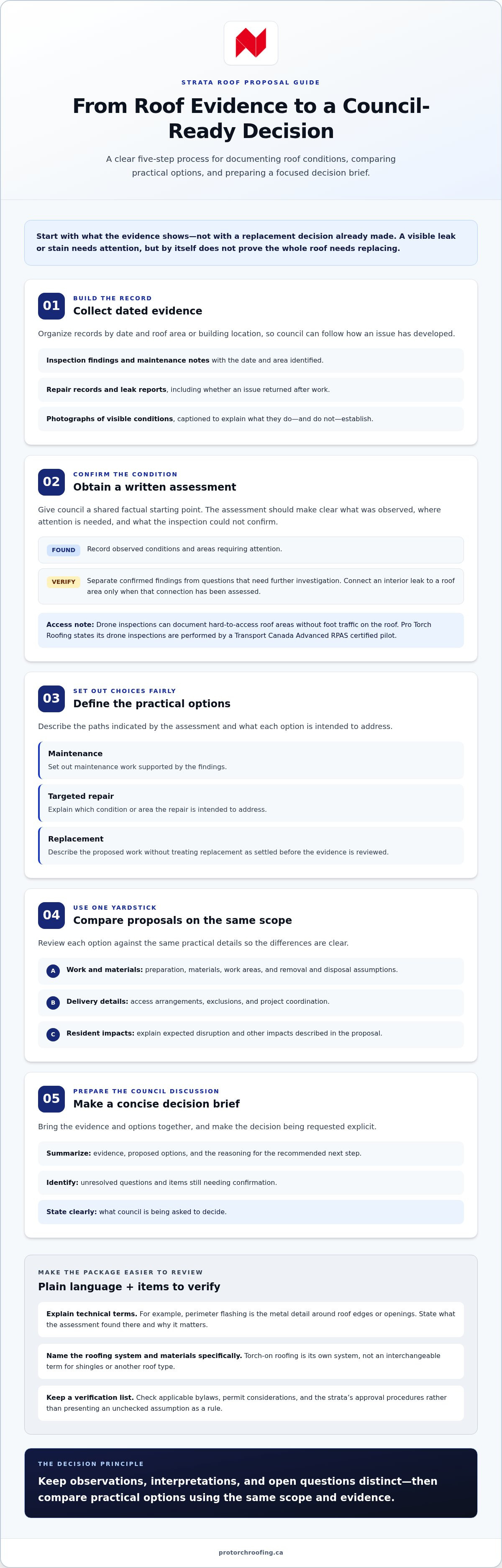
A useful roof proposal lets council trace the path from what’s known about the roof to the work being considered. Keep the package organized, concise, and clear about what still needs confirmation. This makes it easier to discuss each option on its merits without treating a recommendation as an automatic decision.
Build the decision package in order:
Collect the records.
Gather dated inspection notes, maintenance history, repair invoices, leak reports, and photographs. Label each item by roof area or building location where possible.
Obtain an assessment.
Request a written summary of observed conditions, areas requiring attention, and any limits to the inspection. Separate confirmed findings from items needing further investigation.
Define the options.
Set out the practical paths indicated by the findings, such as maintenance, targeted repair, or replacement. Explain what each option is intended to address.
Compare the scope.
Record proposed preparation, materials, work areas, access needs, disposal assumptions, exclusions, and resident impacts for each option.
Prepare a decision brief.
Summarize the evidence, options, recommended next step, unresolved questions, and the decision council is being asked to make.
What belongs in a roof project decision package?
Include inspection documentation, a plain-language condition summary, the recommended work, and the reasoning behind it. If a proposal uses terms such as perimeter flashing, explain that it refers to the metal detail around roof edges or openings. Then state what the assessment found there and why it matters. Describe the proposed roofing system and materials specifically. Torch-on roofing, for example, is its own system, not an interchangeable term for shingles or another roof type.
Keep a short list of items to verify, including applicable bylaws, permit considerations, and the strata’s approval procedures. This helps council identify what needs confirmation before work proceeds, without presenting an unchecked assumption as a rule.
How to make contractor proposals easier to compare
Compare proposals against the same scope. Review preparation, removal and disposal, access arrangements, work areas, exclusions, project coordination, and how resident impacts will be communicated. Note whether documentation is provided for council review and whether work can be scheduled in phases. If one estimate includes an item another excludes, flag the difference rather than comparing totals as though the scopes match.
Itemised written estimates make proposals easier to compare because council can see what work is included, what is excluded, and where scopes differ. Pro Torch Roofing provides free, itemised written estimates and written documentation for strata approvals. For more context on the system, the guide Torch-On Roofing in Vancouver & Burnaby: The Ultimate 2026 Guide explains torch-on roofing in more detail. To add a project estimate to your council package, you can request a roofing estimate.
Compare Roof Repair and Replacement Without Prejudging the Decision
A fair comparison starts with the same inspection findings, not a preference for repair or replacement. A leak near one roof detail may call for a focused repair, while recurring issues across several areas may justify assessing the roof system as a whole. Neither condition alone settles the decision. Council needs to understand how each scope responds to the documented evidence, what it leaves unresolved, and what follow-up may be needed.
For owners considering how to convince strata council on new roof West Vancouver, a side-by-side review can keep the discussion balanced. Use the same criteria for both options:
Condition addressed
Identify the specific defect or broader concern each option is intended to address.
Proposed scope
Describe the roof areas and details included, along with exclusions or assumptions.
Supporting evidence
Connect the work to dated inspection findings, repair records, and relevant photographs.
Resident disruption
Explain access requirements and expected impacts based on the proposed work plan. Don’t assume both scopes affect residents in the same way.
Future review
State what should be monitored or reassessed after the work, and what uncertainties remain.
When should the council assess repair instead of replacement?
A professional condition assessment can help distinguish a localized issue from concerns affecting more of the roof system. Compare the proposed repair area with previous repairs and inspection notes. If the same location has needed attention repeatedly, include that history for review. It’s relevant evidence, but not proof by itself that replacement is necessary. A repair scope should identify the defect it addresses and any related areas it excludes. Avoid promising that a repair will resolve every roof concern or assigning a lifespan without supporting evidence.
How to evaluate a proposed replacement system
Assess whether the proposed system and scope respond to the building’s documented needs, including the roof areas and details identified for work. For example, 2-ply torch-on roofing uses reinforced base and cap sheets made with rubberized bitumen, fiberglass, and polyester. Evaluate its proposed use in relation to the roof assessment and project scope, rather than treating it as a universal answer. Pro Torch Roofing provides roof repair and replacement services for strata projects.
For broader project and material context, consult the existing West Vancouver strata replacement guide. Then compare itemised estimates using matching work descriptions. Pro Torch Roofing’s free, itemised written estimates help council see how proposed scopes differ without relying on unsupported cost assumptions. The aim is a documented decision based on building condition, defined work, and clear remaining questions.
Present the Proposal and Address Common Strata Council Concerns
A short, structured presentation helps council focus on the decision instead of getting lost in roofing terminology. Open with the condition findings, then summarize the options and the evidence behind them. State your recommendation, explain resident impacts, and finish by naming the decision you’re asking council to make, such as approving further assessment or reviewing a defined project scope.
Keep the presentation focused on six points:
Condition
What the assessment observed and where.
Options
Which repair or replacement approaches are being considered.
Recommendation
Why the proposed next step fits the findings.
Documentation
Which inspection records, photographs, and estimates support the discussion.
Resident impacts
What access, noise, or coordination may be involved.
Requested decision
What council should decide now, and what can wait for more information.
Concerns about postponing work, trying repairs first, disruption, or funding deserve direct answers, not pressure. For postponement, explain what the assessment says about monitoring or further review. For a repair-first request, show how the proposed scope relates to the documented condition and history. For funding questions, present the written scope and estimate so owners can discuss the actual work under consideration. Don’t suggest a particular funding or approval route is required unless the strata has verified its procedures.
How to respond when owners question the need
Return to the records. Identify what’s directly observed, what the roofing professional recommends, and what remains uncertain. If a photograph shows a visible defect but doesn’t establish its full extent, say so. Then name the next step that could answer the open question, such as additional assessment or clearer scope documentation. This measured approach helps owners evaluate the evidence without relying on unverified depreciation-report claims or regulatory deadlines to create urgency.
How to make project logistics easier to accept
Explain how phased scheduling can organize roofing work and communication across the property. A practical resident plan can identify how access will be coordinated, where work is expected, how schedule updates will be shared, and where residents can direct questions. Describe impacts based on the proposed scope, not as guarantees. If details are still being planned, mark them as open items in the project plan rather than guessing at dates or disruption levels.
Before presenting the proposal, verify the strata’s current approval procedures and any applicable local requirements. Don’t assume a voting threshold or permit rule applies without checking the relevant documents and authorities. For owners asking how to convince strata council on new roof West Vancouver, this distinction matters: the presentation can support an informed discussion, but the strata’s verified process determines how it proceeds.
Pro Torch Roofing provides written documentation and phased scheduling for strata projects, helping councils organize project decisions and resident communication. A free, itemised roof estimate can give your discussion a clearly defined project scope.
Move from Council Approval to a Planned West Vancouver Roof Project
Council approval marks the transition from evaluating options to organizing the work. Keep the handoff clear: document the roof condition, compare suitable scopes, present the evidence, record the decision, and use the approved scope to plan the project. This sequence gives council and owners a written reference for what was decided and helps keep the work plan aligned with the proposal they reviewed.
What happens after the council decides to proceed?
Start by aligning the approved scope with the written project documentation. Confirm which roof areas and details are included, what work is excluded, and which questions remain open. Then coordinate the project plan around access, work areas, resident notices, and the sequence of tasks. Set the schedule according to the project and its conditions rather than assuming an unverified start date.
Clear communication matters once planning begins. Owners should know how access will be coordinated, where updates will be shared, and how questions can be raised. If the work is phased, explain which areas are planned for each phase and how the sequence will be communicated. A written plan gives the strata a consistent basis for updates as coordination develops.
Pro Torch Roofing provides strata roof work, including flat roof replacement, 2-ply torch-on roofing, repairs, and waterproofing. Reviewing these services alongside the approved scope helps council connect its decision to the work being planned.
How Pro Torch Roofing supports strata roof planning
With more than 25 years of local roofing experience serving Vancouver and West Vancouver, Pro Torch Roofing supports strata planning with written documentation for council approvals and phased scheduling. These tools help organize project information and resident communication; they don’t replace the strata’s own approval records or decisions. A free, itemised written estimate can clarify the proposed work by separating scope components, making it easier to review the estimate alongside the approved plan.
For councils working through how to convince strata council on new roof West Vancouver, a well-documented handoff carries the original evidence and decision into project planning. Keep the assessment, approved scope, estimate, and communication plan together so council can refer to the same information as coordination proceeds.
If your council is ready to discuss a West Vancouver roof project, request a free, itemised roof estimate to clarify the proposed scope and next steps.
Give Your Strata Roof Decision a Clear Next Step
A council discussion doesn’t have to resolve every project detail at once. A useful outcome is a clear next step, whether that means gathering more information, refining the proposed scope, or moving into project planning. Recording what was decided, what remains open, and who will follow up helps keep the process steady after the meeting.
If you’re working out how to convince strata council on new roof West Vancouver, focus on making the decision easier to understand and act on. Keep the conversation grounded in the building’s needs, give owners room to raise practical concerns, and let documented information guide what happens next. A calm, well-organized process can help the strata move forward with greater confidence.
When your council is ready to discuss a roof project, request a free, itemised roof estimate to clarify the proposed work and next steps.
Frequently Asked Questions
How do I convince a strata council that a roof needs replacement?
Show why replacement deserves consideration, then ask council to evaluate the evidence rather than accept a conclusion on trust. For how to convince strata council on new roof West Vancouver, connect the reported problem to its location, history, and professional assessment. Be clear about what’s confirmed and what needs further review. A focused request, such as permission to compare defined repair and replacement scopes, can make the discussion easier to advance.
What evidence should I present to my strata council about a roof?
Bring records that help council follow the issue from its first report to its current status. A leak log can identify the date, affected unit or area, and any repair completed. Pair it with inspection notes, photographs, and maintenance records. If an interior stain is being linked to a roof defect, distinguish that suspected connection from a cause confirmed through assessment. This helps owners see what the documentation establishes and where uncertainty remains.
Can a strata council repair a roof instead of replacing it?
Yes. Repair can be considered if an assessment supports a defined scope for the roof’s condition. Ask that the scope identify the area being addressed and how the strata will determine whether the work resolved the observed issue. For example, a recurring leak near a roof penetration may require attention to both the reported symptom and the relevant roof detail. Don’t treat a repair as a permanent solution unless the evidence supports that conclusion.
How does a strata council approve a new roof in British Columbia?
The process depends on the strata’s governing documents, the proposed work, and how it will be funded. Council should review the current requirements under British Columbia’s Strata Property Act and regulations, along with the strata’s bylaws and applicable meeting procedures, before deciding how approval must be obtained. Don’t assume a particular vote threshold applies. Record the decision and approved scope in the appropriate strata records, following the verified process.
What happens if strata owners disagree about a roof replacement?
Disagreement doesn’t automatically settle whether repair or replacement is appropriate. Identify the specific concern, such as the proposed scope, timing, disruption, or funding, and respond with relevant records or a clearly stated follow-up question. Make sure meeting notes capture the decision and unresolved issues. If owners dispute the strata’s authority or approval procedure, consult the governing documents and obtain appropriate strata or legal guidance before proceeding.
How can a strata council compare roofing proposals fairly?
Compare proposals against one written scope and flag differences before weighing recommendations. Look for variations in roof areas, preparation, materials, disposal, access, exclusions, and coordination. If one proposal includes work another leaves out, record that gap rather than treating the figures as direct equivalents. Council can then decide whether it has enough consistent information to choose an option or needs a revised scope for a fair comparison.
Can a drone roof inspection help document a strata building’s roof?
Yes. A drone inspection can document visible roof areas that are difficult to access without ladder access or foot traffic on the roof. The images can help council review locations and track visible conditions over time. Drone imagery doesn’t automatically reveal concealed damage or determine the full repair scope, so interpret it alongside relevant records and professional assessment. Pro Torch Roofing’s drone inspections are performed by a Transport Canada Advanced RPAS certified pilot.
