

Flat Roof Drainage Solutions Vancouver: The 2026 Property Owner’s Guide
Did you know that an estimated 25% of commercial flat roof failures in the Lower Mainland are directly caused by inadequate drainage rather than the quality of the roofing membrane itself? You've likely felt that familiar sense of anxiety during a heavy storm, wondering if the "rooftop swamp" above your head will lead to structural damage or if the weight of wet snow, which can reach 20 pounds per cubic foot in Vancouver, is compromising your building's safety. It's frustrating to deal with recurring leaks despite minor repairs, especially when you simply want the peace of mind that your investment is secure.
In this guide, you'll discover the most effective flat roof drainage solutions Vancouver property owners are using to eliminate ponding water and protect their structural integrity. We'll show you how to maintain a dry roof deck even after a severe "Pineapple Express" storm while reducing your maintenance costs for the next 20 years. We'll also preview the latest 2026 updates to the Vancouver Building By-law and the RCABC Roofing Practices Manual, ensuring your drainage system is engineered specifically for British Columbia's unique climate and current regulatory standards.
Key Takeaways
• Understand the "dog year" effect where standing water accelerates the aging of SBS torch-on membranes and how to prevent premature structural decay.
• Identify the most effective flat roof drainage solutions Vancouver property owners can implement based on their building’s specific footprint and parapet design.
• Learn how tapered polyiso insulation creates a positive pitch to eliminate ponding water without requiring major structural changes to your roof deck.
• Prepare for the "Pineapple Express" season by prioritizing October maintenance to clear local debris like cedar needles and maple leaves from your drainage system.
• Discover why custom-fabricated sheet metal scuppers and flashing provide a more secure, waterproof seal than off-the-shelf components in our coastal environment.
The Physics of Failure: Why Flat Roof Drainage Matters in Vancouver
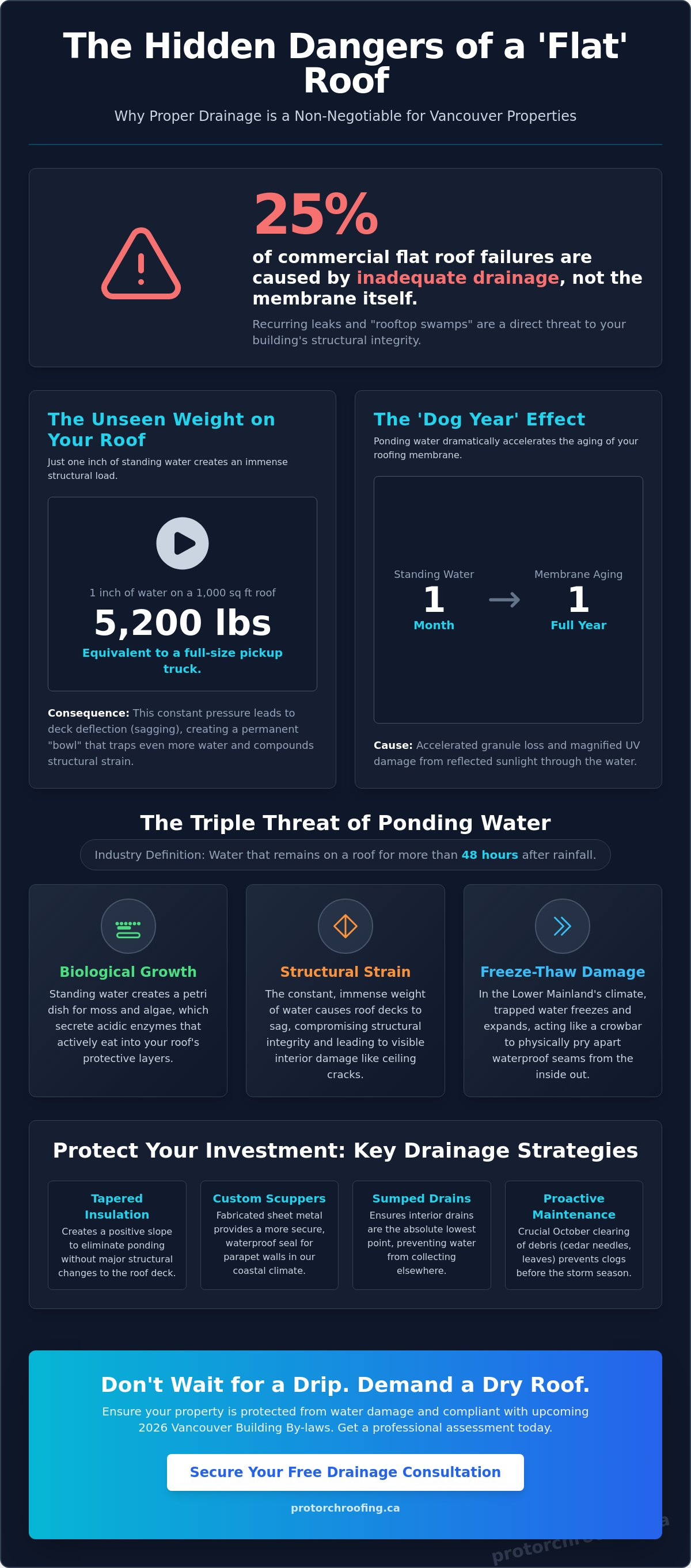
Vancouver receives an average of 1,153 millimeters of rain annually. During a "Pineapple Express" storm, our city can see months of precipitation fall in a single weekend. When your existing drains are overwhelmed, water accumulates rapidly. Understanding The Physics of Failure: Why Flat Roof Drainage Matters is the first step in protecting your property. Without professional flat roof drainage solutions Vancouver systems, this volume of water creates a "Dog Year" effect on your SBS torch-on membranes. Just as one human year equals seven for a dog, one month of standing water can age a membrane by a full year through accelerated granule loss and UV magnification.
Consider the sheer weight involved. One inch of water on a 1,000 square foot roof weighs approximately 5,200 pounds. That's the equivalent of parking a full size pickup truck on your roof deck. Over time, this constant pressure leads to deck deflection, where the wood or steel structure begins to sag. This creates a permanent bowl that collects even more water, compounding the structural strain. In the Lower Mainland, our freeze-thaw cycles make this worse. Trapped water in seams expands as it turns to ice, physically prying apart the waterproof layers of your system.
The Danger of Ponding Water
Industry standards define ponding as water that remains on a roof surface for more than 48 hours after a rainfall event. This standing water acts as a petri dish for biological growth. Moss and algae thrive in these conditions, secreting acidic enzymes that slowly eat into the protective bitumen layers of your roof. Ponding water is the primary catalyst for premature flat roof failure. Once these biological organisms take root, they trap moisture against the membrane even during dry spells, ensuring the decay continues year-round.
Structural Load and Safety
Chronic drainage failure often manifests as visible sagging in your ceiling or persistent interior mould growth, particularly in older Burnaby homes where roof decks have settled over decades. If you notice water pooling around the perimeter rather than flowing toward the scuppers, your structural integrity may already be compromised. Insurance companies are increasingly diligent during leak claims. They often scrutinize maintenance records to see if the property owner addressed known ponding issues. Investing in reliable flat roof drainage solutions Vancouver ensures you remain compliant with the 2026 building by-laws while keeping your insurance coverage secure.
Comparing the 3 Main Flat Roof Drainage Solutions
Selecting flat roof drainage solutions Vancouver property owners can trust involves analyzing your building's footprint and parapet configuration. For most commercial and residential buildings in the Lower Mainland, the goal is to create a system that works in tandem with high-quality waterproofing. Integrating these systems with a robust torch on roofing membrane is vital for a seamless transition where the roof meets the drain. Choosing a system that lacks this synergy often results in perimeter leaks during the first major storm of the season.
Interior Roof Drains
Interior drains are the primary choice for large commercial footprints in Vancouver and North Vancouver. These systems utilize a network of pipes located beneath the roof deck to channel water toward the city's storm sewers. A critical step in our installation process is "sumping" the drain. This involves creating a slight depression in the insulation around the drain assembly. This ensures the drain remains the absolute lowest point on the roof deck, preventing the ponding issues that compromise structural integrity over time.
Gutter Systems and Scuppers
If your building features parapet walls, scuppers act as essential "safety valves." These are specialized openings cut through the parapet that allow water to exit the roof surface directly into an external downspout. For smaller residential flat roofs without parapets, external gutters remain a standard and effective choice. If you have an existing system, regular gutter repair is necessary to prevent clogs from coastal debris like cedar needles and maple leaves.
Drainage Comparison Framework
| System Type | Maintenance Level | Ideal Building Size |
|---|---|---|
| Interior Drains | High (Requires pipe clearing) | Large Commercial |
| Scuppers | Low (Simple visual check) | Medium with Parapets |
| External Gutters | Moderate (Seasonal cleaning) | Small Residential |
Modern BC Building Code requirements now mandate overflow drains for many new builds. These secondary drains sit slightly higher than the primary ones to prevent structural failure if the main drain becomes blocked. Determining the right capacity requires precise "catchment area" calculations, which measure the total surface area and peak rainfall intensity for our region. Scuppers are often the most reliable secondary flat roof drainage solutions Vancouver for Burnaby properties because they're virtually impossible to clog completely. Implementing proper Maintenance Strategies for Vancouver’s Storm Season will help you evaluate which system offers the best long-term return on investment. If you're unsure about your current setup, a professional drainage assessment can provide the clarity you need to protect your property.
Tapered Insulation: Solving Ponding Without Structural Changes
Many older properties across the Lower Mainland suffer from settled roof decks that have lost their original slope over decades of service. Tapered insulation is the most cost-effective way to correct "dead flat" roofs without the high expense of structural reconstruction. By utilizing rigid polyisocyanurate (polyiso) panels manufactured with a built-in slope, we create a "positive pitch" on a perfectly flat surface. This remains one of the most dependable flat roof drainage solutions Vancouver owners can implement to ensure water travels toward drains rather than stagnating in the center of the deck.
When you're planning commercial roofing Vancouver upgrades, a tapered system provides a dual benefit. It solves chronic ponding while significantly boosting your building's energy efficiency. Current 2026 standards for Metro Vancouver recommend an effective thermal resistance of R-50 to R-60 for optimal performance. Because tapered insulation adds thickness to your roof assembly, it helps meet these stringent R-value requirements while protecting your structural integrity from water weight.
The Mechanics of Positive Pitch
The industry standard for effective drainage is a minimum slope of 1/4-inch per foot. While some historical designs utilized a 1/8-inch slope, Vancouver’s heavy rainfall necessitates the 1/4-inch rule to prevent water from lingering. Tapered systems are engineered using a series of panels that increase in thickness to maintain a consistent grade. This design ensures that even after a heavy storm, your roof deck returns to a dry state within the critical 48-hour window.
The "Cricket" System
We also utilize specialized components known as "crickets." These are smaller, diamond-shaped tapered sections installed behind large roof penetrations such as chimneys, skylights, or HVAC units. Without crickets, water tends to dam up against these obstacles, which is a leading cause of seam failure in SBS membranes. By diverting water around these units, we eliminate the primary source of leaks found in complex commercial and residential flat roofs.
Design and Installation
A successful installation requires a comprehensive professional drainage plan before the first panel is laid. Our team maps out the entire roof surface to ensure water flows directly toward primary drains or scuppers without interruption. Precision during this phase is vital to preventing "backwater" situations. These occur when water becomes trapped behind insulation joints due to poor layout or improper sealing. As a local British Columbia business, we use custom layouts designed for our specific coastal weather, ensuring every panel transition is smooth and every seam is fully protected by the final waterproofing layer.
Maintenance Strategies for Vancouver’s Storm Season
October is the most critical month for property owners in the Lower Mainland. It marks the transition into our heavy rain season, providing a final window to ensure your flat roof drainage solutions Vancouver systems are clear. Preparing now prevents the "clog-leak" cycle that plagues many commercial buildings. A simple $50 cleaning to remove accumulated debris often prevents a $5,000 interior repair caused by a sudden backup during a midnight storm. For a complete seasonal checklist, refer to our roof maintenance guide.
Properties in Burnaby and West Vancouver face unique challenges from heavy tree canopies. Cedar needles are particularly notorious because they form dense, felt-like mats that bypass standard plastic strainers. Maple leaves act like a vacuum seal over a scupper during a heavy downpour, causing water to rise rapidly. Regular clearing ensures your primary drainage remains functional when you need it most. We recommend a full inspection after every major windstorm to clear any new obstructions that could lead to ponding.
Clearing Drains and Scuppers
Drain strainers are your first line of defense, but they require frequent monitoring. Look closely at the membrane around the drain flange for signs of "alligatoring." This pattern of small cracks resembling reptile skin indicates the bitumen is aging and prone to failure under the pressure of standing water. To enhance protection, we often install custom-fabricated metal screens. These provide a more durable barrier against debris than standard off-the-shelf plastic versions, which often crack after a single freeze-thaw cycle.
Professional vs. DIY Inspections
When performing a visual check, look for blistering, seam separation, or "soft spots" near your drainage points. Soft spots are a major red flag; they suggest water has already penetrated the insulation layers. Be careful during the winter months. Walking on a flat roof in freezing temperatures can damage the SBS membrane, as the material becomes less flexible and more prone to cracking under foot traffic. If you identify any of these issues, seeking roof repair Burnaby services immediately is the best way to prevent total system failure. Don't wait for the next "Pineapple Express" to test your roof's integrity. Schedule a professional roof assessment today to secure your property for the season ahead.
Custom Metal and Torch-On Integration: The Pro Torch Advantage
Off-the-shelf drainage components are designed for general use, but they often fail in the high-wind coastal environments of the Pacific Northwest. These generic parts don't account for the specific thermal expansion or the intense precipitation rates we experience in British Columbia. When a drainage component doesn't fit perfectly, it creates a weak point where water can bypass the membrane. Our approach to flat roof drainage solutions Vancouver relies on precision fabrication to eliminate these vulnerabilities before they ever reach your job site.
Our 25-year history of protecting local properties has taught us that a roof is only as strong as its weakest penetration. Whether it's a complex commercial deck or a residential torch-on system, the transition between the waterproofing membrane and the metal drainage hardware must be absolute. We focus on engineered reliability, moving away from temporary fixes to provide property owners with long-term security and structural health.
Bespoke Sheet Metal Solutions
Every building has its own architectural quirks, especially in older West Vancouver homes where parapet widths vary significantly from modern standards. We don't rely on pre-made scuppers that require excessive caulking to stay watertight. Instead, our Burnaby shop creates custom-sized scuppers and perimeter flashing tailored to your building’s exact dimensions. Pro Torch’s in-house metal shop is a key differentiator for quality control, allowing our technicians to oversee the craftsmanship of every component. We utilize heavy-gauge metal for high-traffic commercial drainage areas, ensuring the hardware won't crush or deform under the weight of maintenance traffic or heavy snow loads.
Ensuring Long-Term Waterproofing
The most technical part of any installation is the "tie-in," which is the point where the SBS membrane meets the metal drain flange. If this connection isn't handled with expertise, the different expansion rates of bitumen and metal will eventually cause a separation. We utilize a methodical multi-layer torch-on approach around every drainage penetration to ensure a monolithic seal. By perfectly fusing the membrane to the custom metal flange, we create a transition that remains flexible and waterproof through decades of freeze-thaw cycles.
We prioritize your peace of mind through transparent communication and technical discipline. You shouldn't have to guess if your roof is ready for the next storm. Our team provides the specialized regional knowledge required to keep your investment dry and secure. If you're concerned about ponding or aging components, request a professional drainage assessment for your flat roof today. We'll provide a clear, technical remedy that ensures your flat roof drainage solutions Vancouver are built to last.
Secure Your Property Against the Next Vancouver Storm
Managing coastal rainfall requires more than just a standard drain. It demands a system where precision-engineered metal components and high-quality SBS membranes work in perfect unison. By prioritizing seasonal maintenance and considering advanced upgrades like tapered insulation, you protect your building from the structural strain of ponding water. You've seen how professional flat roof drainage solutions Vancouver systems prevent the accelerated aging of your roof deck, ensuring your investment remains secure for decades.
At Pro Torch Roofing, we bring over 25 years of local experience to every project. Our family-owned and operated team in Burnaby utilizes our in-house custom sheet metal fabrication shop to create components that fit your roof's unique dimensions perfectly. This commitment to craftsmanship and transparent communication provides the peace of mind you deserve. Get a Professional Flat Roof Drainage Assessment from Pro Torch Roofing to ensure your property is ready for whatever the 2026 storm season brings. Your roof is your first line of defense; let's make sure it's engineered to last.
Frequently Asked Questions
How much slope does a flat roof need for proper drainage in Vancouver?
A flat roof requires a minimum slope of 1/4 inch per foot to ensure water moves effectively toward drains. While some older structures were built with an 1/8 inch slope, the 2026 RCABC Roofing Practices Manual emphasizes the 1/4 inch standard to combat Vancouver's high rainfall volume. This positive pitch prevents the ponding water that leads to membrane fatigue and structural deflection over time.
Can I add new drains to an existing flat roof without replacing the whole system?
You can often add new drains or scuppers to an existing system, provided the current membrane is in good health. This process involves cutting into the roof deck and professionally tying the new drain flange into the existing SBS membrane. It's a common remedy for older buildings where the roof deck has settled, creating new low spots that weren't present during the original installation.
What is the best way to stop water from pooling around my skylights?
Installing a cricket system is the most effective way to divert water away from skylights and other large roof penetrations. Crickets are small, diamond-shaped tapered insulation sections that create a secondary slope. These divert water around the obstacle and toward the main drainage path. Without them, water often dams against the skylight curb, which is a primary cause of many flat roof failures in our region.
Are scuppers or interior drains better for a commercial building in Burnaby?
The choice depends on your building's structural design and parapet configuration. Interior drains are typically better for large commercial footprints because they move water through the center of the building. However, scuppers are excellent safety valves for buildings with perimeter parapet walls. In Burnaby, many property owners utilize both to ensure flat roof drainage solutions Vancouver standards are met, providing a redundant path for heavy rainwater.
How often should I clean my flat roof drains in the Lower Mainland?
You should clean your drains at least twice a year, ideally in late spring and mid-October before the heavy rain season begins. Properties near heavy tree canopies, such as those in West Vancouver, may require more frequent clearing to manage cedar needles and maple leaves. Checking your drain strainers after a major windstorm is a proactive way to prevent the clog-leak cycle that causes sudden interior damage.
What happens if my flat roof drainage system freezes during a cold snap?
When a drainage system freezes, it can lead to ice dam formation and significant water backup once the thaw begins. Trapped water that turns to ice expands by approximately 9%, which can physically pry apart the seams of your roofing membrane or crack plastic drain components. Utilizing custom-fabricated metal drains and ensuring proper insulation helps mitigate these risks during Vancouver's occasional freeze-thaw cycles.
Does tapered insulation help with my energy bills as well as drainage?
Tapered insulation provides a dual benefit by correcting drainage issues and increasing your building's thermal resistance. By adding layers of polyiso insulation to create a slope, you also improve the overall R-value of the roof assembly. This helps your property meet the 2026 Metro Vancouver requirement of R-40 to R-60, leading to lower heating and cooling costs while keeping the roof deck dry.
Why is water still sitting on my roof after I just had it repaired?
Water often remains on a roof after a repair if the underlying structural deflection wasn't addressed. A simple patch fixes a leak, but it doesn't solve the bowl effect caused by a sagging roof deck. If ponding persists for more than 48 hours, you likely need a more comprehensive flat roof drainage solutions Vancouver assessment to determine if tapered insulation or additional drains are required to restore a positive pitch.
