

Flat Roof Drainage Solutions in West Vancouver: Protecting Your Property from Coastal Rain
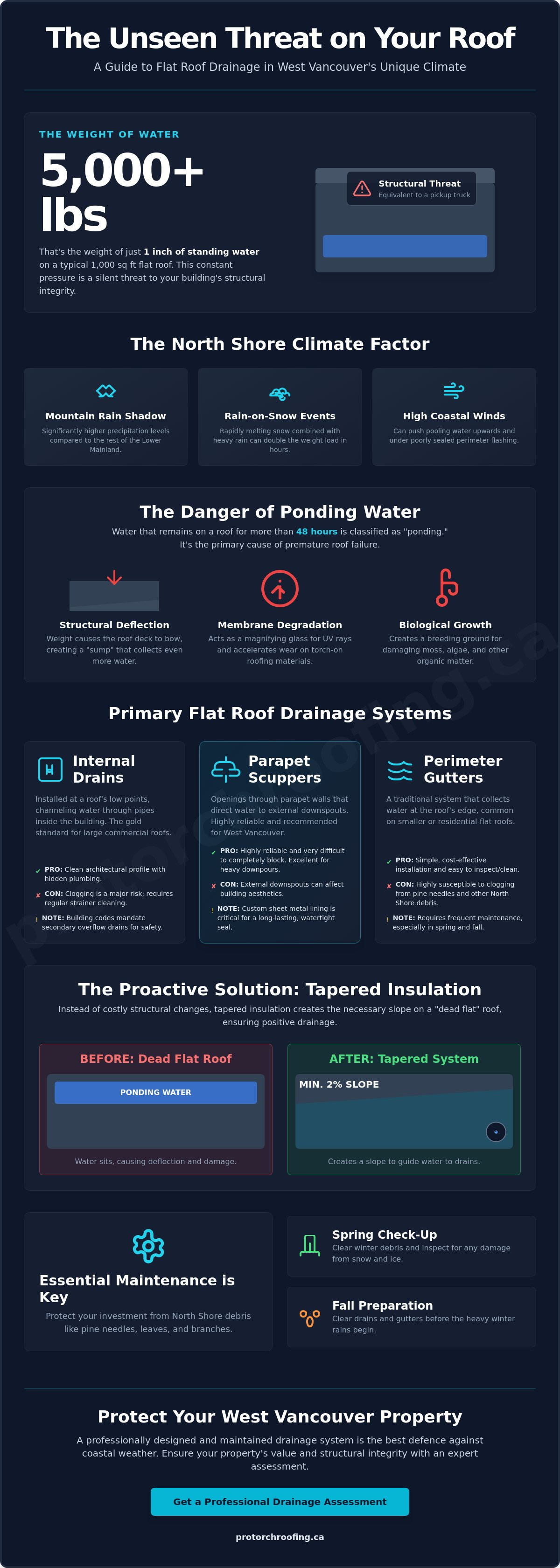
Did you know that just one inch of standing water on a 1,000-square-foot flat roof weighs over 5,000 pounds? In a climate as wet as the North Shore, that weight isn't just a number; it's a constant threat to your home's structural integrity. Finding the right flat roof drainage solutions West Vancouver property owners can rely on is the difference between a secure investment and a recurring cycle of leaks and repairs.
At Pro Torch Roofing, we understand the stress that heavy coastal rain causes for local homeowners and businesses. You'll discover the most effective drainage systems and expert strategies to eliminate ponding water and protect your West Vancouver flat roof from the elements. We'll explore how a hybrid approach using tapered insulation and custom sheet metal scuppers ensures your system meets District of West Vancouver requirements. This guide also details how professional torch-on roofing and waterproofing upgrades can increase your property value while significantly reducing your maintenance frequency.
Key Takeaways
• Understand why West Vancouver's extreme rainfall requires a drainage system capable of removing all surface water within 48 hours to protect your building's structural integrity.
• Compare internal drains, scuppers, and gutters to determine the best flat roof drainage solutions West Vancouver properties require for reliable coastal performance.
• Learn how tapered insulation systems fix ponding water on "dead flat" roofs by creating a necessary slope without the high cost of structural reconstruction.
• Identify how to protect your roof from North Shore debris like pine needles by implementing a bi-annual maintenance plan every spring and fall.
• Discover the advantage of using custom sheet metal for scuppers and flashing to ensure a precision fit and superior waterproofing for your torch-on roofing system.
Why Flat Roof Drainage is Critical for West Vancouver Properties
West Vancouver property owners face a unique environmental challenge. While the rest of the Lower Mainland deals with standard Pacific Northwest rain, the North Shore sits directly in a mountain rain shadow. This geographic position leads to significantly higher precipitation levels than our neighbours across the Burrard Inlet. For any building with a flat roof, the drainage system isn't just an accessory; it's a vital structural component. A functional system must move every drop of water off the membrane and into an approved outlet within 48 hours.
When water stays on the surface longer than two days, it's categorized as ponding. This standing water is a primary cause of premature membrane degradation. Over time, the weight of the water can cause structural deflection, which is a slight bowing of the roof deck. This creates a "sump" effect where even more water collects, worsening the structural strain. To prevent this, professional roofing standards require a minimum 2% slope, or a 1/4 inch drop per foot, to ensure gravity effectively clears the surface. Without this precision, your roof is essentially a shallow pond waiting to find a path into your home.
The North Shore Climate Factor
Living in the shadow of Cypress and Grouse Mountain means your home faces intense, localized weather patterns. Heavy winter snow loads are often followed by rapid rain-on-snow events, which can double the weight on your roof in a matter of hours. High coastal winds also play a role; they can push pooling water upward and under poorly designed perimeter flashing. This makes implementing robust flat roof drainage solutions West Vancouver properties can sustain a matter of long-term safety and security.
The Cost of Poor Drainage
Neglecting your drainage leads to accelerated wear on torch-on roofing systems. When water sits, it acts as a magnifying glass for UV rays and a breeding ground for biological growth like moss and algae. Beyond the membrane, poor drainage increases the risk of interior water damage and expensive mould remediation. For strata owners, these issues often show up in depreciation reports, which can lower property values and increase insurance premiums. Investing in effective flat roof drainage solutions West Vancouver experts recommend is a proactive way to maintain your building's structural integrity and your peace of mind.
Primary Flat Roof Drainage Systems: Drains vs. Scuppers vs. Gutters
Selecting the right flat roof drainage solutions West Vancouver homeowners need requires a technical understanding of how water behaves on a low-slope surface. While the goal is always to move water off the building as quickly as possible, the specific architecture of your property dictates which system is most effective. Most West Vancouver buildings utilize one of three primary methods: internal drains, scuppers, or perimeter gutters. In many cases, the most resilient protection comes from a hybrid system that combines these tools to create redundancy against the North Shore's heavy rainfall.
Internal Roof Drains: Pros and Cons
Internal drains are the gold standard for large commercial flat roofs and many modern residential estates. These drains are installed at the roof's lowest points, connected to a network of pipes that run through the building's interior. This keeps the drainage hardware hidden, maintaining a clean architectural profile. However, because the plumbing is internal, strict building codes require the installation of secondary overflow drains. These emergency outlets sit slightly higher than the primary drain; if the main line clogs with debris, the overflow prevents water from reaching a weight that could compromise structural integrity. Regular cleaning of the strainer basket is essential to keep these lines clear.
Parapet Scuppers and External Downspouts
Scuppers are openings cut directly through the parapet walls at the roof's edge. They allow water to exit the roof surface and flow into external downspouts or conductor heads. This system is highly reliable because it's much harder for a scupper to become completely blocked compared to a small drain pipe. For properties in areas like the British Properties, we often recommend wide-mouth scuppers to handle sudden, intense downpours. To ensure a watertight seal, we utilize custom sheet metal to line the scupper, creating a seamless transition between your torch-on membrane and the exterior wall.
Comparing Drainage Efficiency
Choosing between these systems involves balancing budget, maintenance capacity, and the specific needs of your roof deck. While gutters are common on smaller residential flat roofs where the deck extends past the walls, they often require the most frequent cleaning due to West Vancouver's heavy tree cover.
| System Type | Relative Cost | Maintenance Needs | Reliability | Aesthetic Impact |
|---|---|---|---|---|
| Internal Drains | High | Moderate | High | Minimal (Hidden) |
| Parapet Scuppers | Moderate | Low | Very High | Visible Hardware |
| Perimeter Gutters | Low | High | Moderate | Traditional Look |
Gravity-fed systems are standard for most residential applications, but larger commercial plazas may benefit from siphonic drainage, which uses vacuum pressure to pull water off the roof at high speeds. If your current system is struggling to keep up with the rain, a professional roof maintenance review can identify if a hybrid upgrade is necessary to protect your investment. Implementing effective flat roof drainage solutions West Vancouver property owners can trust often starts with ensuring your primary and secondary systems are perfectly synchronized.
Solving Ponding Water with Tapered Insulation Systems
Many older properties in West Vancouver suffer from "dead flat" roof designs. These structures were built without an inherent slope, leading to the massive water weight issues mentioned earlier. While you could technically rebuild the entire roof frame to create a slope, it's an invasive and prohibitively expensive process. Tapered insulation systems offer a smarter, more cost-effective alternative. This system utilizes sloped rigid foam boards installed directly beneath the roofing membrane to create a precise "false" slope that directs water toward your drains or scuppers.
As one of the most effective flat roof drainage solutions West Vancouver owners can implement, tapered insulation provides a dual benefit. Beyond solving ponding water, it significantly increases your building's R-value. This means your home or business stays warmer in the winter and cooler in the summer, reducing your monthly energy bills. To ensure total accuracy, Pro Torch Roofing designs custom taper layouts using advanced modeling to map out the exact flow of water across your unique roof deck. This precision ensures that every square inch of your roof contributes to efficient drainage.
The Engineering Behind the Slope
Creating a functional slope involves more than just laying down foam. We utilize specialized components known as "crickets" and "saddles." These are diamond-shaped or triangular sloped structures designed to divert water away from obstacles like skylights, chimneys, and HVAC units. By layering tapered EPS (Expanded Polystyrene) or Polyiso (Polyisocyanurate) boards, we can achieve a consistent 2% grade even on the flattest surfaces. This level of technical detail is a hallmark of high-quality commercial roofing Vancouver projects where large surface areas make water management a high-stakes engineering task.
Long-Term ROI of Tapered Systems
The financial argument for a tapered system is compelling. By eliminating standing water, you drastically reduce the frequency of roof repair burnaby calls and West Vancouver maintenance visits. Water is the primary catalyst for membrane failure; when you keep the surface dry, your torch-on system can easily reach its full 25 to 35-year lifespan. Additionally, the improved insulation helps protect the building's structural components from the thermal shock caused by rapid temperature changes. Investing in these advanced flat roof drainage solutions West Vancouver property owners trust is an investment in the long-term health and value of your real estate.
Maintenance Strategies for Coastal Drainage Systems
West Vancouver's lush, forested landscape is a major part of the community's charm, but it's also a primary adversary for your roof's health. The "Pine Needle Problem" is a specific challenge for properties situated near the mountain slopes. Unlike large leaves that sit on top of a drain, pine and hemlock needles are small and agile. They frequently slip through standard grates and collect inside the drain pipe, creating a dense, felt-like plug that can completely stop water flow. Implementing effective flat roof drainage solutions West Vancouver building owners can rely on requires a proactive approach to these unique environmental factors.
In our coastal climate, a bi-annual inspection schedule is non-negotiable. We recommend thorough cleanings in the late spring and early fall. This ensures your system is clear before the heavy winter rains arrive and again after the spring winds have blown debris onto your deck. Beyond debris, we often see moss and algae growth on North Shore roofs. These organisms act like a sponge, holding moisture against the membrane long after the rain has stopped. This constant moisture speeds up membrane degradation and can lead to biological rot in the underlying structural components.
A Seasonal Maintenance Checklist
A disciplined maintenance routine protects your structural integrity and keeps your warranty valid. During each inspection, you should focus on several key areas:
Clear all outlets
Remove debris from internal drain baskets, scuppers, and conductor heads to ensure unobstructed flow.
Inspect the membrane
Look for "alligatoring" or small cracks in the SBS membrane near drainage points where thermal stress is highest.
Evaluate external components
Check if you need professional gutter repair to fix sagging or leaking joints that could damage your building's envelope.
Verify overflow drains
Ensure secondary emergency drains are clear and sit at the correct height to prevent structural overloading.
Professional vs. DIY Maintenance
While a property manager or homeowner can safely clear surface debris from a ladder, a deep technical inspection requires specialized knowledge. A professional roof maintenance plan ensures that the critical seals between your torch-on membrane and the drainage hardware remain watertight. Pro Torch Roofing identifies "silent" failures, such as membrane separation at the drain flange or perimeter flashing, which aren't visible to the untrained eye but will eventually cause significant interior damage. If you haven't had your system inspected this season, you should contact Pro Torch Roofing for a professional assessment to ensure your property is ready for the next coastal storm.
Custom Drainage Solutions from Pro Torch Roofing
For over 25 years, Pro Torch Roofing has focused on engineering flat roof drainage solutions West Vancouver property owners can depend on. We recognize that a standard, one-size-fits-all approach doesn't work for the complex architecture found in the British Properties or our local coastal commercial hubs. Our identity as a local British Columbia business means we understand the specific pressures our environment places on building envelopes. To address these challenges, we operate an in-house custom sheet metal shop. This facility allows our technicians to manufacture bespoke scuppers, perimeter flashing, and gutters tailored to your roof’s exact specifications. By controlling the quality of these components from fabrication to installation, we ensure a level of structural integrity that protects your investment for decades.
Our professional approach is grounded in transparency and dependable communication. We don't believe in high-pressure sales; instead, we focus on providing a clear technical remedy for your roofing problems. When you choose Pro Torch, you aren't just getting a repair. You're getting a comprehensive drainage strategy designed to eliminate standing water and maximize the longevity of your roof. This methodical process provides the peace of mind that comes from knowing your home or business is shielded by the highest standards of professional craftsmanship.
Our Specialized Torch-On Expertise
We specialize in multi-layer SBS torch-on membranes because they are the superior choice for the North Shore's fluctuating temperatures. These membranes remain flexible during freeze-thaw cycles, preventing the cracks and brittle failures common in lesser materials. A critical part of our process is ensuring seamless transitions between the main roof field and the drainage outlets. We carefully integrate the membrane with custom-fitted drain flanges and scupper liners to create a unified, waterproof barrier. Our commitment to craftsmanship ensures that every drainage point is a fortress against moisture rather than a potential leak site. We are dedicated to providing superior craftsmanship and uncompromising structural integrity to ensure your property remains secure for years to come.
Ready to Secure Your West Vancouver Roof?
Taking the first step toward a leak-free property is simple. Our local roofing contractor burnaby team is equipped to serve the entire North Shore, bringing specialized regional knowledge to every project. We offer professional assessments that identify hidden drainage failures and provide logical, effective solutions tailored to your specific building. Don't wait for the next heavy coastal rainfall to test your roof's limits. Contact Pro Torch Roofing today for a flat roof drainage consultation.
Securing Your Building Against Coastal Rainfall
Protecting your property on the North Shore requires more than just a waterproof membrane; it demands a comprehensive strategy to manage the region's intense precipitation. By integrating tapered insulation systems to eliminate ponding water and utilizing custom sheet metal scuppers to handle local debris like pine needles, you ensure your roof remains functional for decades. These proactive flat roof drainage solutions West Vancouver homeowners trust are the foundation of long-term structural health and property value.
ProTorch Roofing brings over 25 years of local experience to every project. Our in-house custom sheet metal fabrication and specialized expertise in torch-on and tapered systems allow us to build drainage components that fit your property's unique architecture perfectly. We focus on providing a clear technical remedy that prioritizes your safety and peace of mind. Book Your West Vancouver Flat Roof Drainage Assessment today to ensure your building is prepared for the next coastal storm. Your home deserves the protection of a system designed specifically for the unique challenges of the West Vancouver climate.
Frequently Asked Questions
How much ponding water is normal on a flat roof after a West Vancouver storm?
Ponding water is only considered acceptable if it evaporates or drains completely within 48 hours of a rainfall. If standing water remains on your membrane beyond this window, it indicates a functional failure in your drainage system or an insufficient slope. Addressing these flat roof drainage solutions West Vancouver properties require early prevents the water from degrading your SBS membrane and causing structural deflection.
Can I add more drains to an existing flat roof without a full replacement?
Yes, it's often possible to add additional drainage points without a complete roof tear-off. We can frequently install new scuppers or secondary overflow drains during a targeted repair or a membrane restoration project. This is a practical way to improve water flow on older roofs that were originally under-engineered for the North Shore's intense coastal precipitation patterns.
What is the difference between a roof drain and a scupper?
A roof drain is an internal system where water enters a basin on the roof and travels through plumbing pipes located inside the building. In contrast, a scupper is an opening cut directly into the perimeter parapet wall that directs water to an external downspout. Scuppers are often preferred for their reliability and ease of maintenance in areas with high debris, like the British Properties.
How often should I clean the drains on my West Vancouver commercial building?
Commercial properties should have their drains professionally cleaned at least twice a year, typically in the late spring and early fall. If your building is located near the mountain slopes with heavy evergreen cover, quarterly maintenance is a safer approach. Regular clearing of the strainer baskets prevents the dense "pine needle plug" that often leads to catastrophic overflows and interior water damage.
Are tapered insulation systems worth the extra cost for residential flat roofs?
Tapered insulation is a highly effective investment because it solves the root cause of ponding water while simultaneously lowering your monthly energy bills. For residential owners, this means a significantly longer lifespan for your torch-on roofing and fewer emergency repair calls. It's often the most cost-effective way to achieve the required slope on an older, "dead flat" roof deck without structural reconstruction.
What happens if my flat roof drainage system fails during a heavy rainstorm?
A drainage failure during a storm can lead to rapid water accumulation, placing immense weight and stress on your building's structure. If your primary drains are blocked, water will rise until it reaches the emergency overflow drains. If those are also blocked or missing, the weight can cause the roof deck to deflect, eventually leading to serious structural failure or massive interior flooding.
How do I know if my roof has a 2% slope for proper drainage?
You can identify a lack of slope by looking for large, persistent puddles that remain 48 hours after a storm has passed. A professional assessment uses digital levels to confirm if your roof meets the 2% (1/4 inch per foot) industry standard for effective water shedding. Ensuring your flat roof drainage solutions West Vancouver system maintains this grade is critical for keeping the underlying structure dry and secure.
Does Pro Torch Roofing provide custom sheet metal for drainage repairs?
Yes, we operate a dedicated in-house custom sheet metal shop to support all our drainage and waterproofing projects. This allows us to fabricate bespoke scuppers, conductor heads, and perimeter flashing that provide a precision fit for your specific building. Custom metalwork ensures a watertight transition between your drainage hardware and the roofing membrane, which is essential for the long-term protection of your property.
