

What Happens If My Roofer Isn’t Insured in BC? Risks and Next Steps
What happens if my roofer isn't insured in BC and a worker gets hurt or my home is damaged? “Insured” can refer to different protections. WorkSafeBC coverage relates to workplace injuries, while commercial general liability insurance may respond to certain property damage or third-party claims, depending on the policy. If either is missing, you could face costs or complications, but the outcome depends on the circumstances and coverage involved.
It’s reasonable to want clarity before work starts, especially if roofing work is already underway or finished. This guide explains the difference between WorkSafeBC coverage and liability insurance, what a gap in either may mean, and which documents and status checks can help clarify a roofer’s coverage. You’ll also find practical next steps for an active project or after the work is complete, so you can document the situation and make informed decisions about your property.
Key Takeaways
• What happens if my roofer isn't insured in BC depends on the coverage gap and circumstances. Identify whether WorkSafeBC coverage, liability insurance, or both are in question.
• A WorkSafeBC clearance letter and a certificate of liability insurance can help clarify different details. Neither document establishes that every incident or loss is covered.
• Injury, accidental damage, and incomplete-work scenarios can raise different concerns. The facts and applicable coverage matter in each case.
• If work is underway, use a calm sequence: pause non-urgent work, gather documents, verify status, and keep a record of communications.
• A roofing assessment can help clarify roof condition and project scope. Insurance and liability questions require separate consideration.
What could happen if your roofer isn’t insured in BC?
“Uninsured” can mean different things, and it doesn’t automatically establish who would pay after an accident. First identify what’s missing: coverage for workplace injuries, insurance for damage to someone else’s property, or clear documentation of a policy’s status and scope. The answer to what happens if my roofer isn't insured in BC depends on the facts, contract terms, applicable policy wording, and current British Columbia rules.
Quick answer: If a roofer has no liability insurance, there may be no contractor policy to respond to certain claims involving accidental property damage or injury to a third party. If a roofer has no WorkSafeBC coverage, a worker injury raises separate workers’ compensation and legal questions. Neither gap alone determines who is responsible or guarantees how a claim will be handled.
Does “uninsured roofer” mean the same thing in every situation?
No. Liability insurance and WorkSafeBC coverage serve different purposes. Liability insurance may respond to covered third-party claims, subject to the policy’s terms and exclusions. WorkSafeBC relates to workplace injuries and compensation. One type of coverage doesn’t replace the other.
A policy might be absent, expired, limited in scope, or difficult to verify from the paperwork provided. Those situations aren’t identical. There may also be separate questions about subcontractors and the business that hired them. A document for one company doesn’t establish the coverage status of every crew member or business involved.
What concerns should BC property owners take seriously?
If roofing materials, tools, or work activity accidentally damage a vehicle, neighbouring property, or part of the home, an applicable liability policy could be relevant. If no such coverage applies, resolving the damage may be more difficult and could involve direct discussions, a dispute, or a claim through another route. The outcome depends on what caused the damage and the facts of the situation.
A worker injury is a different matter. It may raise questions about WorkSafeBC coverage, the work arrangement, and responsibilities under current BC rules. Don’t assume the homeowner is automatically liable, or automatically protected, based only on a roofer’s verbal assurance or a missing document.
There can also be practical disruption. A coverage concern or disagreement about responsibility may delay work, complicate repairs, or leave a roof exposed while the parties clarify what happened and how to proceed. Keep the contract, messages, records of work completed, and details of any incident or damage together. An insurance gap is a reason to establish the facts, not a legal conclusion by itself.
WorkSafeBC coverage vs. liability insurance: what each can mean
These documents answer different questions. WorkSafeBC coverage relates to workplace injuries and an employer’s account status. Commercial general liability insurance may respond to certain third-party claims involving injury or property damage. Neither document proves that every loss is covered. To understand what happens if my roofer isn't insured in BC, first identify which protection is in question and what the records show.
| Coverage or document | Typical question it helps answer | What it cannot prove |
|---|---|---|
| WorkSafeBC clearance letter | What does WorkSafeBC’s status check show for this business and period? | That the contractor has liability insurance or that a particular injury claim will be accepted. |
| Liability insurance certificate or policy information | What liability policy and insured business are identified for the stated dates? | That a specific incident, repair, or loss is covered. |
What does a WorkSafeBC clearance letter help establish?
A clearance letter is a status-check document from WorkSafeBC. It can help confirm whether a contractor has an account in good standing, including whether required premiums are up to date. WorkSafeBC provides an online clearance process, and its guidance for homeowners hiring someone to work at home explains why checking contractor status matters. Match the legal business identity and relevant work period to your project, since status can change. A clearance letter isn’t proof of liability insurance or a guarantee about a claim.
What does commercial general liability insurance address?
Commercial general liability is a separate policy category that may cover certain third-party claims, subject to the policy wording. A certificate can summarize coverage, but the policy itself determines the terms. Check which entity is insured, the policy dates and limits, and the stated project scope. Review any exclusions in the policy information. A policy may not respond to every leak, injury, or repair dispute, so don’t treat a certificate as a promise that a particular loss will be paid.
WorkSafeBC coverage and liability insurance aren’t interchangeable: one concerns workplace injury and account status, while the other may address covered third-party claims. A contractor, subcontractor, and hiring business may each raise separate questions about who is covered. WorkSafeBC also notes that, depending on the circumstances, a homeowner hiring someone may have responsibilities related to unpaid premiums. Review the facts and current guidance rather than drawing a legal conclusion from one document alone.
If a roofing concern has left you unsure about the roof’s condition or the work required, a professional assessment can help clarify the physical project scope. It won’t determine insurance coverage or legal responsibility.
How an insurance gap can affect a Burnaby or Vancouver roofing project
An insurance gap can affect more than a claim. It may create uncertainty about who to notify, how to document damage, or whether work can continue. The details matter, and a missing policy doesn’t mean a homeowner is automatically liable. For residential and commercial properties in Burnaby, Vancouver, West Vancouver, and North Vancouver, the contract, worker status, coverage documents, and circumstances can all inform the next steps.
Hypothetical scenario: a worker is injured
Imagine a roofing worker is hurt while working on a home in Burnaby or a commercial building in Vancouver. Which rules and processes apply may depend on the worker’s status, the work arrangement, and WorkSafeBC coverage. Don’t infer responsibility from the injury or an insurance gap alone. Preserve the contract, work dates, site communications, and incident records, then consult current WorkSafeBC guidance about the situation.
Hypothetical scenario: roofing work damages property
Suppose materials or tools damage a window, vehicle, or neighbouring property during a project. The roofer’s liability policy may respond only if the incident falls within its terms. The property owner’s own insurance is separate, and its coverage depends on that policy as well. Neither response is automatic.
Photograph visible damage promptly, noting when and where it occurred, and save relevant messages. Avoid disturbing the area or discarding damaged materials if they could help document what happened. Keep receipts and any repair assessments. These records can support discussions with the contractor or insurer, but they don’t guarantee reimbursement or determine responsibility.
Hypothetical scenario: work stops before the roof is complete
A dispute, missing documentation, or a contractor’s inability to continue could leave a roof partially completed. That may affect weather protection and the timing or scope of further work. Keep the written scope, approved changes, invoices, payment records, progress photos, and messages together. They can help show what was agreed, what was paid for, and which work remains, whether the property is a house or commercial building.
So, what happens if my roofer isn't insured in BC depends on the specific gap and events, not just the label “uninsured.” A homeowner isn’t automatically responsible whenever a contractor lacks coverage. Responsibility depends on the facts and applicable rules. Avoid making legal conclusions from a verbal assurance, a missing certificate, or an incomplete clearance record. A clear project file gives you a firmer basis for understanding what happened and deciding how to proceed.
What to do if your roofer lacks insurance coverage
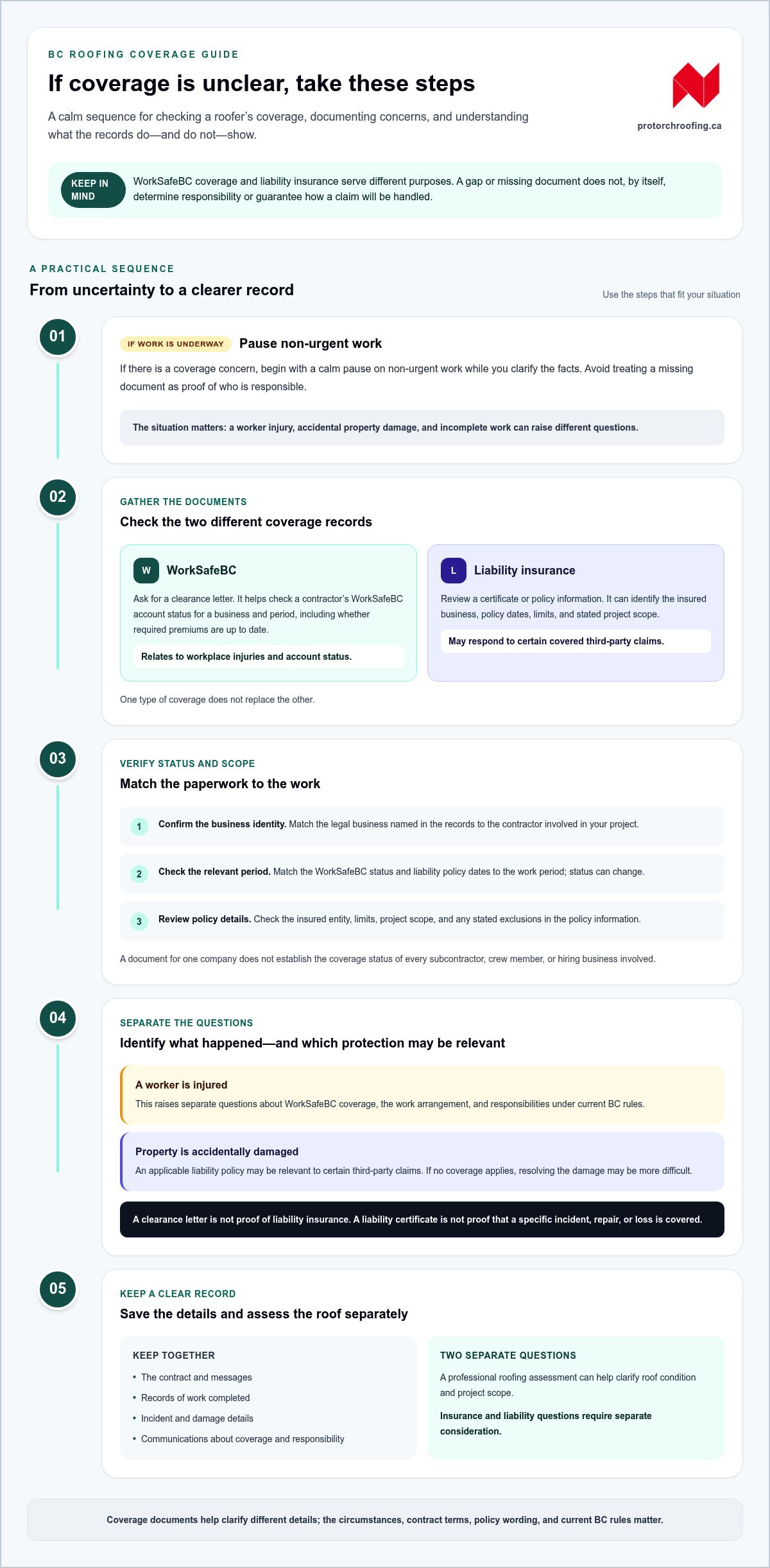
Start by identifying what’s unclear. A missing document doesn’t, by itself, prove that coverage has lapsed or determine who is responsible. If there’s no immediate safety risk, pause non-urgent work while you gather records and verify the details. If someone is in danger or damage is actively occurring, prioritize site safety and contact appropriate emergency assistance.
A practical document and status-check checklist
Work through these steps before deciding how to proceed:
Match business identities.
Record the contractor’s legal business name and compare it with the contract, invoices, WorkSafeBC records, and insurance documents. Note differences, including a subcontractor’s name.
Check WorkSafeBC status.
Use WorkSafeBC’s current official clearance process to check the relevant business and work period. A clearance letter is a status check, not proof of liability insurance or a guarantee about a claim.
Review insurance details.
Note the named insured, policy dates, stated limits, and described scope on the certificate or policy information. These details can help identify questions, but interpreting exclusions or deciding whether a loss is covered may require the insurer or qualified advice.
Keep a project record.
Save the written scope, changes, invoices, payment records, photos, and communications. Record dates and who provided each document or update.
Don’t draw a legal conclusion from a verbal assurance or a document that’s missing. If coverage, responsibility, or a claim is disputed, seek guidance from the relevant authority or a qualified legal or insurance professional.
If work has started or the roof is exposed
Document the current work status, site conditions, visible damage, and conversations, including dates. Before making abrupt changes, consider safe work sequencing and how the roof will be protected from weather. An exposed section may need prompt attention to limit further damage, but the appropriate next step depends on the roof and site conditions.
For background on evaluating a roofing contractor in the area, read our guidance on hiring a roofing contractor in Burnaby. If you’re concerned about roof condition or unfinished work, a professional assessment can help clarify the physical condition and project scope. It won’t determine insurance coverage or legal responsibility.
To discuss a roofing concern or arrange an assessment, request a roofing assessment.
How to move forward with a roofing project in the Lower Mainland
A coverage concern doesn’t have to leave you guessing about the roof itself. Keep two questions separate: what coverage can be verified, and what work does the building need? Identify the gap, check the relevant status and documents, keep a clear record, then decide on next steps based on the facts. That approach helps you address what happens if my roofer isn't insured in BC without treating an insurance question as a roofing diagnosis or legal conclusion.
What a roofing assessment can clarify
A professional assessment can examine the roof’s visible condition, signs of damage, and the scope of repair or replacement work that may be appropriate. For a flat roof, the assessment can consider the roofing surface, membrane condition, and visible details that may affect the work plan. Pro Torch Roofing provides roofing and repair services for residential and commercial properties.
Technical observations help describe the roof and project requirements. They don’t establish who caused damage, interpret an insurance policy, determine whether a claim is covered, or settle legal responsibility. If your property has a flat roof and you’re considering a torch-on system, read the company’s Torch-On Roofing guide for information about that roofing approach.
A clear next step for Burnaby and Vancouver property owners
Pro Torch Roofing is a family-owned Burnaby business with more than 25 years of roofing experience, serving Burnaby, Vancouver, West Vancouver, North Vancouver, and the Lower Mainland. The company’s residential and commercial roofing services can address concerns ranging from visible damage to an unfinished scope of work. For related planning advice, read our article about hiring a roofing contractor in Burnaby.
When requesting a quote, share your property’s location, the concern you’ve noticed, and whether work has started or is complete. Include relevant photos or project details if available. This gives the roofing discussion a useful starting point.
First verify the coverage question and keep your project records together. Then assess the roof’s condition and clarify the scope of work. Request a roofing quote to discuss your project and next steps.
Take a clear next step with your roofing project
Understanding what happens if my roofer isn't insured in BC starts with identifying the coverage gap. WorkSafeBC status and liability insurance serve different purposes, and a missing or unclear document alone doesn’t determine who is responsible. Verify the relevant records, keep contracts and project communications, and base your next steps on the specific facts.
If work is underway or the roof has visible damage, a professional assessment can help clarify the roof’s condition and the repair or replacement scope. It won’t decide insurance coverage or legal responsibility, but it can give you a practical picture of the work your property may need.
Pro Torch Roofing is a family-owned contractor serving Burnaby and the Lower Mainland, with more than 25 years of roofing experience. Share your property location, roofing concern, and project status when you request a roofing quote and discuss your project.
With clear records and a better understanding of the roof itself, you can move forward one informed step at a time. For homeowners planning broader home improvements alongside their roof repairs, click here to learn more about residential general contracting and renovation services.
Frequently Asked Questions
What happens if a roofer has no liability insurance in BC?
If a roofer has no liability insurance, there may be no contractor policy to respond to certain claims for accidental property damage or injury to another person. What happens if my roofer isn't insured in BC depends on the incident, contract, applicable laws, and any other available coverage. A missing policy doesn’t automatically make the homeowner responsible, and it doesn’t establish that a particular loss would otherwise have been covered.
Can I be held responsible if an uninsured roofer is injured on my property in BC?
Possibly, but an injury or missing coverage document alone doesn’t determine your responsibility. The worker’s status, work arrangement, and current WorkSafeBC rules can affect which processes and responsibilities apply. WorkSafeBC’s homeowner guidance explains considerations when hiring someone to work at your home. Review that official guidance and seek qualified advice about your circumstances rather than relying on a contractor’s verbal assurance or drawing a conclusion from an injury alone.
What is a WorkSafeBC clearance letter, and does it prove a roofer is insured?
A WorkSafeBC clearance letter is a status-check document that can help show a business’s standing with WorkSafeBC for the relevant period. It does not prove the roofer carries commercial general liability insurance. That’s a separate policy. Check the business identity and dates on the letter, and treat it as one piece of information, not a guarantee about coverage or the outcome of an injury claim.
How can I check whether a roofing contractor has WorkSafeBC coverage?
Use WorkSafeBC’s current official clearance process to check the contractor’s status. Match the legal business name on the clearance information to the name on your contract and other project documents, and pay attention to the period covered. If subcontractors or another business are involved, their identities may raise separate questions. Keep a copy of the result with your project records, and contact WorkSafeBC if you need help understanding its status-check process.
Does my home insurance cover damage caused by an uninsured roofer?
It depends on your policy and what happened. Your home insurance may respond to some damage, but coverage can be affected by policy wording, exclusions, the cause of the loss, and other circumstances. Contact your insurer to report the situation and ask how your policy applies before assuming a repair will be reimbursed. Keep dated photos, project records, and any damage assessments available for the insurer’s review.
Should I stop roofing work if the contractor cannot show insurance documents?
Don’t make a blanket decision based only on a missing document. If there’s no immediate safety concern, consider pausing non-urgent work while you request and verify the records, and keep communication in writing. If the roof is exposed or conditions are unsafe, prioritize site safety and weather protection before changing the work sequence. The right next step depends on the project, contract, and circumstances. Seek qualified guidance if there’s a dispute.
What documents should I keep if I discover my roofer may not be insured?
Keep the signed contract, written scope, approved changes, invoices, payment records, and all messages about the work or coverage. Save any WorkSafeBC clearance information and liability insurance documents provided, noting the business name and dates shown. Take dated photos of the roof, work progress, and visible damage, if any. Store records together so you can provide a clear timeline to the contractor, insurer, WorkSafeBC, or a qualified adviser.
