

Torch-On Roofing for Low Slope Roofs in Vancouver: The 2026 Property Owner’s Guide
In a city that sees over 160 days of rain annually, a low-slope roof isn't just a structural component; it's a specialized waterproof shield. If you're considering torch on roofing for low slope roofs Vancouver property owners often find themselves caught between the fear of chronic leaks and the confusion of technical jargon like SBS, TPO, and EPDM. You likely already know that flat or low-pitch sections are the most vulnerable parts of your building when coastal storms hit. It's frustrating to deal with moisture issues that reappear every November despite previous quick fixes.
This guide clarifies why SBS membranes are the gold standard for our unique climate, offering a leak-proof lifespan of 20 to 30 years while addressing your concerns about installation safety and long-term value. We'll show you how to achieve total peace of mind through professional craftsmanship and specialized "hot works" insurance. You'll discover the ROI of 2026 building code requirements, the necessity of R-40 insulation, and why custom sheet metal detailing is the secret to a truly secure perimeter.
Key Takeaways
• Identify why heat-welded SBS membranes provide superior waterproofing compared to TPO for the specific challenges of Vancouver's coastal saturation.
• Understand the anatomy of a professional 2-ply system, from high-density cover boards to the critical "bleeding" technique at every seam.
• Learn how to evaluate torch on roofing for low slope roofs Vancouver based on long-term ROI, expected 20-30 year lifespans, and proactive maintenance.
• Gain confidence in the safety of the installation process by learning about modern fire watch protocols, thermal imaging, and specialized insurance requirements.
Understanding Torch-On Roofing for Vancouver’s Low-Slope Architecture
Vancouver’s architectural landscape features many modern and West Coast contemporary homes with gentle pitches that standard roofing simply can't handle. For these structures, torch on roofing for low slope roofs Vancouver property owners rely on is the primary solution for long-term protection. This system utilizes multi-layered Modified Bitumen Membranes that are heat-welded together using a propane torch. Unlike traditional asphalt shingles or cedar shakes that rely on gravity and overlapping to shed water, this process creates a monolithic, seamless waterproof barrier. It effectively seals the entire roof surface into a single, impenetrable skin.
The Lower Mainland has seen a significant historical shift in roofing technology. Decades ago, the standard for flat surfaces was the "tar-and-gravel" or built-up roof. These systems were heavy, messy to install, and difficult to repair when leaks inevitably occurred. The transition to modern SBS systems represents a major leap in craftsmanship and material science. For roofs with slopes between 1:4 and 1:12, water doesn't run off immediately. It tends to linger, and this ponding water is the primary enemy of structural integrity. A heat-welded membrane is the only reliable way to ensure that standing water doesn't penetrate the building envelope.
The Science of SBS: Why Elasticity Matters in BC
Styrene-Butadiene-Styrene (SBS) is a synthetic rubber that's blended with high-quality bitumen to create a flexible, durable sheet. This modification is vital for the British Columbia coast because our weather involves more than just heavy rain. We experience frequent freeze-thaw cycles where moisture trapped in small crevices expands as it freezes, then thaws as the sun comes out. This cycle causes building materials to expand and contract with surprising force. Without the rubber-like properties of SBS, a roof membrane would become brittle and crack under the mechanical stress of these temperature swings. SBS elasticity is the primary defense against membrane cracking.
Low-Slope vs. Flat Roofs: Navigating the Nuances
It's a common misconception among homeowners that "flat" roofs are perfectly level. In reality, every functional roof must have a slight pitch to facilitate drainage. Standing water creates "dead loads," which refers to the significant weight of ponding water that can eventually cause structural sagging or deck rot. Even a slight slope ensures that moisture moves consistently toward internal drains or perimeter gutters. To better understand how these systems protect your specific property type, you can explore our ultimate guide to torch-on roofing in Vancouver for broader context on regional installation standards.
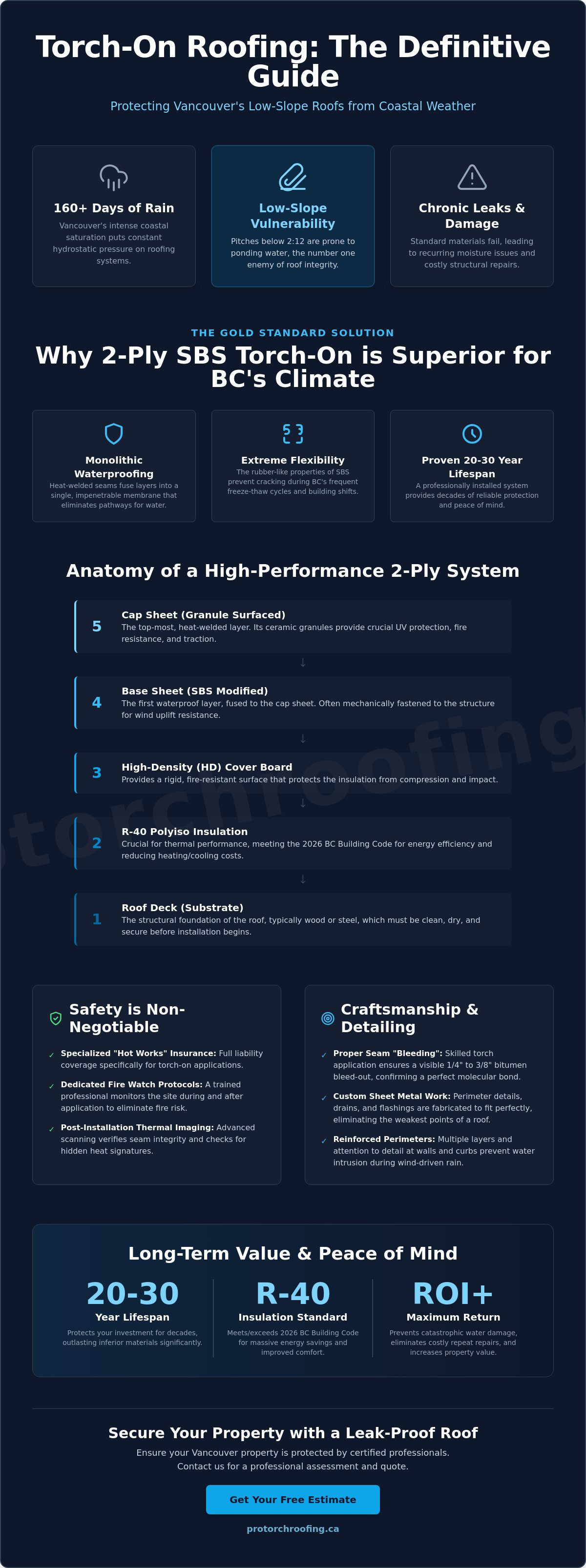
The Anatomy of a High-Performance 2-Ply SBS System
A reliable roof assembly is more than just a surface layer; it's a carefully engineered stack of materials designed to handle the weight of coastal rain and the stress of temperature shifts. When installing torch on roofing for low slope roofs Vancouver professionals first focus on the substrate. We ensure the insulation meets the 2026 BC Building Code standard of R-40 before installing high-density (HD) cover boards. These boards provide a rigid, fire-resistant surface that prevents the insulation from compressing under the weight of maintenance crews or heavy snow loads.
The system relies on two distinct layers of SBS-modified bitumen. The first is the base sheet. In many Vancouver residential settings, we use mechanical fastening to secure this layer to the wood deck, though some structures require a heat-welded base for maximum adhesion. The second layer is the cap sheet. During the installation process, the heat from a propane torch melts the bitumen on the underside of the cap sheet and the top of the base sheet. This creates a "welded seam" where the two layers fuse into a single, cohesive unit. It's not just a bond; the layers molecularly become one, eliminating the risk of water traveling between plies.
Reinforcement Layers: Fiberglass vs. Polyester
Modern SBS membranes aren't just asphalt; they're reinforced with internal mats that provide structural integrity. We utilize a combination of fiberglass for dimensional stability and polyester for superior puncture resistance. This dual-core approach ensures the membrane doesn't shift or "bleed" during the heat of a Vancouver July. Most residential projects in the Lower Mainland utilize a 180g or 250g polyester reinforcement to meet the Canadian Roofing Contractors Association's specifications for long-term durability.
UV Protection and Granule Surfacing
The ceramic granules on the cap sheet aren't just for looks. They act as a shield against solar degradation, reflecting UV rays that would otherwise dry out and crack the bitumen over time. Choosing lighter-colored granules can improve energy efficiency by creating a "cool roof" effect, which helps lower cooling costs in the summer. These granules also provide a slip-resistant surface, making it safer for professionals to perform regular roof maintenance. If you're unsure which granule color best suits your home's aesthetic, our team at Pro Torch Roofing can provide samples during a professional site assessment.
Why Vancouver Property Owners Choose Torch-On Over Alternatives
Selecting the right material for a flat or nearly flat surface requires a balance between durability and long-term cost. While several membrane options exist, torch on roofing for low slope roofs Vancouver residents select stands out for its physical resilience and multi-layered protection. Compared to Thermoplastic Polyolefin (TPO), which is typically a single-ply system, SBS torch-on provides the security of two distinct layers. TPO can be prone to punctures from falling debris or heavy foot traffic, whereas the thick, rubberized bitumen of an SBS system absorbs impact without compromising the waterproof seal. Similarly, while EPDM (rubber) is a common choice, its seams rely on adhesive tapes that can deteriorate in Vancouver’s high humidity. Heat-welded seams don't just stick together; they fuse permanently, making them far more reliable for our local climate.
Longevity is a major deciding factor for property owners in the Lower Mainland. A professionally installed 2-ply SBS system often exceeds a 25-year lifespan in areas like Burnaby and North Vancouver. This durability is coupled with the ease of localized maintenance. If a section of the roof is damaged, a technician can simply weld a new patch over the area, creating a permanent bond that is as strong as the original membrane. This stands in stark contrast to older systems where finding and fixing a leak was a costly, multi-day endeavor.
Torch-On vs. Tar and Gravel: The Modern Upgrade
Many older Vancouver homes still feature "built-up" tar and gravel roofs. These systems are incredibly heavy, often adding thousands of kilograms of unnecessary weight to a building's structure. Upgrading to a modern SBS membrane significantly reduces this "dead load," which is especially beneficial for older homes with aging timber frames. Furthermore, tar and gravel roofs make leak detection nearly impossible because the source of water ingress is hidden beneath layers of stone. Modern torch-on surfaces allow for immediate visual inspection and faster expert roof repair in Burnaby, ensuring small issues don't turn into structural rot.
Performance in High-Moisture Coastal Environments
Properties in West Vancouver and North Vancouver face unique challenges from salt spray and intense wind-driven rain. In these coastal environments, "water-lapping" occurs when wind pushes standing water against the edges and seams of a roof. Because torch-on membranes are chemically fused, they are immune to the peeling that often plagues glued or taped systems. Additionally, the ceramic granule surfacing on modern SBS sheets provides a hostile environment for moss and algae. Unlike organic shingles or cedar shakes, which trap moisture and encourage biological growth, torch-on membranes remain clean and functional with minimal intervention.
The Installation Process: Safety, Precision, and Perimeter Detailing
The installation of torch on roofing for low slope roofs Vancouver property owners require is a high-precision task that demands a disciplined approach to safety and craftsmanship. Because the process involves an open flame, we adhere to rigorous safety protocols that go beyond standard industry requirements. Every project includes a dedicated fire watch for at least two hours after the torches are extinguished. We also utilize thermal imaging technology to scan the roof deck and perimeter for any hidden heat signatures, ensuring the structure is completely secure before our team leaves the site. Our specialized "Hot Works" liability insurance provides an additional layer of protection, giving you total peace of mind throughout the project.
Precision in the welding process is visible at the seams. A skilled installer ensures a consistent 1/4 inch of melted asphalt, known as "bleeding," at every overlap. This signifies a perfect thermal bond where the layers have fused into a single unit. Given the Lower Mainland’s frequent rainfall, we only perform these installations during verified dry weather windows. Moisture trapped under the membrane is a leading cause of premature failure, so we never compromise on substrate dryness. This methodical approach ensures the transition from the membrane to your internal drains or gutters is perfectly sealed.
The Critical Role of Custom Sheet Metal
Generic, store-bought flashing is a common failure point on low-slope systems because it rarely accounts for the specific angles and drainage needs of a building. As a specialized metal roofing company, we fabricate custom perimeter flashing for every project. These custom pieces create a superior "drip edge" that directs water away from your fascia and siding, preventing rot and water staining. This tailored approach ensures the most vulnerable parts of your roof, the edges and corners, are protected by heavy-gauge metal that won't warp or leak under the weight of coastal snow or heavy rain.
Seismic Considerations and Building Movement
Vancouver’s location in a seismic zone means buildings are constantly subjected to minor shifts and vibrations. Rigid roofing systems often crack under this stress, but the rubberized nature of SBS membranes allows them to remain flexible. We install expansion joints and detailed flashing around penetrations like skylights and vents to accommodate this natural movement. Flexible SBS membranes succeed where rigid materials fail because they can stretch and recover without losing their waterproof integrity. If you are ready to secure your property with a professionally installed system, request a detailed assessment from our local experts today.
Maximizing ROI: Maintenance and Longevity in the Lower Mainland
A professional installation of torch on roofing for low slope roofs Vancouver property owners invest in should provide a reliable service life of 20 to 30 years. The true return on investment isn't just found in the initial materials, but in the disciplined care the system receives over time. While the upfront cost of a high-quality SBS membrane is an investment, the long-term cost-effectiveness is unmatched when you factor in the avoidance of emergency leak responses. Dealing with a structural failure during a December atmospheric river is far more expensive than a scheduled inspection. Pro Torch Roofing acts as your local partner, ensuring your building's primary defense remains intact through every season.
In Vancouver’s competitive real estate market, a documented maintenance history is a powerful asset. Providing a prospective buyer with records of annual inspections and professional repairs can significantly increase property resale value. It demonstrates that the structural integrity of the home or commercial building has been a priority. This transparency builds immediate trust and justifies a premium price point, as the new owner won't have to worry about hidden roofing liabilities or immediate replacement costs.
The 2026 Low-Slope Maintenance Checklist
Proactive care doesn't have to be complicated, but it must be consistent to be effective. We recommend that property owners follow this basic schedule to protect their investment:
Clear Drains and Scuppers
Perform this task twice a year, specifically in the late spring and late fall. Vancouver's heavy foliage can quickly clog drainage points, leading to ponding water and unnecessary structural stress.
Inspect Seams and Flashing
Look for signs of "alligatoring," which are small cracks that resemble reptile skin, or any physical separation at the perimeter metal. Catching these early prevents water from migrating between the SBS plies.
Debris Removal
Regularly remove organic matter like needles and leaves. As these decompose, they release acids that can prematurely degrade the protective ceramic granules on your cap sheet.
Choosing a Certified Vancouver Roofing Contractor
The safety of your property depends on the credentials of the people on your roof. Always verify that your contractor carries active WCB coverage and specialized "hot work" liability insurance. This specific insurance is mandatory for torch-applied systems and protects you from the risks associated with open-flame installations. With a 25-year local track record serving Burnaby, the North Shore, and the Greater Vancouver area, our team brings specialized regional knowledge to every project. We understand the specific nuances of BC Building Code compliance and the unique demands of our coastal environment. If you're ready to ensure the long-term health of your roof, contact Pro Torch Roofing for a professional low-slope assessment today.
Secure Your Property with a Precision-Engineered SBS System
Choosing the right protection for your building means looking beyond the surface. We've explored how a multi-layered SBS membrane provides the elasticity needed for BC’s freeze-thaw cycles and why custom metal detailing is the final defense against coastal rain. Investing in torch on roofing for low slope roofs Vancouver property owners require is about more than just a leak-proof seal; it's about the long-term health and resale value of your property. A system installed with precision today prevents the structural liabilities of tomorrow.
As a family-owned business based in Burnaby with over 25 years of local expertise, Pro Torch Roofing prioritizes your safety and security. We maintain specialized "Hot Work" liability insurance and full WCB compliance on every project to ensure a disciplined, worry-free installation. Our commitment to craftsmanship and transparent communication means you can move forward with total confidence in your roof’s structural integrity. Don't leave your property's safety to chance during the next coastal storm.
Get a Professional Torch-On Roofing Estimate Today and discover the peace of mind that comes with a professionally engineered waterproof shield.
Frequently Asked Questions
How long does a torch-on roof last on a low-slope home in Vancouver?
A professionally installed torch-on roof typically lasts between 20 and 30 years in the Vancouver climate. Its longevity depends heavily on the quality of the SBS membrane and consistent maintenance. Because these systems are designed to handle high humidity and frequent freeze-thaw cycles, they often outlast single-ply alternatives when properly cared for by a local expert.
Is torch-on roofing safe for residential homes with wood structures?
Yes, torch-on roofing is safe for wood-frame homes when installers follow strict safety protocols. This includes maintaining a dedicated four-hour fire watch after the project is complete and using thermal imaging to detect hidden heat. It's vital to hire a contractor who carries specialized "Hot Works" liability insurance specifically for open-flame applications on residential structures.
Can you install torch-on roofing in the rain or during Vancouver winters?
You cannot install torch-on roofing during active rain or on a damp substrate. The roof deck must be completely dry to ensure the bitumen bonds correctly and to prevent trapping moisture between layers. While installations can happen during the winter, they are strictly limited to clear weather windows where the surface is dry and temperatures allow for proper membrane fusion.
How much does a torch-on roof cost compared to TPO or EPDM?
The average cost for torch on roofing for low slope roofs Vancouver area projects ranges from C$10 to C$15 per square foot. While single-ply systems like TPO might have a lower initial price point, torch-on SBS membranes often provide a better return on investment. This is due to their superior puncture resistance and a longer 25-year service life in coastal environments.
Does a torch-on roof require a special permit in Burnaby or Vancouver?
Yes, most municipalities in the Lower Mainland require a roofing permit for a complete replacement or a change in roofing material. In Vancouver, permits are mandatory for new construction and structural alterations. These regulations ensure that your new system meets the 2026 BC Building Code requirements for fire resistance and energy efficiency, including the R-40 insulation standard.
How do I know if my low-slope roof needs a repair or a full replacement?
You should consider a full replacement if your roof is over 20 years old and shows signs of widespread "alligatoring" or membrane separation. While minor punctures or flashing issues can be fixed with a localized repair, persistent leaks across multiple sections usually indicate that the SBS membrane has reached the end of its functional life. A professional assessment can determine if the substrate is still sound.
What is the difference between a 1-ply and a 2-ply torch-on system?
A 1-ply system is generally insufficient for primary waterproofing on a residential home. A 2-ply system, which is the standard for torch on roofing for low slope roofs Vancouver property owners trust, consists of a base sheet and a reinforced cap sheet. These two layers are heat-welded together to create a redundant, monolithic barrier that is much thicker and more durable than a single layer.
Can I walk on my torch-on roof to clean my gutters?
Yes, you can walk on a torch-on roof for routine tasks like cleaning gutters or inspecting drains. The ceramic granule surface provides traction and protects the membrane from foot traffic. It's best to wear soft-soled shoes and avoid walking on the roof during the hottest part of a summer day when the bitumen is most flexible and susceptible to scuffing.
