

Industrial Roofing in Vancouver: A Guide for Property Managers
In November 2021, during the historic atmospheric river that hit the Lower Mainland, a warehouse manager in Delta watched as a minor ceiling drip turned into a C$45,000 emergency repair bill in under six hours. This wasn't just a membrane failure; it was a failure to recognize the heavy-duty demands of industrial roofing compared to standard commercial designs. You understand that managing a facility in Vancouver means constantly battling 1,100mm of annual rainfall and the strict safety oversight of WorkSafeBC. It's stressful to worry if your roof will hold up through the next storm or if a hidden drainage issue is silently compromising your structural integrity.
We'll show you how to protect your investment by choosing the right SBS membranes and perimeter flashing to ensure your facility remains dry and compliant. You'll learn the critical differences between industrial and commercial systems so you can avoid the 20% premature failure rate often seen in poorly maintained BC properties. We'll break down the technical requirements for local building codes and how a proactive maintenance plan can extend your roof's life by up to 15 years while ensuring total peace of mind.
Key Takeaways
• Understand the specific technical demands placed on industrial roofing systems by heavy machinery, chemical emissions, and high-capacity HVAC loads.
• Learn why SBS torch-on membranes remain the gold standard for providing long-term structural integrity in Vancouver’s notoriously wet climate.
• Discover why standard roofing specifications often fail in the Lower Mainland and how specialized drainage systems prevent costly water damage.
• Ensure your facility remains WorkSafeBC compliant while protecting your investment through proactive maintenance strategies rather than reactive repairs.
• Leverage over 25 years of local Burnaby expertise to find a roofing partner committed to transparent communication and high-quality craftsmanship.
What is Industrial Roofing? Defining the Scope for BC Facilities
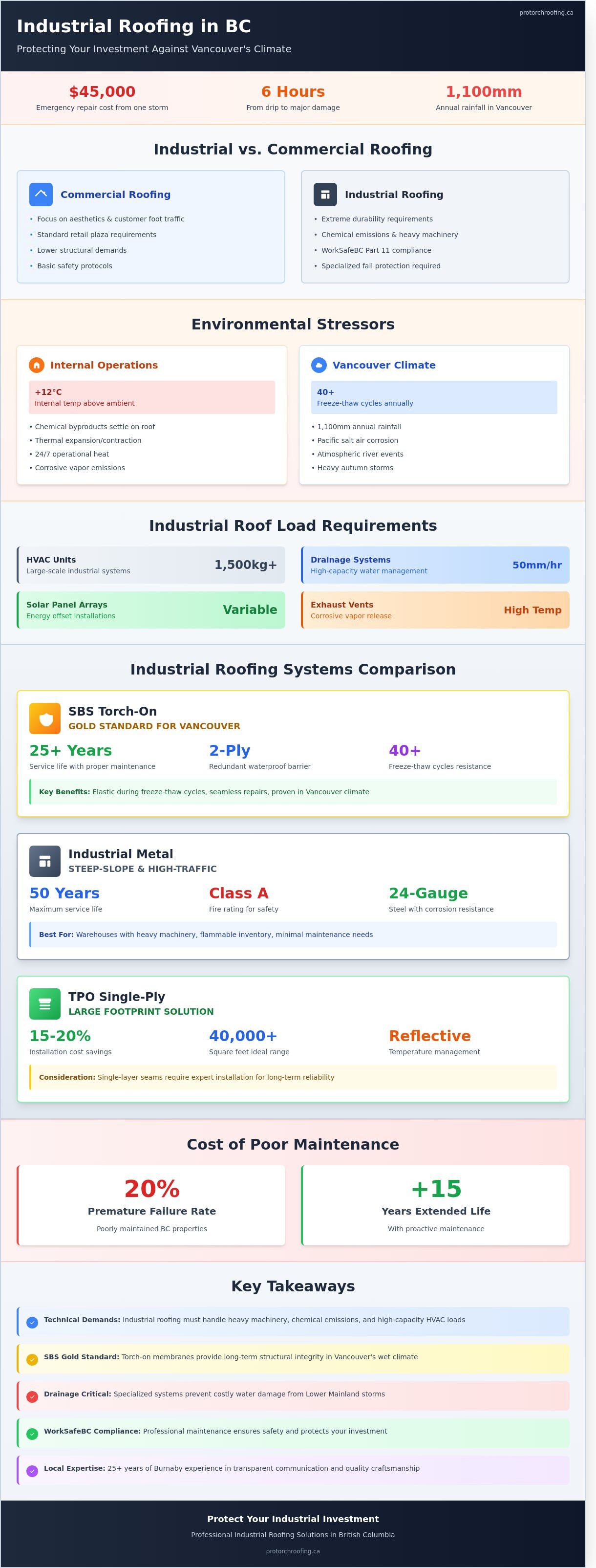
Industrial roofing isn't simply a larger version of a commercial flat roof. In British Columbia's industrial corridors, such as those found in Delta or Langley, these systems must withstand internal and external pressures that would cause a standard retail roof to fail within 5 to 8 years. Industrial facilities often house heavy manufacturing, food processing, or chemical storage. These operations create a micro-climate inside the building that directly impacts the roof's lifespan and structural health.
Industrial vs. Commercial: Key Differences
While a retail plaza focuses on aesthetics and customer foot traffic, industrial sites prioritize extreme durability. Manufacturing plants often release airborne particulates or chemical byproducts that settle on the roof surface. These substances accelerate the degradation of standard membranes. Accessing these roofs also requires specialized training. Our teams follow WorkSafeBC Part 11 regulations for fall protection on structures that often exceed 10 metres in height, requiring heavy-duty safety equipment and specialized lifts not typically seen on smaller commercial jobs.
Environmental Stressors in Industrial Settings
Internal operations generate massive amounts of heat. A facility running 24/7 can maintain an internal temperature 12 degrees Celsius higher than the ambient air. This creates constant thermal expansion and contraction of the roof deck, which can tear weaker materials. You also have to consider the weight of essential equipment. Modern industrial roofing must support heavy loads, including:
• Large-scale HVAC units often weighing over 1,500 kilograms.
• Extensive solar panel arrays installed to offset high energy costs.
• Complex drainage systems designed to move 50 or more millimetres of rainwater per hour during Vancouver's heavy autumn storms.
• Exhaust vents that release corrosive vapours or high-temperature steam.
Choosing the right material, such as a multi-layer SBS torch-on system, provides the structural integrity needed to handle these loads. These systems offer the puncture resistance and chemical stability required for long-term protection. We've found that industrial facilities using inferior single-ply membranes often face leaks at penetration points within 10 years. A robust torch-on system, however, can reliably protect a BC facility for 25 years or more when maintained by a professional team. It's about ensuring the safety of the assets beneath the membrane through disciplined craftsmanship and specialized regional knowledge.
Industrial Roofing Systems: SBS Torch-On vs. Metal and TPO
Selecting the right industrial roofing system requires balancing long-term structural integrity against immediate capital expenditure. In British Columbia, the choice usually comes down to three primary technologies. Each offers distinct advantages for the 1,150mm of annual precipitation typically seen in the Lower Mainland. Property managers must weigh the 20 to 50 year lifespan of these materials against the specific operational needs of their tenants.
The Advantages of SBS Torch-On in Vancouver
SBS (Styrene-Butadiene-Styrene) modified bitumen is the gold standard for flat or low-slope commercial buildings in Vancouver. This 2-ply system uses a base sheet and a granular cap sheet to create a redundant waterproof barrier. Unlike single-ply options, SBS membranes remain elastic during Vancouver's 40+ annual freeze-thaw cycles. This flexibility prevents cracking when the building expands and contracts. If a puncture occurs, localized repairs are straightforward because new bitumen bonds seamlessly to the existing layer. It's a dependable choice for those prioritizing peace of mind and ease of maintenance.
Industrial Metal Roofing and Custom Fabrication
For steep-slope warehouses or high-traffic industrial zones, standing seam metal roofs provide a 50 year service life. Most systems utilize 24-gauge steel with specialized finishes to resist corrosion from Pacific salt air. Custom sheet metal fabrication is vital here; it ensures that perimeter flashing and roof penetrations, like HVAC curbs or vents, are perfectly watertight. Metal's Class A fire rating makes it a safe choice for facilities housing heavy machinery or flammable inventory. While the initial investment is higher, the minimal maintenance requirements over five decades offer a lower total cost of ownership.
Single-ply membranes like TPO (Thermoplastic Polyolefin) are often selected for facilities exceeding 40,000 square feet. These systems are lightweight and cost-effective, offering a 15% to 20% savings on installation for massive footprints. TPO is highly reflective, which helps manage internal temperatures, though it relies on single-layer seams that require expert heat welding to prevent leaks. When you're deciding between these systems, consider your building's current use and your 10 year financial plan. A warehouse with high internal humidity might require the robust vapor barrier of a torch-on system, whereas a dry storage facility might benefit from the cost efficiency of TPO. You can request a professional roof assessment to determine which material fits your specific structural requirements.
Building Use
Heavy manufacturing often requires the durability of metal or SBS.
Budget
TPO offers the lowest entry price for large-scale roofs.
Lifespan
Metal leads with 50+ years, followed by SBS at 25 years, and TPO at 15 to 20 years.
These principles of balancing building use, budget, and lifespan are universal across the roofing industry. To see how these factors are applied in different settings, you can explore Commercial Roof Installation for additional context and examples.
The Vancouver Factor: Managing Rain and Humidity in the Lower Mainland
Vancouver’s climate demands more than standard industrial roofing specifications. While national building codes provide a baseline, they often fail to account for the 1,188mm of annual precipitation recorded at Vancouver International Airport. Property managers must prioritize high-capacity drainage systems. This includes properly sized scuppers, internal drains, and secondary overflows capable of handling atmospheric river events. In Burnaby, where localized rainfall is often 20% higher than coastal areas, ponding water is the primary cause of premature failure. If water remains on a flat roof for more than 48 hours, it accelerates membrane degradation and can void many manufacturer warranties.
Thermal movement is another critical factor for local properties. BC’s temperature fluctuations, ranging from -10°C in winter to 35°C in summer, force roof membranes to expand and contract constantly. Without high-quality SBS (Styrene-Butadiene-Styrene) modified bitumen, these cycles cause seams to split and fasteners to back out. We focus on reinforced torch-on systems that offer the elasticity needed to survive these shifts without losing structural integrity.
Waterproofing for High-Precipitation Zones
Effective industrial roofing in the Lower Mainland requires a 2-ply SBS membrane system for superior puncture resistance and waterproofing. We pay close attention to the installation of perimeter flashing to defend against horizontal rain. Perimeter flashing is a continuous metal strip installed along the edges of a roof to redirect water away from the building’s structural walls and prevent moisture from entering the building envelope. This ensures that even during 90 km/h wind gusts, moisture stays out of your insulation and decking.
Custom Sheet Metal: The First Line of Defense
Pre-fabricated flashing often fails on complex industrial sites because it doesn't account for unique HVAC curbs or irregular parapet walls. Using in-house custom metal fabrication allows for a precision fit that eliminates the gaps where leaks typically start. This is vital for creating seamless transitions between different roofing sections or old and new additions. When gutters and caps are tailored to the specific dimensions of your building, you reduce the risk of localized leaks by 40% compared to using generic, off-the-shelf components. This methodical approach ensures the long-term health of your asset and provides the peace of mind that your inventory and tenants are protected.
Critical Considerations for Industrial Roof Maintenance and Safety
Managing an industrial facility in the Lower Mainland requires a disciplined approach to structural health. Your roof is the primary shield against our coastal environment. Reactive repairs are often 300% more expensive than proactive care. By identifying issues like membrane blisters, punctures from HVAC traffic, or clogged internal drains early, you prevent internal inventory damage and structural rot. Vancouver sees over 160 rainy days per year, which means the window for dry, effective repairs is narrow. Scheduling your assessments in late August or September ensures your industrial roofing system is ready before the first atmospheric river hits in October.
WorkSafeBC and Industrial Safety Standards
Safety isn't just a preference; it's a legal mandate. WorkSafeBC Occupational Health and Safety Regulation Part 11 requires fall protection for any work performed above 3 metres. This includes certified anchor points that must be inspected and recertified annually. If your warehouse was constructed before 1990, an asbestos survey is a mandatory requirement before any demolition or membrane removal begins. We maintain a clean safety record because protecting our crew and your property is our top priority. Hiring a contractor without these certifications exposes property managers to significant legal and financial liability.
The ROI of Preventative Maintenance Plans
A professional industrial roofing inspection in Burnaby provides a clear roadmap for your capital expenditures. During these sessions, technicians focus on the critical SBS torch-on system components. They clear organic debris from drainage basins and check the integrity of perimeter flashing. These small tasks prevent water ponding, which is the leading cause of premature membrane failure. Data shows that consistent annual maintenance can extend the life of an SBS system by 12 years or more. This effectively lowers your annual cost of ownership by thousands of dollars. We provide detailed reports that help you transition from emergency fixes to a predictable, budget-friendly maintenance cycle.
Don't wait for a ceiling leak to disrupt your operations. To secure your building's future, schedule a comprehensive industrial roof assessment with our local experts.
Partnering with a Local Industrial Roofing Expert in Burnaby
Choosing the right partner for industrial roofing in the Lower Mainland involves more than just hiring a contractor. It requires a team that understands how the Pacific Northwest climate affects large scale structures. With over 25 years of local experience, Pro Torch Roofing has refined a methodical approach to SBS membrane systems designed to withstand the 1,100mm of annual rainfall typical in our region. We prioritize the long term health of your building while ensuring your daily operations continue without a hitch. Our crews coordinate logistics to minimize site congestion, which keeps your tenants or employees productive during the installation process.
The Pro Torch Difference in the Lower Mainland
We believe quality craftsmanship stems from controlling every detail of the project. This is why we operate a dedicated in-house custom sheet metal shop. Rather than relying on external suppliers, we fabricate our own perimeter flashing and bespoke components to ensure a precise fit for every unique industrial facility. As a family owned business, we combine industrial scale capability with a personal commitment to structural integrity. You receive the peace of mind that comes from a disciplined, local expert who specializes in high performance torch-on systems.
Planning Your Industrial Roofing Project
Every facility presents distinct challenges. Our process begins with a site-specific assessment where we identify drainage patterns, mechanical penetrations, and potential structural weaknesses. We provide a transparent quoting process with a clear breakdown of labor and material costs in C$. This ensures property managers can budget accurately without fear of hidden fees. We focus on providing the technical data you need to make an informed decision for your asset.
• Detailed inspection of existing SBS or built-up roof membranes
• Evaluation of insulation R-values and energy efficiency opportunities
• Custom fabrication of metal details for superior weatherproofing
• Clear timelines to ensure minimal business interruption
Take the first step toward securing your facility for the next several decades. Contact us today for a professional roof assessment and let our team provide the protection your business deserves.
Protect Your Industrial Investment in the Lower Mainland
Managing a facility in Greater Vancouver requires a strategic approach to structural health. You've seen how selecting the right industrial roofing system, particularly SBS Torch-on membranes, helps combat the heavy annual rainfall common in the region. Effective property management also relies on strict adherence to WorkSafeBC safety standards and proactive maintenance schedules that prevent costly downtime. ProTorch Roofing provides over 25 years of local experience in Burnaby and Vancouver to ensure your assets remain secure. As specialists in SBS Torch-on systems and custom sheet metal, we deliver the technical precision required for the B.C. climate. Our team is fully insured and WorkSafeBC compliant; you can trust the safety and quality of our workmanship. It's time to move beyond reactive repairs and invest in the long term durability of your building. Secure Your Facility with a Professional Industrial Roof Assessment. We're ready to provide the dependable protection your business deserves.
Frequently Asked Questions
What is the best type of roof for an industrial building in Vancouver?
The best type of roof for an industrial building in Vancouver is a 2-ply SBS torch-on membrane system. This material provides superior waterproofing for the 1,153 mm of average annual rainfall we experience in the Lower Mainland. Its multi-layer construction offers the structural integrity needed to withstand temperature fluctuations between 0°C and 25°C. Property managers prefer it because the modified bitumen remains flexible, which prevents cracks during seismic shifts or heavy wind loads.
How long does an industrial torch-on roof typically last in the PNW?
An industrial torch-on roof typically lasts between 20 and 25 years when installed by local British Columbia experts. Regular maintenance can extend this lifespan by an additional 5 years. In our damp PNW climate, the heat-welded seams of an SBS system create a monolithic barrier that resists ponding water better than single-ply alternatives. We recommend a professional assessment every 12 months to ensure your investment remains secure and leak-free.
How much does industrial roof replacement cost in Burnaby?
Industrial roof replacement in Burnaby currently costs between C$12 and C$22 per square foot for a standard SBS system. For a 10,000 square foot facility, owners should budget between C$120,000 and C$220,000 depending on insulation requirements and deck condition. These figures include the removal of old materials and the installation of new perimeter flashing. Prices fluctuate based on the 2024 market rates for raw bitumen and specialized labor.
Can I repair my industrial roof instead of replacing it entirely?
You can repair your industrial roof instead of replacing it if the damage affects less than 25% of the total surface area. Localized repairs using SBS membrane patches can resolve 90% of minor leaks at a fraction of the cost of a full tear-off. If the underlying insulation remains dry and structural integrity is intact, a restoration coating or targeted patching is a viable strategy. It's a cost-effective way to gain another 5 years of protection without a massive capital layout.
What are the WorkSafeBC requirements for industrial roofing contractors?
WorkSafeBC requires industrial roofing contractors to maintain a formal fall protection plan and a valid Clearance Letter. Contractors must also adhere to Part 11 of the Occupational Health and Safety Regulation, which covers chemical safety and equipment standards. Most reputable Vancouver firms carry C$5 million in general liability insurance to protect the property owner. Always verify a contractor’s standing on the WorkSafeBC website before any work begins on your facility.
How often should I have my industrial roof inspected in Vancouver?
You should have your industrial roof inspected at least 2 times per year, specifically in the spring and fall. These scheduled checks identify 85% of potential issues before they become emergency leaks during Vancouver's winter rain season. Inspections focus on clearing drains, checking perimeter flashing, and examining sealants. Proactive monitoring ensures your industrial roofing system reaches its full 20-year design life without unexpected expenditures.
Does industrial roofing come with a warranty for leak protection?
Yes, industrial roofing installations include both a manufacturer’s material warranty and a contractor’s workmanship guarantee. Manufacturers like IKO or Soprema typically offer 10 to 20 years of coverage on SBS membranes. Our local team provides an additional workmanship warranty that covers leak protection for up to 10 years. These documents provide the peace of mind that your facility is protected against the West Coast elements and any installation defects.
What is the difference between SBS torch-on and TPO for industrial use?
The main difference is that SBS torch-on uses 2 layers of rubberized asphalt while TPO is a single-ply thermoplastic membrane. SBS provides 4.0 mm to 6.0 mm of thickness, making it more resistant to punctures from foot traffic or HVAC maintenance. TPO is reflective and helps with cooling, but it lacks the redundant protection of a multi-layer industrial roofing system. For Vancouver's high-moisture environment, the dual-layer security of SBS is often the more dependable choice.
