

Expert Flat Roof Repair in Vancouver: The 2026 Property Owner’s Guide
Last November, during an atmospheric river that dumped 140mm of rain on the city in just 24 hours, a Kitsilano property owner watched a single damp spot on their ceiling turn into a C$12,500 restoration bill. This wasn't just bad luck; it was the predictable failure of a 15-year-old SBS membrane that had reached its limit without a professional assessment. When you're facing the relentless Pacific Northwest winter, a delayed flat roof repair in Vancouver isn't just a maintenance task; it's a race against structural decay.
You likely know that our coastal humidity and 2026's unpredictable freeze-thaw cycles are brutal on even the best roofing materials. It's exhausting to receive three conflicting quotes while water is actively damaging your investment. This guide will show you how to cut through the confusion, identify the specific failure points in your torch-on system, and implement repairs that can extend your roof's lifespan by 5 to 10 years. We will examine the technical signs of perimeter flashing failure and the exact steps to find a disciplined local expert who prioritizes your property's long-term security.
Key Takeaways
• Identify how Vancouver’s unique "Rainforest Effect" and standing water contribute to premature membrane failure in our local climate.
• Compare the technical advantages of modern 2-ply SBS torch-on systems over outdated hot-mopping methods for enhanced durability and protection.
• Use the "Rule of 25" to determine whether a strategic flat roof repair Vancouver or a complete system replacement is the right financial move for your property.
• Explore the professional repair sequence, including non-destructive moisture testing and the critical role of surface cleanliness in achieving a permanent bond.
• Learn why local knowledge of the BC Building Code is essential for maintaining the structural integrity and long-term warranty of your roofing system.
Common Causes of Flat Roof Leaks in Vancouver’s Wet Climate
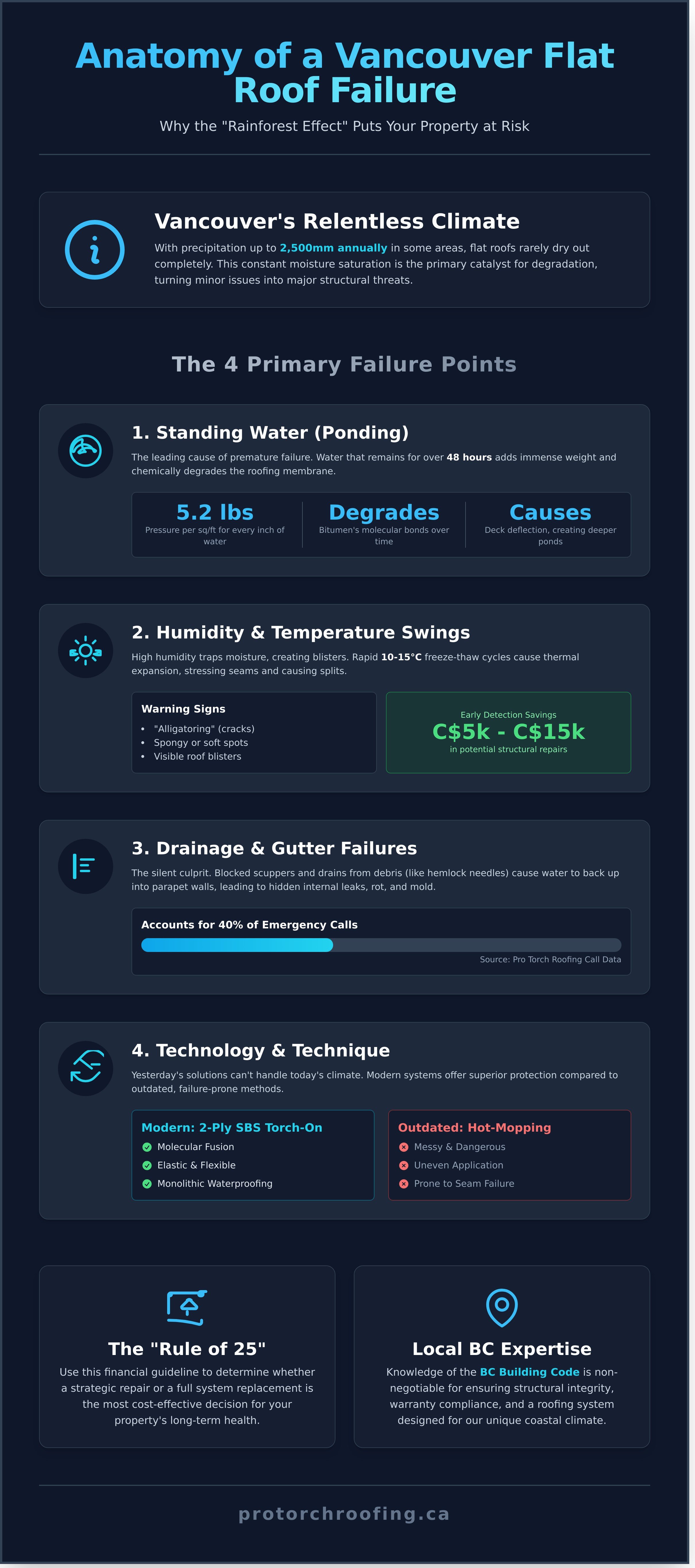
Vancouver's unique geography creates a relentless "Rainforest Effect" that puts local roofing systems under constant duress. With annual precipitation levels reaching up to 2,500mm in areas like North Vancouver and parts of the Fraser Valley, your roof rarely has the opportunity to fully dry out. This persistent moisture saturation is the primary catalyst for structural degradation. Unlike sloped roofs that shed water instantly, flat systems must rely on precision engineering to manage high volumes of liquid. When these systems falter, the resulting damage often requires professional flat roof repair Vancouver specialists to intervene before the building's integrity is compromised.Standing water, commonly known as ponding, is the leading cause of premature roof failure in British Columbia. Industry standards define ponding as water that remains on the roof surface for more than 48 hours after a rainfall. This isn't just a moisture issue; it's a weight issue. A single inch of water adds approximately 5.2 pounds of pressure per square foot. Over time, this weight causes the roof deck to deflect, creating deeper basins that collect even more water. Most commercial properties in the Lower Mainland utilize Bituminous waterproofing systems which are designed to be water-shedding, not submerged. Continuous submersion eventually breaks down the molecular bonds of the bitumen, leading to seepage.
High humidity levels, which frequently exceed 85% during Vancouver's autumn months, contribute to membrane delamination and blister formation. If moisture becomes trapped between the membrane layers during a previous repair or through a pinhole leak, the sun’s heat causes that moisture to turn into water vapor. This vapor expands, creating "roof blisters" that stretch the material. You can identify early warning signs by looking for "alligatoring" (a pattern of small cracks) or soft, spongy spots when walking the perimeter. Identifying these issues early can save a property owner between C$5,000 and C$15,000 in potential structural wood rot repairs.
The Impact of Temperature Fluctuations in the Lower Mainland
Burnaby and Coquitlam often experience rapid temperature shifts where the thermometer moves 10 to 15 degrees Celsius within 24 hours. These cycles force SBS torch-on membranes to expand and contract repeatedly. This thermal expansion puts immense stress on the seams. While the UV rays during our 2,000 hours of annual sunshine degrade the protective granules, the freeze-thaw cycle is what ultimately splits the weakened material. A well-maintained roof needs the flexibility to "move" without cracking its perimeter seals.
Drainage and Gutter Failures: The Silent Culprits
Clogged scuppers and internal drains are responsible for 40% of the emergency calls we receive. If a 4-inch scupper is blocked by hemlock needles or debris, water backs up into the parapet walls rather than exiting the building. This leads to internal leaks that often manifest inside the wall cavities, making them difficult to track. We use custom 24-gauge sheet metal flashing to reinforce these transition points. Proper flat roof repair Vancouver depends on ensuring these drainage paths remain clear to prevent catastrophic deck rot and mold growth.
Technical Breakdown: SBS Membrane and Torch-On Repair Methods
Most modern residential and commercial flat roofs in British Columbia rely on a 2-ply SBS (Styrene-Butadiene-Styrene) system. This material is a modified bitumen, essentially a high-grade asphalt blended with synthetic rubber to provide elasticity. In the 1980s and 1990s, "hot-mopping" with kettles of molten tar was the industry standard. This method was messy, dangerous, and often resulted in uneven application. Today, we utilize advanced torch-on techniques. This process involves using a propane torch to heat the underside of the membrane to approximately 180 degrees Celsius, allowing it to fuse directly to the base sheet or substrate.
The science behind this is molecular fusion. A professional patch isn't just stuck onto the roof with glue; it becomes a single, monolithic unit with the existing structure. This creates a waterproof barrier that can withstand the 1,100mm of annual rainfall common in the Lower Mainland. For those interested in the technical standards of local builds, the B.C. flat roof construction guide provides an excellent overview of how these systems should be designed to handle our coastal precipitation. When performing a flat roof repair Vancouver property owners can trust, we prioritize this permanent fusion over temporary fixes.
Many homeowners attempt to fix leaks with liquid tar or "mastic" from a hardware store. This is often a waste of money. Liquid tar dries out and cracks within 12 to 18 months because it lacks the UV stabilizers found in professional SBS membranes. A permanent repair requires cutting out the damaged section and heat-welding a new SBS cap sheet that matches the original specifications. This methodical approach ensures the repair lasts as long as the rest of the roof, typically 20 years or more.
Seam Failures and Cap Sheet Restoration
Seams are the most common failure point on a flat roof. Over time, capillary action allows water to "climb" into small gaps in the lap joints. Once moisture gets under the membrane, it rots the plywood decking below. We use specialized seam welding tools to re-fuse these areas. We also monitor granule loss. If your roof has lost more than 15% of its ceramic granules, the bitumen is exposed to the sun. This leads to "alligatoring" and brittleness. Restoring these sections early is essential for a lasting flat roof repair Vancouver residents can rely on. Our team can provide a detailed roof health assessment to identify these specific failure points before they become emergencies.
Flashing and Penetration Repairs
Statistics show that 80% of flat roof leaks occur at penetrations like skylights, HVAC sleepers, and plumbing vents. These areas require more than just a bead of sealant. We utilize custom metal fabrication to create watertight perimeters. Using 24-gauge galvanized or pre-painted steel ensures that the flashing won't rust or warp under extreme temperature shifts. We wrap the SBS membrane up the vertical surface of the curb and secure it with a termination bar. This creates a mechanical and chemical seal that prevents water ingress even during heavy wind-driven rain. Properly detailed flashing around chimneys and vents is what separates a professional repair from a temporary patch.
Flat Roof Repair vs. Replacement: A Cost-Benefit Analysis for 2026
Deciding between a localized fix and a full replacement requires a disciplined approach to budgeting. We utilize the "Rule of 25" to guide our clients through this process. If the quoted cost for a flat roof repair Vancouver project exceeds 25% of the total replacement value, the long-term investment rarely pays off. For a standard 1,500 square foot residential roof in 2026, a high-quality torch-on replacement might cost between C$18,500 and C$23,000. If your repair bill hits C$6,000, you're usually better off investing in a new system. However, a professional repair on a relatively young roof can extend its service life by 5 to 10 years, successfully deferring major capital expenditures.
Beyond the surface membrane, we must evaluate the condition of the underlying roof deck and insulation. Trapped moisture is the primary enemy of structural integrity. According to the fundamental principles of flat roof design, wet insulation loses up to 80% of its thermal resistance. This leads to significantly higher heating bills and potential rot in the plywood or concrete deck. If our thermal imaging shows that more than 28% of your insulation is saturated, a full tear-off is the only professional recommendation to ensure the safety of the building's inhabitants and the longevity of the structure.
Assessing the Age and History of Your Torch-On System
Torch-on systems in the Lower Mainland typically last 20 to 25 years. By year 18, the SBS membrane often reaches its "brittle point." You'll see significant granule loss and surface cracking that looks like alligator skin. Previous "band-aid" repairs using asphalt plastic cement or silicone often complicate current restoration options. These petroleum-based mastics contaminate the surface; they make it impossible to heat-weld a new patch properly. If your roof has more than five such patches, the structural integrity is likely compromised beyond the point of a simple flat roof repair Vancouver solution.
Commercial vs. Residential Repair Considerations
For Vancouver strata and business owners, liability and insurance factors are major considerations. A single leak in a commercial unit can result in C$75,000 in interior damage and business interruption claims. Minimizing disruption is our priority. We schedule repairs during off-peak hours to ensure your operations continue smoothly. 88% of North Vancouver property managers now use scheduled inspections to avoid emergency service calls, which often start at C$1,500 during peak storm events. You can find more detail in our Commercial Flat Roof Repair Guide. A well-executed maintenance plan keeps your tenants dry and your insurance premiums stable.
The ROI of proactive maintenance is clear when comparing annual costs to emergency interventions:
• Scheduled inspections typically cost between C$450 and C$900 annually.
• Emergency repairs during a November rainstorm in North Vancouver can exceed C$2,200 for a single visit.
• Preventative sealing of perimeter flashing can add roughly 7 years of life to an aging SBS membrane.
• Regular gutter and drain clearing prevents "ponding," which is responsible for 60% of early membrane failure.
Step-by-Step: What to Expect During a Pro Torch Repair
A professional flat roof repair Vancouver project begins long before a flame is lit. We start with non-destructive moisture detection using infrared thermography. This technology allows our technicians to pinpoint trapped water within the insulation layers that the naked eye often misses. In 85% of the leak cases we investigate, moisture has migrated at least 2 metres from the original entry point. Identifying these saturated zones ensures we don't just patch the surface; we protect the structural health of the roof deck.
Next, we focus on the substrate. Cleanliness is the absolute foundation of SBS (Styrene-Butadiene-Styrene) adhesion. Our crews remove all debris, dust, and degraded bitumen that could compromise the bond. When performing a flat roof repair Vancouver residents can trust, we prioritize the longevity of the repair over a quick fix. We then apply high-performance primers and base-ply reinforcements. This creates a stable, chemically compatible surface for the cap sheet to fuse with.
The torch-down process itself requires extreme precision. We use controlled propane heat to melt the bitumen backing of the SBS membrane, creating a permanent, monolithic seal. Our technicians maintain a consistent 5-millimetre "bleed-out" at the seams. This visible bead of melted asphalt confirms a watertight fusion between rolls. It's a disciplined approach that ensures the repair remains flexible during Vancouver’s freeze-thaw cycles.
Safety and Insurance: The Non-Negotiables
Open-flame roofing carries specific risks that many general contractors aren't equipped to handle safely. ProTorch Roofing carries C$5 million in specialized hot-work liability insurance to protect your assets and provide total peace of mind. Our safety protocol includes a mandatory two-hour fire watch after the last torch is extinguished. To guarantee success, we often perform a 24-hour flood test on internal drains to verify the integrity of the repair before we sign off on the project.
Custom Metal Integration
Waterproofing isn't just about the membrane; it's about how that membrane meets the edge of your building. We replace rusted or undersized perimeter flashing with 26-gauge custom-fabricated shop metal. For a typical Burnaby townhome, we ensure the "drip edge" extends at least 15 millimetres past the fascia. This prevents capillary action from pulling water into your siding or soffits. This final integration creates a seamless transition that directs water exactly where it belongs: away from your structure.
If you suspect your current membrane is failing or have noticed water stains on your ceiling, don't wait for the next heavy rainfall. Contact our team for a professional flat roof assessment to secure your property's future.
Why Local Expertise Matters for Vancouver Flat Roofing
Vancouver properties face some of the most demanding weather conditions in Canada. With an average of 160 rainy days per year, a small vulnerability in your membrane can quickly escalate into a structural disaster. Successfully executing a flat roof repair Vancouver project requires more than just general construction knowledge; it demands a deep understanding of the BC Building Code. Our team brings 25 years of experience to every job site, ensuring all repairs meet the strict environmental separation standards outlined in Part 5 of the provincial code. This specialized knowledge prevents premature system failure and keeps your building compliant with local regulations.
Choosing a family-owned, Burnaby-based contractor means you're working with professionals who understand the specific challenges of the Lower Mainland. We don't treat your property like a transaction. We treat it like a vital part of our community. Our local roots allow us to provide rapid response times and detailed assessments that national firms often overlook. We prioritize transparent communication by providing clear, photographic evidence of damage and explaining the technical remedies in plain language. This commitment to quality craftsmanship ensures your investment remains protected against the West Coast's relentless moisture. You deserve a contractor who values the structural integrity of your home as much as you do.
The Pro Torch Peace of Mind Approach
We've built our reputation on a foundation of trust rather than high-pressure sales tactics. Our focus remains squarely on the long-term structural health of your building. When you face a leak during a November storm, our emergency repair teams respond quickly to stabilize your property in the Greater Vancouver area. We evaluate the integrity of your SBS membranes and perimeter flashing to prevent recurring issues. You can take the first step toward a secure building by Contacting Pro Torch Roofing for a Flat Roof Inspection today. Our professional assessments provide the data you need to make informed decisions about your property's safety.
Supporting the Lower Mainland Community
Our 25-year history in Burnaby has transformed us into your neighbors. We've spent decades perfecting torch-on systems specifically designed for local residential and commercial architecture. These systems are the gold standard for BC's climate because they offer superior waterproofing and durability. We specialize in these high-performance materials because we know they stand up to the 1,100mm of annual rainfall our region typically receives. Every flat roof repair Vancouver we complete reflects our dedication to the safety and longevity of our local neighborhoods. We take pride in our disciplined, methodical approach to roofing, ensuring that every seam is sealed and every drain is clear. Your peace of mind is our primary metric for success, and we continue to serve the Lower Mainland with the same integrity we started with over two decades ago.
Secure Your Property Investment for 2026 and Beyond
Vancouver property owners face significant environmental challenges as we head into 2026. With local precipitation levels often exceeding 1,100mm annually, your building's structural integrity depends on high-performance SBS membrane systems. We've explored how professional torch-on applications provide a superior moisture barrier compared to outdated methods. Choosing a strategic repair over a total replacement can save you thousands in C$ capital expenses while extending your system's functional lifespan by 10 to 15 years.
Pro Torch Roofing brings over 25 years of local experience to every job site. As an A+ rated family-owned business, we specialize specifically in SBS torch-on systems designed for the unique climate of the Pacific Northwest. Don't let a minor leak evolve into a C$20,000 structural restoration project. Our team provides the disciplined craftsmanship and transparent communication you need for a reliable flat roof repair Vancouver solution.
Get Your Professional Flat Roof Repair Estimate
We're ready to help you protect your home or business with a roof that's built to endure.
Frequently Asked Questions
How much does a flat roof repair cost in Vancouver?
Flat roof repair in Vancouver typically costs between C$500 and C$3,500 depending on the damage extent and material type. Minor flashing adjustments or small patch jobs often fall at the lower end of this range. If your 2-ply SBS membrane requires extensive seam sealing or structural deck repair, costs increase to reflect the labor and specialized torch-on equipment required for a long-term fix.
Can I repair a flat roof leak in the middle of a rainstorm?
You can perform emergency wet-patch repairs during a rainstorm to prevent immediate interior damage, but permanent solutions require a dry surface. We use specialized cold-process cements that bond in wet conditions for temporary relief. Once the weather clears and the substrate reaches a moisture content below 19 percent, our team returns to install a permanent SBS membrane patch to ensure structural integrity.
How long does a torch-on roof repair typically last?
A professionally executed torch-on repair typically lasts between 10 and 15 years. This longevity depends on the quality of the fusion between the new SBS membrane and the existing surface. By ensuring proper heat application and perimeter flashing integration, reputable contractors like RightWay Roofing can extend the life of a flat roof, effectively matching the remaining lifespan of the overall roofing system.
Is a 2-ply SBS system better than a single-ply EPDM for Vancouver?
A 2-ply SBS system is generally superior to single-ply EPDM for Vancouver’s heavy rainfall and temperature fluctuations. The dual-layer protection provides a redundant barrier that resists punctures better than a single 60-mil EPDM sheet. In our 20 years of local experience, SBS membranes handle the mechanical stress of BC's freeze-thaw cycles more reliably, reducing the risk of seam failure over time.
What are the most common signs of flat roof failure in Burnaby?
The most common signs of failure in Burnaby include membrane blistering, open seams, and granular loss on torch-on surfaces. You might notice water ponding that remains 48 hours after a storm, which indicates drainage issues. If you see alligatoring or cracks in the bitumen, your roof’s UV protection has likely failed, leaving the underlying structure vulnerable to the 1,400 millimeters of annual rainfall typical for the region.
Do I need a permit for minor flat roof repairs in Vancouver?
You don't need a building permit for minor flat roof repairs in Vancouver that don't involve structural changes or cost less than C$5,000. The City of Vancouver typically classifies membrane patches and flashing replacements as general maintenance. However, if you're replacing more than 25 percent of the roof area or altering the roof deck, we assist with the necessary permit applications to ensure full compliance with local bylaws.
Why is standing water on my flat roof a problem if it doesn’t leak yet?
Standing water is a serious problem because it accelerates the deterioration of your roof’s protective granules and puts 62.4 pounds of weight per cubic foot on your structure. Even if it hasn't leaked yet, the constant hydrostatic pressure weakens SBS seams and can lead to sudden, catastrophic failure. We recommend correcting the slope or clearing drains if water remains for more than 48 hours to preserve your roof's longevity.
Does Pro Torch Roofing offer emergency flat roof repairs?
Pro Torch Roofing provides 24/7 emergency flat roof repairs across the Lower Mainland to stop active leaks immediately. Our rapid response teams arrive equipped with temporary sealing compounds to protect your assets during a storm. We prioritize these calls to minimize water damage, followed by a detailed assessment and a permanent repair plan once the weather permits a high-quality torch-on application.
